On December 23, 2022, a meteorologist in Ontario found every Model 3 door handle frozen solid at −15°C — after preheating. She got in only after updating the Tesla app and using its remote door-unlatch, a workaround few owners knew. The video passed ten million views (owner-posted, via autoevolution).
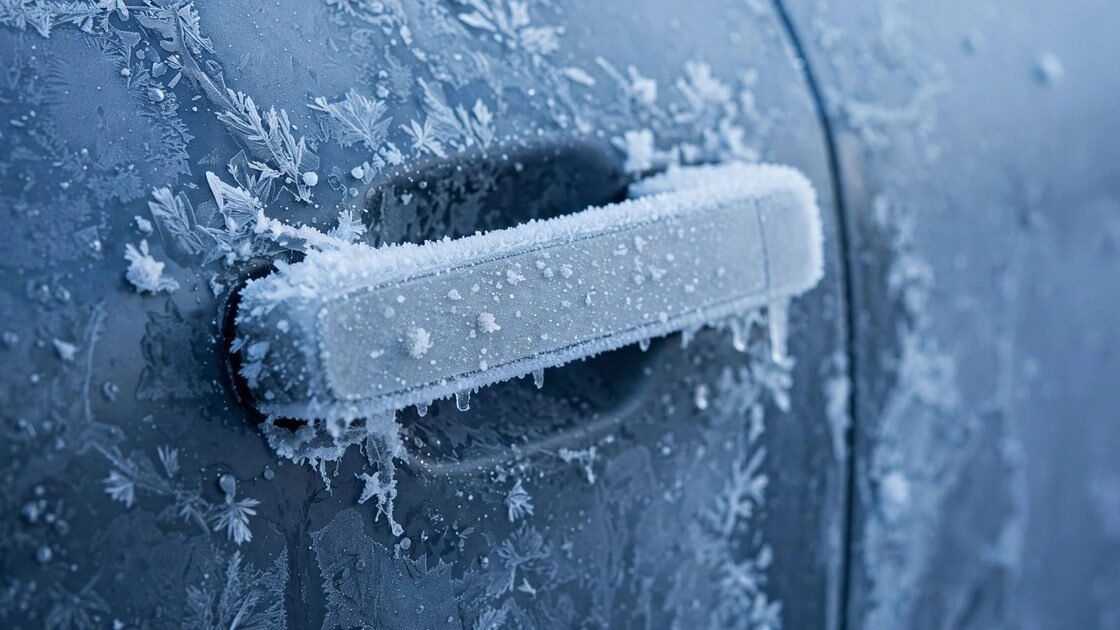
That clip is the whole story in miniature. Frozen EV door handles are not an electronics problem. They are an ice problem wearing a design problem’s clothes: flush handles that sit in a shallow pocket, collect meltwater, and lock shut overnight. The fix is usually free. The damage, when impatience wins, is not.
The numbers behind a frozen handle
- $250–$500: what owners report paying for one Model 3 or Model Y handle replaced at a Tesla service center. Tesla publishes no repair price list, so every figure here is owner-reported, not official.
- ~$0.46: our calculation for one app-triggered defrost session — 2.5 kWh at the US residential average of 18.3¢/kWh (EIA, July 2026). Twelve frosty winters beat one replacement.
- 10 minutes: how long one owner pounded a frozen handle before it budged, in December 2022 (owner-reported).
- $5–$21: a can of silicone spray versus WD-40 Specialist Silicone — the entire prevention budget for a winter.
- 0: the number of NHTSA complaints specifically about frozen handles. The agency’s 2025 door-handle review covers electronic failures, not ice.
Short answer: it is ice, not electronics
Frozen EV door handles are an ice problem: water seeps into the pivot pins and seams of flush handles, then locks them shut overnight. Tesla’s guidance says to press or fist-bump the handle — never tools or excessive force — or pop the door from the app; WD-40 on the pivot pins helps. Forcing a frozen handle can snap the mechanism, and replacement runs roughly $250–$500 at a Tesla service center (owner-reported), while prevention costs a few dollars a winter.
Why EV handles freeze shut — and old pull handles did not
Almost every new EV uses some form of flush door handle. The Model 3 and Model Y use a push-type handle you rock with your thumb. The Ioniq 5 and EV6 use pop-out handles that present themselves as you approach. The Model S and X use self-presenting retracting handles. The reason is aerodynamics: a flush side panel is worth a few thousandths of drag coefficient, and at highway speed that is real range.
The trade is a shallow pocket behind the handle that collects rain and meltwater around the pivot pins; overnight, the assembly becomes one block of ice. An old pull handle had no cavity to fill — you could grab it through a glove and yank. Tesla’s manual names the culprit directly: ice buildup within the door handle, at the pivot pins.
Freezing rain is the worst case. Dry cold below −10°C troubles owners less than a wet day at −3°C, because liquid water has to get in before ice can lock anything — the freeze-thaw belt of the upper Midwest and Northeast reports this most.
This is not Tesla-only. An upstate New York Ioniq 5 owner wrote that the handles “require some chiseling out in the winter” after freezing rain (owner review, SureCritic) — and Kia is the only automaker besides Tesla with a published page on thawing flush handles.
What Tesla actually tells owners to do
Tesla’s winter driving support page gives a procedure that depends on your handles. Black door handles: press the frontmost part to break the ice, then the rearmost part, then open and close the door a few times once it moves. Silver door handles: press the rearmost part, then bump on and around the handle with your fist, and repeat. The manual sets the force limit memorably: like knocking on your neighbor’s front door — never hard enough to dent.
The same page offers the workaround the viral videos made famous: add an “Unlatch Door” quick control in the Tesla app, and tapping it pops the driver door open without touching the handle. Set it up before the first freeze.
For prevention, the manual is specific: “Preemptively applying WD-40 to the door handle pivot pins can help prevent ice buildup inside your door handle.” That line is verbatim in every Model Y manual from 2020 to 2026 — I checked five editions (2023 manual, page 88). It says plain WD-40, not silicone, and that starts arguments: many owners prefer silicone or Teflon sprays, warning standard WD-40 washes factory grease out of the pivot. Both camps have a point — use either on the pins, sparingly, before the storm, and keep spray off the paint.
One free tip from the same page: turn off mirror auto-fold before a freeze. Ice locks folded mirrors the same way, and manually cycling them is free but annoying.
Kia wrote the other manual; Hyundai wrote nothing
Kia’s official guidance for frozen flush handles is refreshingly physical: tap the circumference of the handle in a circular pattern with the bottom of your fist, gradually increase the tapping strength if it won’t open, and once it frees, open and close the door several times. Alternatively, press something warm — your hands, a hand warmer — against the handle to melt the ice out.
That covers the EV6 and EV9. The Ioniq 5 shares the platform and freezes the same way, but I found no equivalent page from Hyundai USA — the Kia page is the only verified non-Tesla automaker guidance. Kia applies the same procedure to frozen charge-port doors, which ice up identically — see our frozen charge port guide.
What forcing it breaks — and what the bill looks like
Ice locks the pivot pins and linkage arms behind the handle. Forcing it does not break the ice; it breaks the parts around it — bent arms, snapped pivot tabs, torn seals, damaged microswitches. Tesla’s manual explicitly cautions against tools and excessive force: pry, and the repair bill is yours.
Tesla publishes no repair price list, so everything below is owner-reported — invoices, estimates, forum threads — not official pricing:
| Repair | Reported cost (US) | Notes |
|---|---|---|
| Model 3/Y handle, Tesla service center | $243–$600 | Owner invoices, 2019–2026; the usual band is $250–$500 with labor |
| Model 3/Y handle, mobile service | ~$300–$490 | Owner-reported; some regions add a trip charge |
| DIY rebuild kit | $50–$175 | Aftermarket parts; labor is your Saturday afternoon |
| Model S/X retracting handle (contrast only) | $800–$1,200 | Out of warranty per secondary reports — a different, pricier part. Not a Model 3/Y number. |
The 3/Y handles are fixed mechanical pivots, not motorized retractors — hence the lower bill. One cost the how-to articles skip: break a window getting into your own car, as four families did in the NHTSA reports below, and side-glass replacement adds several hundred dollars.
On warranty: an electronic failure under the factory warranty is generally covered; a handle snapped by prying is usually owner-caused damage and is not. The manual’s caution is effectively the warranty boundary.
Prevention costs almost nothing — here is the math
A can of generic silicone spray runs $5–$10; WD-40 Specialist Silicone lists around $21 for an 11-ounce can at some retailers. One can treats all four handles for several winters. That is the entire hardware budget.
The energy budget is the app-defrost habit: full defrost pulls roughly 8–12 kW (owner measurements), about 2–4 kWh a session (secondary estimates). Our calculation: 15 minutes at 10 kW is 2.5 kWh, and at 18.3¢/kWh (EIA, July 2026) that is about $0.46 a session. Three frosty mornings a week over a 20-week winter: roughly $28 for the season. One $350 handle replacement buys about 765 defrost sessions — roughly 13 winters of thawing from your kitchen.
Parking is free prevention too. A garage — even unheated — keeps freezing rain off the handles entirely. Parked outside, wipe the handle pockets dry after a car wash before a freeze; it takes thirty seconds. Our garage heater guide and winter range guide cover the rest of cold-weather ownership.
Frozen-handle winter cost calculator
Put in your own numbers: how often you defrost, for how long, and what a broken handle would cost you. Defaults are examples, not quotes.
The formula: session kWh = (minutes ÷ 60) × heater kW; session cost = kWh × your rate; winter cost = session cost × frosty days per week × 20 weeks. The comparison divides the replacement bill by the per-session cost. A 20-week winter is an assumption for the frost belt — shorten it if your winters are mild.
The handle design is under regulatory pressure
Frozen handles are an annoyance. Electronic handles are becoming a safety file — keep the two separate, but know the second one exists.
In September 2025, NHTSA’s Office of Defects Investigation opened a preliminary evaluation (PE25010) into roughly 174,290 model-year 2021 Model Y vehicles after nine owner reports of electronic door handles going inoperative — in four cases, parents broke a window to reach children locked inside (secondary reporting of the agency action). The apparent cause was insufficient voltage to the electronic locks; invoices frequently showed the 12-volt battery replaced afterward, with no warning beforehand. An aging 12-volt battery causes outsized trouble — our 12-volt battery guide explains why.
That investigation is about electronics, not ice — I found no NHTSA complaints about frozen handles at all. But the direction is clear: China recalled around three million Teslas over power-driven handles failing to deploy (electronic, not ice) and plans to require a mechanical fallback on hidden handles from 2027 (secondary reporting). A door handle must work when the power doesn’t.
For winter drivers the read is simpler: treat the handles as a wear item — lubricate before the season, thaw before you touch, never force what ice is holding.
Frequently asked questions
How do I open a frozen Tesla Model 3 or Y door handle?
On black handles, press the frontmost part to crack the ice, then the rearmost part; on silver handles, press the rearmost part and bump around the handle with your fist, repeating until it moves. Force should feel like knocking on a neighbor’s door — never use tools. Or skip the handle: set up the app’s “Unlatch Door” quick control before winter and pop the driver door remotely.
Can I use WD-40 on frozen EV door handles?
Tesla’s manual explicitly recommends WD-40 on the pivot pins, wording unchanged across the 2020–2026 Model Y manuals. Some owners prefer silicone or Teflon sprays instead, warning standard WD-40 can wash factory grease out of the pivot. Either beats nothing; apply sparingly to the pins before a storm and keep spray off the paint.
Will my warranty cover a door handle that broke when it was frozen?
It depends on how it broke. An electronic failure under warranty is generally covered; a handle snapped by forcing or prying is usually owner-caused damage and is not. Tesla’s manual warns against tools and excessive force — that caution is the warranty boundary. If the mechanism failed on its own, document it and claim before touching anything.
Does preconditioning the car thaw frozen door handles?
Yes, with lead time. App defrost and cabin heat melt the ice around the handles; Tesla suggests 30–45 minutes before departure in severe cold. A session costs roughly $0.10–$0.50 — the calculator above works it out, and our preconditioning guide covers the battery side. It will not help if you need the car in ninety seconds.
Should I pour hot water on a frozen door handle?
No. Hot water can thermally shock glass and trim, and the runoff refreezes inside the mechanism — often leaving the handle more solidly locked than before. Use the fist-tap procedure, the app unlatch, or a hand warmer pressed against the handle instead.
What does it cost to replace a frozen or broken EV door handle?
Owner-reported Model 3/Y invoices at Tesla service centers land between $250 and $500 per handle with labor; mobile service runs a little higher. Tesla publishes no official price list — treat every figure as reported. DIY kits run $50–$175. The Model S/X self-presenting handles are a different part at $800–$1,200 — not a 3/Y number.
The bottom line on frozen handles
A frozen EV door handle is a $5 problem wearing a $350 disguise. The ice costs nothing to beat — a fist-bump, an app tap, a few cents of defrost — and a $5–$21 can of spray in November mostly prevents it. The money disappears when impatience wins: a snapped pivot, a torn seal, or a shattered window turns a winter nuisance into a service invoice. Lubricate before the season, thaw before you touch.
Never drive with a door that has not latched fully — a half-closed door can swing open at speed. And never use boiling water or tools on a frozen handle; the fix should not cost more than the problem.
Written by Shurah Beel, who researches and writes independently on the real cost of EV ownership — charging, maintenance, and total cost of ownership — backed by primary data and original calculations rather than recycled lists.