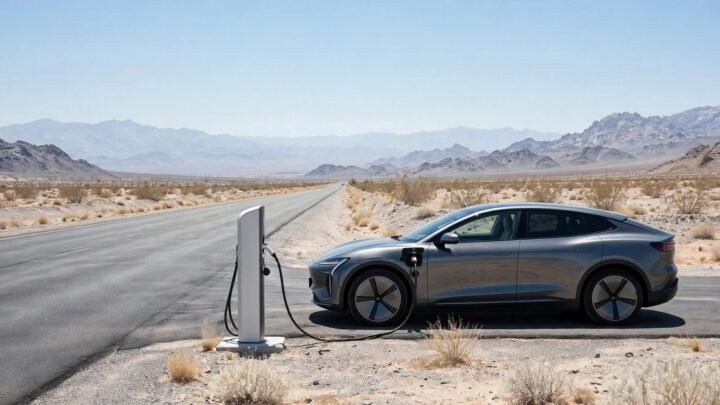
An electric car can be sitting on 80% of a 75 kWh battery — enough for 200 miles — and be completely immobile. The doors will not unlock, the screen is dead, the charge port will not open. Nothing about the expensive battery is wrong.
What has failed is a lead-acid battery the size of a shoebox, worth about $150, doing the same job it does in a petrol car.
This is not an edge case. Germany’s ADAC, Europe’s largest motoring organisation, publishes annual breakdown statistics from millions of real callouts. Its 2026 edition covers roughly 3.7 million assistance deployments across 158 models from 27 manufacturers, and its headline finding on cause is blunt: the single most common reason for a breakdown call, regardless of what powers the car, is a faulty 12-volt battery. Almost half of all cases.
The key numbers
- 50.5% — share of EV breakdowns caused by the 12-volt battery
- 44.6% — the same figure for petrol and diesel cars
- 6.5 vs 12.5 — breakdowns per 1,000 four-year-old cars, EV versus combustion
- 48% — how much less often an EV breaks down overall
- Half — the share of EV breakdowns you could remove by maintaining one $150 part
- ~$100–$260 — what replacing it typically costs
What the breakdown data actually shows
Two findings sit side by side, and both are worth having.
EVs are markedly more reliable. A four-year-old electric car recorded 6.5 breakdowns per 1,000 vehicles in 2025 against 12.5 for a comparably aged petrol or diesel car — roughly half the rate. For cars first registered between 2020 and 2022 the gap was wider still, 4.2 against 10.4. ADAC attributes it to the obvious: an EV has far fewer wear-prone parts, with no fuel system, no exhaust, no timing belt and brakes that barely wear.
And yet they break down for the same reason petrol cars do. The 12-volt battery accounts for 50.5% of EV breakdowns against 44.6% for combustion cars — slightly worse in the EV, not better.
Run those two together and something useful falls out. Of the 6.5 breakdowns per 1,000 four-year-old EVs, about 3.3 are the 12-volt battery. Take those away and the rate drops to 3.2 per 1,000. In other words, looking after one cheap, replaceable part halves your odds of being stranded. There is no other single maintenance item in an electric car with anything like that leverage.
UK data points the same way. Start Rescue found plug-in cars accounted for 23.7% of flat-battery callouts against 29.7% for petrol and diesel, and that EVs overall were 59% less likely to need assistance — while still naming the 12-volt battery as one of the most common causes.
The traction battery habits above protect long-term value, not day-to-day reliability — the far more common breakdown cause is a separate, much cheaper part.
Why an EV has a 12-volt battery at all
It seems absurd to carry a small lead-acid battery in a car built around a large lithium one, and manufacturers are slowly moving to lithium 12-volt units. But the low-voltage system is not going away, for a straightforward reason: everything in the car that is not the motor runs on 12 volts.
Door locks, lights, wipers, the infotainment screen, the alarm, the telematics module, and critically the contactors that connect the high-voltage battery to the rest of the car. Those contactors are held closed electrically. With no 12-volt power, they stay open — and the traction battery is electrically isolated from everything, by design, as a safety measure.
So a flat 12-volt battery does not just kill the radio. It locks the big battery out of the circuit entirely. The car cannot use its own 200 miles of range to help itself.
Why it dies faster in an electric car
A petrol car has an alternator spinning whenever the engine runs, continuously topping up the 12-volt battery. An EV has no alternator. Instead a DC-to-DC converter draws from the traction pack to charge the 12-volt system — but only when the car decides to wake up and do it.
That difference, plus how modern EVs are used, is why the failure rate is higher:
- App polling. Most EVs are checked, preconditioned and monitored through a phone app while parked. Every one of those wake-ups runs on 12 volts. A car that is “asleep” in a car park is answering your phone all day.
- Always-on systems. Sentry modes, dashcams, cabin monitoring and connected services draw continuously.
- Long idle periods. An EV parked for two weeks at an airport has no engine runs to recover from. Fleet operators have reported 12-volt batteries draining on electric vans even while plugged into a charge point, because the car was not waking the converter.
- Undersized batteries. Because there is no starter motor to crank, manufacturers fit small low-capacity 12-volt batteries. Less reserve means less tolerance for parasitic drain.
- Short trips. The same enemy as in a petrol car. Frequent short journeys never give the converter long enough to fully recover the charge.
The same app-polling and connectivity habits that drain the 12-volt system also quietly drain the main pack while the car sits parked — worth the same attention.
The one area where EVs do worse
Since this article is built on the data, it should report the part that does not flatter electric cars. ADAC found EVs have an above-average rate of onboard electrical system faults — higher than combustion cars — and its experts attribute this directly to the greater complexity of EV electronics.
There is a second, smaller one: tyre-related callouts run at 1.3 per 1,000 for EVs against 0.9 for combustion cars, about 44% higher, which is what you would expect from heavier vehicles with more torque. Our guides to EV tyre wear and cost and choosing the right tyres cover that side.
Neither reverses the headline — EVs still break down about half as often overall — but “fewer moving parts” is not the whole story. More software and more modules bring their own failure modes.
Warning signs, in the order they usually appear
A 12-volt battery rarely fails without notice. The signals are just easy to misread as software glitches, which is exactly what most owners do.
- The app takes longer to connect, or reports the car as offline more often. The car is sleeping harder to conserve power.
- Random warning lights that clear themselves. Low voltage makes modules behave strangely and report faults that are not real.
- The infotainment screen reboots or is slow to wake.
- An explicit low 12-volt battery warning. Some cars give one; treat it as urgent rather than advisory.
- Interior lights dim when you open the door on a car that has been parked a while.
- Charging sessions fail to start for no obvious reason. This one gets blamed on the station constantly — see our guide to why charging fails for the other causes, but if it started after months of working fine, check the 12-volt system.
How to stop it happening
- Replace it on age, not on failure. Lead-acid 12-volt batteries last roughly three to five years. Replacing at four is cheap insurance against the most common breakdown in motoring. Almost nobody does this.
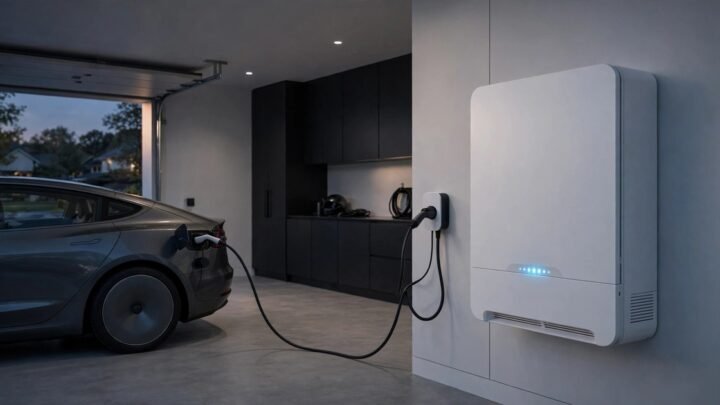
- Leave the car plugged in when parked for long periods. Most EVs will maintain the 12-volt system from the traction pack when connected. Check your model actually does — some do not wake reliably, which is exactly what caught out the fleet operators mentioned above.
- Turn off what you are not using. Sentry-style camera modes, cabin overheat protection and always-connected features all draw from the 12-volt system continuously. Disable them for long-stay parking.
- Stop checking the app so often. Every remote check wakes the car. Once a day is fine; once an hour is a measurable drain.
- Drive it, or at least wake it, weekly. A short trip or a scheduled preconditioning session runs the DC-to-DC converter and tops the battery up.
- Consider a lithium replacement if your car supports it. Longer life, better tolerance of deep discharge, more expensive up front. Check the vehicle’s charging profile is compatible before buying — not all are.
None of this appears on a maintenance schedule, because in most manufacturer schedules the 12-volt battery is inspected rather than replaced. Our EV maintenance schedule covers what is on the official list; this is the item worth adding to it yourself.
If it is already flat
The important thing to know before it happens: find your car’s emergency access method now, not in a dark car park. Most EVs have one, and most owners have never looked.
- Mechanical key access. Nearly every EV has a hidden physical keyhole, often behind a cap on the driver’s door handle. The key blade usually lives inside the key fob.
- External jump terminals. Many EVs route 12-volt jump points to an accessible location — behind a panel in the front bumper, in the frunk, or under a cover in the boot — precisely because you cannot open the bonnet without power.
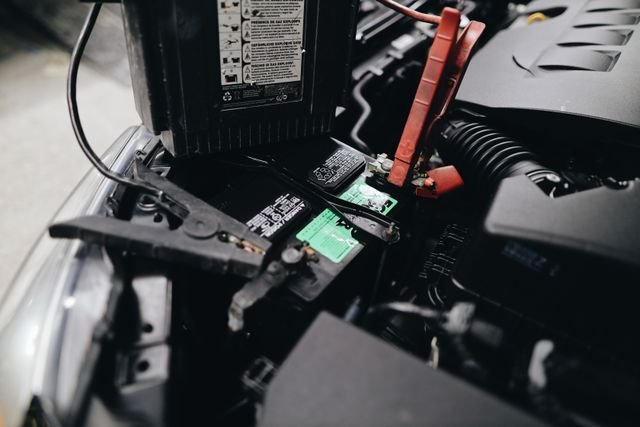
- Jump-start it like a normal car, from another vehicle or a portable jump pack. This is safe and normal: you are connecting to a standard 12-volt system, not to anything high voltage.
- Never try to jump-start another car from your EV. The small 12-volt battery and its converter are not designed for it, and you can damage both.
- Once running, drive it or charge it for long enough to recover the charge — and then replace the battery. A 12-volt battery that has been fully flattened rarely holds up afterwards.
Frequently asked questions
Why does an electric car have a 12-volt battery?
Because everything except the motor runs on 12 volts — lights, locks, screens, and the contactors that connect the traction battery to the car. Without 12-volt power those contactors stay open and the main battery is isolated.
What is the most common cause of EV breakdowns?
The 12-volt battery, by a wide margin. ADAC’s data attributes 50.5% of EV breakdowns to it, against 44.6% for petrol and diesel cars.
Do EVs break down more than petrol cars?
No. A four-year-old EV averaged 6.5 breakdowns per 1,000 vehicles against 12.5 for a comparable combustion car — about half the rate. EVs do have a higher rate of onboard electronics faults, which is the exception.
How long does an EV’s 12-volt battery last?
Typically three to five years, the same as in any car, and sometimes less because EV units are small and face constant parasitic drain from connected features.
Can I jump-start an electric car?
Yes, the 12-volt system jump-starts exactly like a petrol car’s, usually via dedicated terminals since the bonnet may not open without power. Do not use your EV to jump-start someone else.
How much does replacement cost?
Roughly $100 to $260 for a conventional lead-acid unit, more for a lithium replacement. It is one of the few genuinely routine consumables on an EV.
Will leaving my EV plugged in protect the 12-volt battery?
Usually, since most cars maintain the low-voltage system from the traction pack while connected. Verify it for your model — fleets have reported 12-volt batteries draining on electric vans even while tethered to a charge point.
Does a dead 12-volt battery mean my main battery is failing?
No. They are entirely separate systems, and traction packs degrade slowly and predictably rather than failing outright. Our guide to battery health and degradation covers what to watch there instead.
The short version
Electric cars break down about half as often as petrol ones, but when they do it is usually for the same reason: the 12-volt battery, which accounts for slightly over half of all EV breakdown callouts. A flat one isolates the traction pack entirely, so a car with 200 miles of range sits immobile because a $150 part has died. It fails faster in an EV because there is no alternator, the battery is small, and app checks and always-on features drain it continuously. Replace it at four years rather than waiting for it to fail, leave the car plugged in for long stays, turn off camera and connected modes when parked, and find your car’s mechanical key slot and jump terminals before you need them. One cheap part, half the breakdowns.