You leave home with 240 miles on the dashboard. Sixty miles later it reads 145. You did not take a wrong turn and nothing is broken. The number simply changed its mind — and it will do it again tomorrow, probably in the other direction.
Owners call it the guess-o-meter for a reason. Here is what that number is and how to work out a range you can trust.
The numbers that matter
- The EPA label range is a lab result multiplied by 0.7, then blended 55% city and 45% highway.
- Consumer Reports, 2026: nearly 30 EVs at 70 mph, about half fell short — the F-150 Lightning by 50 miles.
- AAA’s May 2026 testing: EVs lose 39% of range at 20°F, and 8.5% at 95°F.
In short: Your EV’s range estimate is a forecast, not a measurement. The car knows roughly how much energy is left, then guesses how efficiently you will drive next, mostly from your recent trips. Change the speed, the weather, or the heater, and the guess changes with it. Trust battery percentage plus your own recent efficiency instead.
What the dashboard is actually calculating
The range figure on your dash is a multiplication the car repeats every few seconds: energy left, times how efficiently the car thinks you are about to drive. The first half is fairly solid. The second half is a guess, and it is where every complaint starts.
No manufacturer publishes exactly how its guess works. The car looks at your recent driving — the last few trips, or the last 10 to 50 miles — and turns that into an efficiency figure in miles per kWh. Some cars blend that recent average with the official EPA figure. A few show two numbers at once: Tesla’s “rated range” uses a fixed EPA-derived efficiency figure, while its Energy app shows a “projected range” from your own recent consumption. Both are legitimate — they answer different questions.
That backwards-looking habit explains nearly every strange thing the estimate does. After a week of slow town driving, the car expects that efficiency to continue, so the estimate looks generous — until you join the motorway and the miles left fall faster than the miles you drive. The energy did not change. The guess about how you will use it did. The same habit explains why the number can jump back up overnight: a gentle drive home feeds efficient numbers into the average, and the forecast turns optimistic again.
Where the sticker number comes from
In the United States the official figure comes from the Environmental Protection Agency, and it is a laboratory figure, not a road test. The EPA defines the methods; automakers run the tests, and the EPA confirms only about 15% of them itself.
Testing happens on a dynamometer — a treadmill for cars — over five cycles: city, highway, aggressive high-speed, hot (95°F, air conditioning on), and cold (20°F, heat and defrost on). A fully charged EV is driven over the city cycle until the battery is depleted, then the same over the highway cycle.
Then comes the step that matters most. The lab results are adjusted downward for real-world factors the cycles do not fully capture — air conditioning, cold temperatures, high speeds, aggressive driving — most commonly by a single factor of 0.7. The EPA’s own example: an EV that achieves 200 miles on the highway lab test is rated at 200 × 0.7 = 140 miles. City and highway figures are then weighted 55% and 45%: with an adjusted city range of 168 miles and highway of 140, the official figure is (0.55 × 168) + (0.45 × 140) = 155 miles.
None of that is wrong — it is a disclosed method, useful for comparing models. The mistake is reading it as a promise: the 0.7 factor is a fleet-wide correction, not a personalised one. A slippery sedan will beat it on the highway; a heavy truck will not.
What independent road tests actually found
Consumer Reports drove nearly 30 EVs at a constant 70 mph until the battery was flat, climate at 72°F, regenerative braking at its lowest — a tough highway benchmark, since the EPA rating blends in slower city driving where EVs are most efficient. About half fell short. Edmunds runs a mixed route of 60% city and 40% highway at about 40 mph average, closer to everyday driving — and several cars beat their EPA figures there.
| Model | EPA rating | Tested range | Difference | Test |
|---|---|---|---|---|
| BMW i4 M50 | 267 miles | 318 miles | +51 miles | Consumer Reports, 70 mph |
| Mercedes-Benz GLC 400 EV | 331 miles | 392 miles | +61 miles | Edmunds, mixed route |
| Kia EV3 | 280 miles | 309 miles | +29 miles | Edmunds, mixed route |
| Ford F-150 Lightning | 320 miles | 270 miles | −50 miles | Consumer Reports, 70 mph |
The spread is the story: the same sticker method produced a car that went 51 miles further than promised and a truck that went 50 miles less. Aerodynamics and weight explain most of it. Neither test is the “true” range — your driving sits somewhere between them. The Edmunds results come from its published range-test reports.
The five things that move your estimate most
1. Speed. Aerodynamic drag grows with the square of speed. Our calculation: at 70 mph a car faces roughly 62% more drag force than at 55 mph, and about twice the power to push through the air. That is why the estimate can look fine around town and fall off a cliff on a highway trip — and why highway driving costs more range than most owners expect.
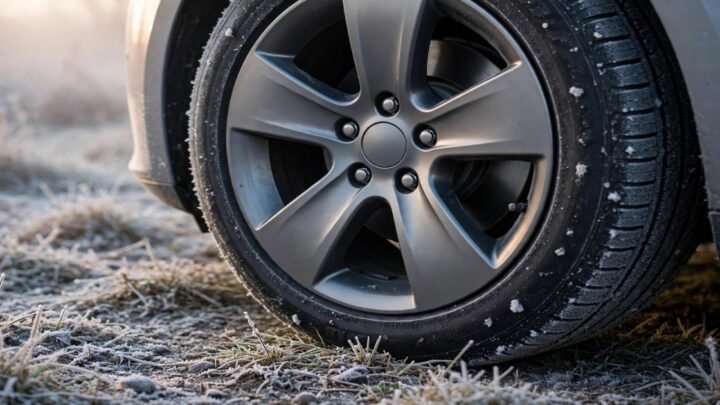
2. Cold weather and the heater. This is the biggest single hit most owners will ever see. AAA’s May 2026 testing, on climate-controlled dynamometers found a 39% loss of range at 20°F, and a 35.6% drop in efficiency. At 95°F with the air conditioning running, the same cars lost 8.5%. The heater does most of the cold-weather damage: AAA’s 2019 study found a 41% drop at 20°F with the heater on, but only 12% with it off. In a petrol car, cabin heat is free waste heat from the engine; in an EV it comes straight from the battery. A heat pump softens the blow — owner data tracked by Recurrent found heat-pump cars keep about 10% more range at 32°F — one reason a heat pump is worth understanding before you buy. For the full picture, see our guide to EV range in winter.
3. Short trips. A cold battery is less efficient, and energy goes into warming it first. Short cold trips are the worst: the car heats the cabin and the pack, then you park before either reaches its efficient temperature, and the next trip starts cold again.
4. Hills, wind, and rain. Climbing costs energy, and regenerative braking only wins some of it back on the way down. A headwind is the same as driving faster, and rain adds rolling resistance — none of which the dashboard’s average knows about until it has happened.
5. Driving style and load. Repeated hard acceleration raises resistive losses, and a roof box changes the car’s aerodynamics outright. The estimate cannot know you fitted a cargo box this morning. Put together, they explain how a winter highway trip with the heater on and a roof box can easily cost you half your sticker range.
Work out your real range from your own numbers
You need two numbers: how much usable energy is left, and how efficiently you will drive on this trip.
Your real range calculator
Enter your usable battery capacity (check your owner’s manual), your current charge, and your recent efficiency from the trip meter. The EPA figure is optional.
How the formula works: usable capacity in kWh, times the charge as a fraction, gives the energy in the battery right now. Multiply that by your recent efficiency in miles per kWh and you get the miles that energy will carry you. The defaults above — a 75 kWh usable pack, 80% charge, 3.0 miles per kWh — give 75 × 0.80 × 3.0 = 180 miles remaining, and 225 miles from a full charge, 25% below a 300-mile EPA rating. That is our calculation, and the honest version uses the efficiency from the driving you are about to do.
When a low estimate means a real problem
Most of the time it does not. A lower full-charge range in winter is usually the weather and the driving, not the battery. Geotab’s 2026 data puts average degradation at 2.3% of capacity a year, so a five-year-old car showing roughly 10% less than new is behaving normally — and a cold morning can cost you three times that in a single day. Check the battery’s state of health at a similar temperature instead. Our battery health guide explains how.
There are exceptions. A range estimate can also be wrong because the battery management system has lost calibration — its idea of how much energy is in the pack drifts from reality. Rivian, for example, told owners in a technical service bulletin that an inaccurate estimate below 20% charge was a software calibration issue, fixed by an update and charging to 100% for a few weeks. If your estimate drops suddenly or behaves erratically at low charge, that is a dealer conversation, not a weather excuse.
And if the battery genuinely has lost capacity, the warranty is what matters — not the dashboard. Most manufacturers cover the pack for eight years or 100,000 miles with a capacity threshold around 70%, but the exact terms sit in the warranty booklet. Our warranty guide walks through what each brand promises.
How to get a number you can trust
Stop planning trips from the miles figure and start planning from the percentage — the percentage is a measurement, the miles are a forecast. Five habits make the difference: switch the display to battery percentage; measure your own efficiency by resetting the trip meter at a full charge, once for town and once for highway driving; use a route planner; precondition while plugged in; and compare like with like, in the same season and temperature.
The estimate also cannot tell you how much charge you will lose while the car sits — a parked EV still draws power for battery management and sentry features. If your car loses noticeable range overnight without moving, that is a separate issue — phantom drain has its own causes and fixes.
Frequently asked questions
Why does my EV lose range overnight while parked?
A small overnight drop is usually the estimate recalculating — the car re-averages your recent driving and the battery cools. Real overnight loss, phantom drain, is typically a few miles at most.
Is my battery degrading if the full-charge estimate has dropped?
Probably not. A lower full-charge estimate in winter is almost always the weather and your recent driving. Average degradation runs about 2.3% of capacity a year, so a five-year-old car is normally around 10% down. Check the battery’s state of health at a similar temperature.
Why does my Tesla show a different range than the Energy app?
Because they are two different numbers. The range next to the battery icon is a rated range built from a fixed EPA-derived efficiency figure, so it does not change with how you drive. The Energy app’s projected range is built from a trailing average of your own recent consumption — its 30-mile average is usually the more honest for trip planning.
Will charging to 100% fix a wrong range estimate?
Sometimes. A full charge can help the battery management system recalibrate its idea of the pack’s capacity, which is why some makers recommend it after a software update. But charging to 100% every day adds wear — most makers recommend a daily limit around 80%. Use a full charge as an occasional recalibration, not a daily habit.
Why does range fall faster on the highway than in town?
Two reasons. Aerodynamic drag grows with the square of speed — our calculation puts drag force at 70 mph about 62% above what it is at 55 mph. And on the highway there is almost no stop-start driving, so regenerative braking barely gets a chance to work.
The short version
Your EV’s range estimate is wrong the way a weather forecast is wrong: a good-faith guess about the future built from the recent past. The EPA number is a laboratory yardstick, useful for comparing cars and useless as a promise. The dashboard number is a rolling average of how you have just driven, useful as a hint and dangerous as a plan. Trust the number you work out yourself — battery percentage times your own recent efficiency — checked before a trip instead of after one.
Written by Shurah Beel, who researches and writes independently on the real cost of EV ownership — charging, maintenance, and total cost of ownership — backed by primary data and original calculations rather than recycled lists.