A nail in the tread is not a $300 problem yet
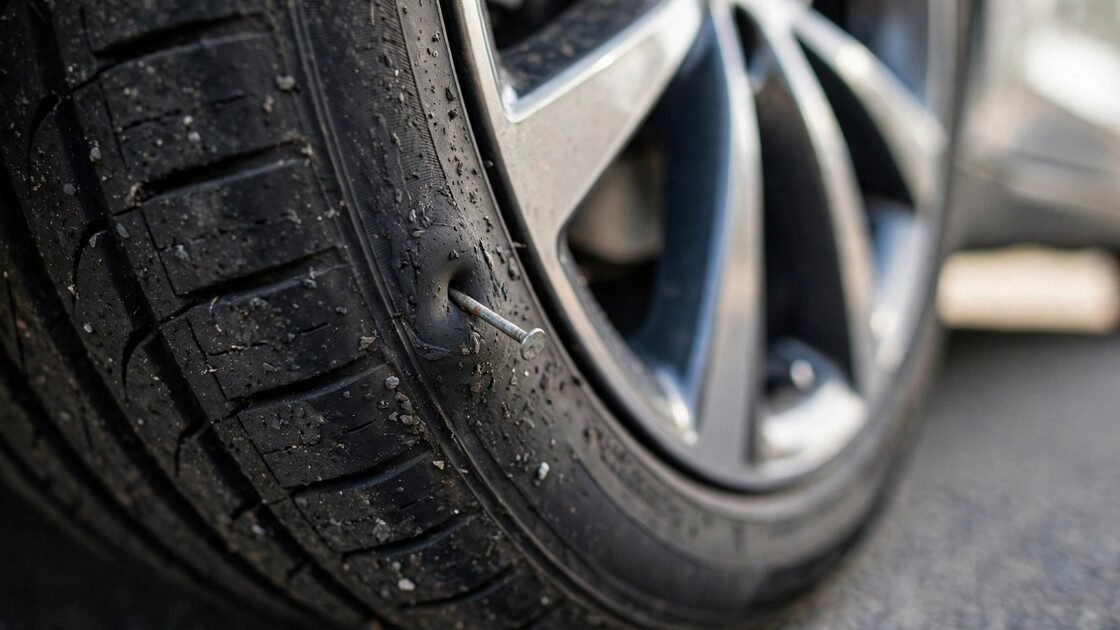
It usually starts with a warning light, or a screw head you spot during a wash. Your first thought is the price of a new tyre, because EV tyres are expensive and your car has no spare. But most small tread punctures do not need a new tyre. The industry rulebook is strict about where a puncture sits and how big it is, and generous within those limits: a clean nail hole in the middle of the tread, repaired properly from the inside, costs nothing at a chain that repairs flats free, or roughly $20 to $50 at an independent shop. The expensive outcomes come from cases that fail the test, or from driving on the flat tyre while you decide.
The Numbers at a Glance
- Repairable puncture: tread area only, no wider than 1/4 inch (6 mm), repaired with a plug-and-patch unit after the tyre comes off the wheel.
- Typical shop repair: $20 to $50 for a proper plug-patch, per secondary price guides; free at Discount Tire for a repairable flat, per the company’s own service list.
- DIY plug kit: $5 to $20, but a plug alone is a temporary fix, not a permanent repair.
- One replacement EV tyre: roughly $200 to $400 before mounting and balancing, so a repair that works saves about $200 to $380 on the tyre alone.
- Tesla’s emergency kit: $110 for the compressor and sealant kit, limited to tread holes of 6 mm or less and 62 miles of driving.
In Short
An EV tyre puncture costs $0 to $50 to repair if the hole is small, in the tread, and the tyre has not been driven flat, because a plug-and-patch repair from inside the tyre, including on most foam-lined EV tyres, costs that much. It costs $200 to $400 plus fitting if the damage is in the sidewall or shoulder, wider than 1/4 inch, or the tyre ran flat; a tow can add $75 to $225.
The repairable test: five questions before anyone touches the tyre
The U.S. Tire Manufacturers Association (USTMA) publishes the repair rules most reputable shops follow, and its puncture repair procedures are blunt. A repair must be done with the tyre removed from the wheel so the inside can be inspected. A plug alone, or a patch alone, is not an acceptable repair. The two must be combined: the plug fills the puncture channel, the patch seals the inner liner. A shop offering an outside-only plug as a permanent fix is selling a temporary repair at a permanent price.
| Question | Pass | Fail means replacement |
|---|---|---|
| Where is the hole? | In the tread, clear of the shoulder | Shoulder or sidewall, where the tyre flexes constantly |
| How big is it? | No wider than 1/4 inch (6 mm) | Wider, or a cut rather than a round puncture |
| What angle did it enter at? | Straight enough for a repair unit to seal | Angled into the shoulder area |
| Was it driven flat? | No, or only a very short distance at low pressure | Driven on low or zero pressure, which cooks the inner liner |
| What shape is the tyre in? | At least 2/32 inch of tread left, no bulges or prior overlapping repairs | Worn out, bulging, or already repaired in the same spot |
Two of these catch EV owners out. The first is driving flat: an EV is heavy and quiet, so a slow leak can go unnoticed, and the extra weight builds heat inside a flat tyre fast. By the time the warning feels urgent, the inner liner may already be shredded, and no patch can restore it. The second is tread depth: a tyre with 3/32 inch left is nearly worn out anyway. If the tyre passes, the repair takes well under an hour.
The foam problem: why shops say no to EV tyres
Many EV tyres carry a ring of sound-deadening foam glued to the inside of the tread. With no engine noise to mask it, the foam damps road noise. It creates no problem for driving, but it sits exactly where a repair patch needs to go, and that is where the refusals start. A trade review of EV tyre repair practice, Tire Review’s best-practices guide, quotes a repair consultant with 38 years in the trade: lots of shops assume they cannot repair EV tyres and throw them out without trying, when the foam only adds a few extra steps.
Those steps are simple. The technician cuts out the foam section over the injury, repairs the tyre by the standard method, then glues the foam back and rebalances the wheel. USTMA’s bulletin on acoustic-foam tyres, as reported by secondary coverage in 2026, says the removed foam piece does not have to be replaced for the repair to be safe, though the tyre maker’s own guidance still matters. A Kia bulletin for the foam-lined EV6, also reported second-hand, gives the same sequence plus a road-force check.
So when a shop says “we cannot patch this tyre,” ask which reason it means. Shoulder damage, a hole wider than 6 mm, or a tyre driven flat are safety answers, and a second shop will give the same one. “We do not repair foam-lined tyres” is a store policy answer, and a different shop may give a different one.
Plug, patch, sealant: what each one actually buys you
Three roadside options get confused constantly. A plug is a sticky cord pushed into the hole from the outside. It holds air, sometimes for thousands of miles: it does not seal the inner liner, and nobody has inspected the inside of the tyre. Treat it as a way to reach a shop, at modest speed, and no further.
A patch, in the proper sense, is the plug-patch unit fitted from inside after dismounting. It is the only permanent repair in this list, and it is what the $20 to $50 shop price buys. A sealant kit is the third option: a bottle of liquid sealant plus a compressor, the setup Tesla sells as its $110 Air Compressor + Tire Repair Kit 3.0. Tesla’s own listing limits it to tread holes of 6 mm or less, caps driving on the repaired tyre at 62 miles, and says the tyre and the pressure sensor should be replaced at the earliest convenience.
| Option | What it is | Typical cost | Verdict |
|---|---|---|---|
| DIY plug kit | Sticky cord from the outside | $5 to $20 | Temporary only |
| Shop plug-patch | Plug and patch from inside, tyre off the wheel | $20 to $50 | Permanent, the right fix |
| Sealant + compressor | Liquid sealant and air, no dismounting | $110 for Tesla’s kit, $30 for a refill bottle | Emergency only, 62-mile limit |
| Mobile repair visit | Technician comes to the car | $75 to $225, per secondary provider listings | Worth it only if the car cannot move |
| New tyre, fitted | Replacement plus mounting, balancing, disposal | $200 to $400 plus roughly $30 fitting | Only when repair fails the test |
What the bill looks like, route by route
Secondary price guides agree on the broad bands but disagree at the edges, so treat these as planning ranges, not quotes. Independent shops are usually cheapest, at $10 to $50 across guides. Dealers sit at the top, often $65 or more for the same plug-patch.
The big exception is Discount Tire. Its own service list includes free flat tire repairs, and secondary reporting confirms the policy applies whether or not you bought the tyre there, provided the tyre passes the repairability test. It is the best first call for a repairable puncture: a free repair versus a $330 fitted replacement is a $330 saving. Other chains offer free repairs mainly for tyres bought from them or under a road-hazard certificate, which typically costs $20 to $40 per tyre at purchase, per secondary guides.
The bill grows when the car cannot get to a shop. Secondary provider listings put a mobile flat repair at $75 to $225 all-in. A tow to a shop that then refuses the repair is the worst combination: you pay the tow, then pay again for a replacement, then discover the shop across town would have repaired it free. One more hidden line: tread matching. If the other tyre on the same axle is heavily worn, a shop may recommend replacing both; ask for the tread depths in writing first.
EV-specific traps around a simple repair
Four things make an EV puncture different from the same puncture on a petrol car. First, the jacking point. Battery packs sit low and flat, and jacking in the wrong place can damage the pack or the body, so confirm any mobile technician knows the car’s jack points. Second, load rating. EV tyres are often XL rated for the extra weight, and a replacement must match the load index and speed rating on the door sticker, not just the size. Third, the pressure sensor: sealant can damage it, and a dismount is the moment to replace a sensor with a dying battery, since the labour is already paid for. Fourth, the missing spare. Most EVs ship without one, as covered in our guide to driving an EV with no spare tyre, so a puncture that cannot be plugged or sealed leaves only a tow.
None of this changes the repair test. It changes what happens when the test fails. A $20 plug kit and a portable inflator in the boot, plus the number of a shop that repairs foam tyres, is the cheapest preparation you can buy; our guide to EV tyre pressure in cold weather explains why cold mornings make the warning light lie.
Run your own flat-tyre bill
The formula: repair route equals the quoted repair plus any tow or call-out fee; replacement route equals the tyre price plus mounting, balancing and disposal plus the same fee. The fee cancels in the saving but matters to the cash you hand over. Defaults are examples only.
Before you approve anything: a five-point check
Photograph the puncture and tread depth, so a second shop can judge it unseen. Ask whether the repair is a plug-patch from inside, and whether the shop has repaired foam-lined tyres before. Ask whether the tyre was driven flat; the inside inspection settles it. Get the replacement quote in writing, with size, load rating, fitting, disposal and sensor lines separated. If the tyre is replaced, ask for the old tyre back, or a photo of the damage. For the wider budgeting question, see our guides to EV tyre costs and wear, the best tyres for EVs, and winter tyre costs.
Questions drivers actually ask
Can a foam-lined EV tyre be patched?
Yes, in most cases. The technician cuts out the foam over the injury, repairs the tyre by the standard plug-patch method, glues the foam back, and rebalances the wheel. Refusal is usually store policy, not a safety rule.
Is a plug a permanent repair?
No. A plug alone does not seal the inner liner and is not accepted by USTMA as a permanent repair. It is a temporary fix to reach a shop, where the tyre should be dismounted, inspected, and repaired with a plug-patch unit.
How much does a tyre patch cost at a shop?
Secondary price guides put a proper plug-patch repair at roughly $20 to $50, with independent shops cheaper and dealers dearer. Discount Tire repairs repairable flats free, per its own service list. Confirm whether balancing and disposal are included in the quote.
Can I drive on a tyre with a nail in it?
Only as far as a repair shop, slowly, and only if it still holds air. Do not drive on a flat tyre to save a tow fee, and do not treat a plugged tyre as fixed. A tyre driven flat can suffer internal damage that makes it unrepairable.
Does tyre sealant damage the pressure sensor?
It can, and Tesla’s own kit notes say the tyre and sensor should be replaced at the earliest convenience after sealant use. Tell the shop sealant was used, and budget $50 to $150 for a sensor, per secondary guides.
When should I replace instead of repairing?
Replace when the damage is in the sidewall or shoulder, wider than 1/4 inch, angled into the shoulder, overlapping an earlier repair, or the tyre was driven flat or is below 2/32 inch of tread.
The takeaway
A nail in an EV tyre is usually a small bill wearing a large bill’s clothes. If the hole is small, central, and caught early, a proper plug-patch repair, free at some chains and roughly $20 to $50 elsewhere, returns the tyre to service, foam and all. If the hole is in the wrong place, too big, or the tyre ran flat, accept the replacement, get the quote itemised, and check the surviving tyre’s tread before approving a pair.
Written by Shurah Beel, who researches and writes independently on the real cost of EV ownership — charging, maintenance, and total cost of ownership — backed by primary data and original calculations rather than recycled lists.