You pull into a 350 kW charging station, plug in, and watch the screen show 38 kW. The station isn’t broken — your battery is cold, and the car is protecting it. This is exactly what preconditioning exists to prevent, and most drivers who hit it simply didn’t trigger it correctly.
What Matters Here
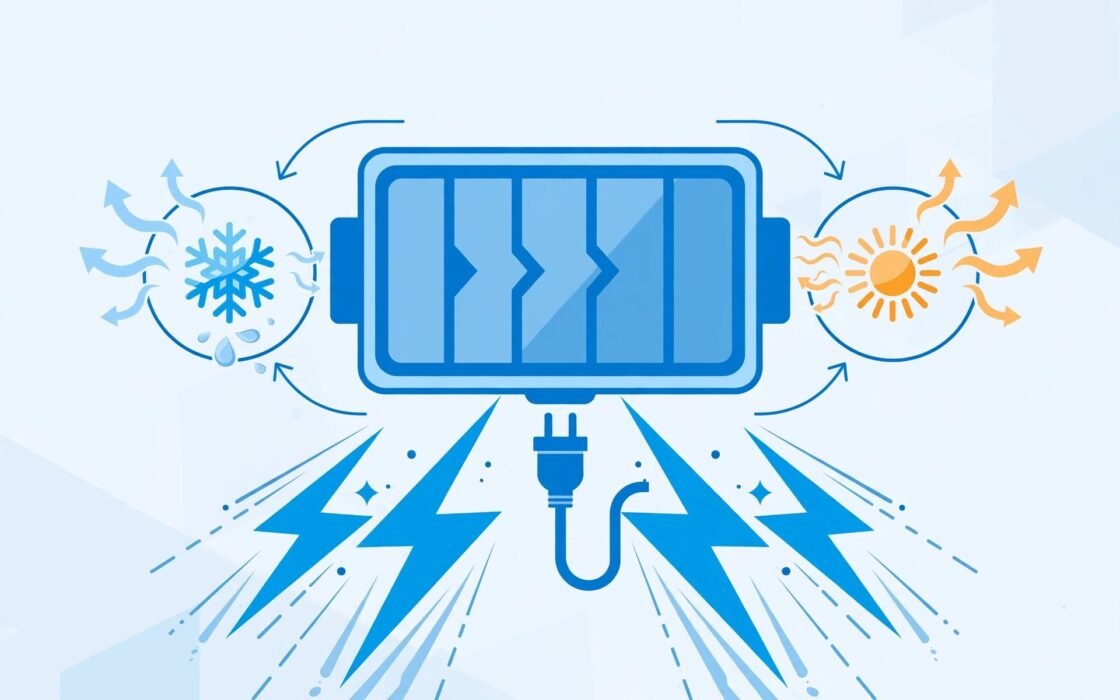
- Lithium-ion EV batteries charge fastest in a specific temperature window, roughly 59-95°F (15-35°C) — outside it, the battery management system deliberately limits power to protect the cells.
- A properly preconditioned battery can charge 2-3x faster than a cold one in winter — a 45-minute session can become an 18-minute one.
- The near-universal trigger is navigating to a DC fast charger using the car’s own built-in navigation — most EVs won’t precondition if you’re routing through Google Maps, Apple CarPlay, or Android Auto instead.
- Preconditioning typically starts 10-45 minutes before arrival, depending on distance, current battery temperature, and automaker (Tesla runs 30-45 minutes in cold weather).
- Preconditioning doesn’t improve range or battery longevity — it’s purely a charging-speed feature, separate from the cold-weather range loss covered in our winter range research.
Quick answer: Battery preconditioning warms or cools your EV’s pack to its ideal charging temperature before you arrive at a DC fast charger, so it can accept full power immediately instead of ramping up slowly. It’s triggered automatically when you navigate to a compatible fast charger using the car’s built-in nav — not a third-party app. Done right, it can more than double your charging speed in cold weather; skipped, you’re charging at a fraction of the station’s rated power for no reason.
Why Temperature Controls Charging Speed
Inside a lithium-ion cell, charging is a chemical process — lithium ions moving through an electrolyte into the anode. Cold slows that movement down; if you force high current into a cold cell anyway, ions can plate onto the anode surface instead of intercalating properly, which permanently damages the cell. So the battery management system doesn’t take the risk — it simply caps the charging power until the pack reaches a safer temperature. That’s the entire reason a “350 kW charger” doesn’t guarantee 350 kW: the station’s ceiling means nothing if your pack won’t accept it yet.
How the Car Actually Does It
Under the floor, most EVs run coolant loops through the battery pack, connected to heaters, and on newer models, a heat pump that recovers waste heat from the motor and inverter rather than generating it from scratch. Per Motorpoint’s explainer, this system runs independently from cabin climate control — heating the cabin does nothing to the battery pack, since they’re separate thermal loops entirely. When preconditioning activates, that hardware starts moving heat into (or out of) the pack ahead of your arrival, so by the time you plug in, the cells are already in their efficient charging range.
The Trigger Almost Everyone Gets Wrong
The single most common reason preconditioning fails to happen isn’t a car fault — it’s routing. On most EVs, the car only knows to precondition if a compatible DC fast charger is set as the destination in its own built-in navigation system. Per Tesla’s own Supercharging support documentation, Tesla vehicles automatically begin preconditioning when navigating to a Supercharger through the car’s nav — and Hyundai’s official battery conditioning guide describes the same automatic activation tied to its own compatible-charger navigation. If you’re using your phone’s maps app instead, even mirrored onto the car’s screen, the vehicle typically has no idea a charging stop is coming, and preconditioning simply doesn’t fire.
How Much It Actually Saves
| Scenario | Typical result |
|---|---|
| Cold, unconditioned battery on a 150+ kW charger | May start well under 50 kW despite the station’s rated power |
| Properly preconditioned battery, same conditions | Can hit close to peak power almost immediately on plugging in |
| Real-world winter comparison | A 45-minute unconditioned session can become roughly an 18-minute preconditioned one |
That gap is exactly why our battery blanket mythbust piece pointed to preconditioning as the free, built-in alternative to aftermarket garage heaters — the car’s own system already does this job, and does it better, without any add-on hardware.
Preconditioning Doesn’t Fix Everything
It’s worth being precise about what preconditioning changes and what it doesn’t. It gets you to peak charging speed faster — it does not eliminate the normal charging curve taper as your state of charge climbs. Every EV still charges fastest in the lower state-of-charge range and slows as it approaches full, the same physics behind our charging time research and the 80% stopping-point etiquette covered in our charging etiquette guide. A preconditioned battery that hits 250 kW at 10% state of charge will still taper down by the time it reaches 55-60%, same as always — preconditioning just makes sure you actually get that early peak instead of missing it entirely.
Common Mistakes
- Using a third-party map app instead of the car’s built-in nav — the car doesn’t know a charging stop is coming, so it doesn’t warm the pack.
- Assuming a warm cabin means a warm battery — cabin heat and battery thermal management are separate systems.
- Blaming the charger when the session starts slow and climbs — a session that opens low and ramps up over several minutes is often the pack self-warming from the charging current itself, a sign preconditioning didn’t trigger.
- Expecting preconditioning to fix the taper above 80% — that’s normal charging-curve behavior, not something to troubleshoot.
Calculate the Time Savings
Estimated Preconditioning Time Savings
This uses a 2.5x average from documented winter comparisons — treat it as a reasonable estimate, not a guarantee, since the actual gain depends on your specific battery temperature, chemistry, and charger.
FAQ
Does preconditioning use extra energy?
Yes, a small amount — typically 1-3 kW while it’s running. If you’re driving (not plugged in), that draws from the battery itself, a minor trade-off for a much faster charging stop.
Can I manually trigger preconditioning without navigating to a charger?
Some EVs offer a manual preconditioning option in settings, but many require a compatible fast charger set as the nav destination as the actual trigger — check your specific model’s manual.
Does preconditioning work for home Level 2 charging too?
Not meaningfully. Pack temperature has little effect on AC (Level 2) charging speed, since it’s already well below what the taper or thermal limits would affect — this is a DC fast-charging feature specifically.
Will preconditioning damage my battery if I do it every time?
No — it’s designed for regular use and is part of the vehicle’s normal thermal management, not an aftermarket stress on the pack.
My charging session started slow and climbed over several minutes — did I do something wrong?
Not necessarily wrong, but it’s a sign preconditioning likely didn’t trigger — check that you routed to the charger through the car’s own navigation next time, not a phone map app.
The Short Version
Preconditioning is one of the few genuinely free performance features on an EV — it costs nothing extra to use, and skipping it (usually by accident, through routing) can quietly cost you 20+ minutes at every cold-weather fast-charging stop. Route to the charger through your car’s own navigation, and let the thermal system do its job before you arrive.
Heat deserves the same treatment: hot weather slows EV charging just as surely as cold does, so cooling the pack on the way to a summer fast-charge stop saves real minutes too.
About the author: Written by Shurah, who researches and writes independently on the real cost of EV ownership — charging, maintenance, and total cost of ownership — backed by primary data and original calculations rather than recycled lists.