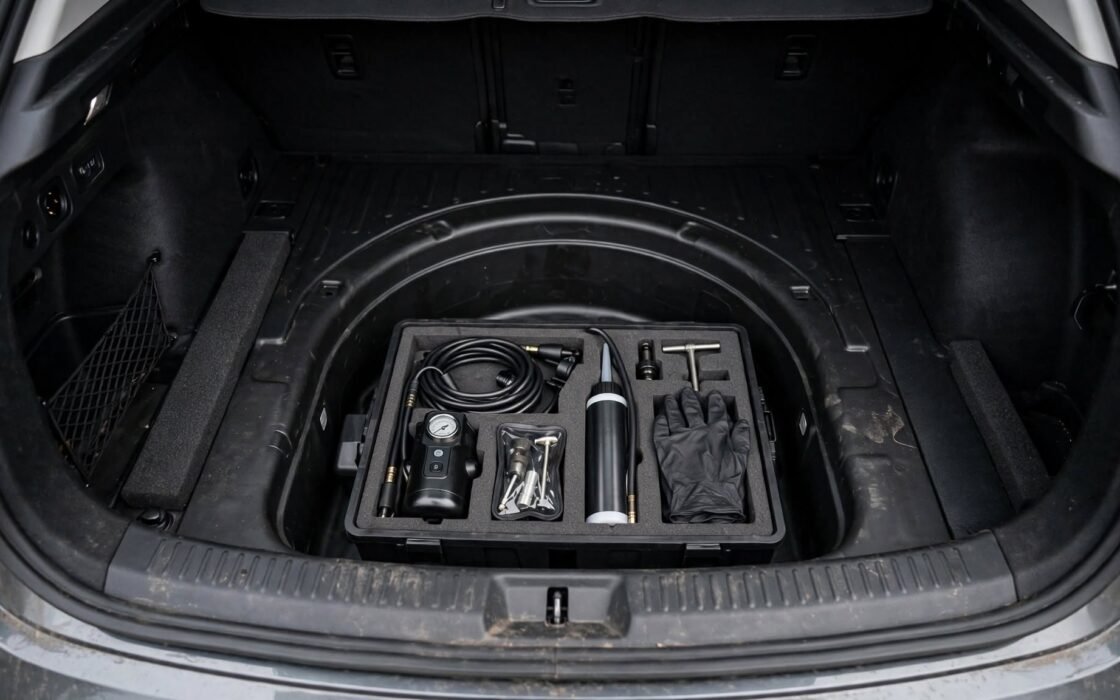
You hear the tick-tick-tick of a screw in the tread, pull over, and lift the cargo floor. There’s no spare under it. If you’re lucky you’ll find a small compressor and a bottle of sealant. If not, you’ll find foam trays and a charging cable.
That’s normal now, and it’s most common on EVs. Below: what is likely under your floor, what a sealant kit can actually fix, the 12V outlet limit that can trip you up, and whether buying a spare is worth it.
Fast facts
- New cars with no spare at all (Consumer Reports test fleet since 2020): about 45%. Sealant kit 34%, run-flat tires 7%, nothing 4%
- Chevrolet EVs that carry a sealant kit instead of a spare: Equinox EV, Blazer EV, Silverado EV, Bolt EUV and others
- Largest hole the Tesla and Chevrolet kits are meant to seal: 1/4 in (6 mm), in the tread only
- Chevrolet’s limits after sealing: 55 mph max, dealer inspection within 100 miles
- Tesla Model Y 12V outlet rating: 12A continuous, 16A peak
- Longest Tesla says to run its kit’s compressor: 20 minutes in a row
- Spare-tire kit (tire, jack, wrench), per Consumer Reports: from about $250
In short
Most EVs come without a spare. Usually there’s a sealant-and-compressor kit instead, and sometimes nothing. A kit can seal a hole up to about 1/4 inch (6 mm) in the tread and get you to a shop at reduced speed. It can’t fix sidewall damage, big cuts or a tire that’s come off the rim. Check what’s under your floor today, note the sealant’s expiry date, and make sure the compressor’s current draw suits your 12V outlet.
The spare is mostly gone
Consumer Reports checked the cars it has bought for testing since 2020. Only 9% had a full-size spare and 46% had a temporary space-saver. The other 45% had no spare at all: 34% came with a sealant kit, 7% ran on run-flat tires and 4% had nothing.
Those figures cover all new cars, not just EVs. Chevrolet’s own tire inflator kit page says these kits are “commonly found in electric vehicles (EV) instead of spare tires,” and lists the Equinox EV, Blazer EV, Silverado EV, Bolt EUV and BrightDrop van. Tesla’s flat-tire advice is built around a repair kit and Roadside Assistance, not a spare.
Look before you need it. The US Model Y manual’s tire repair page says the temporary kit can be bought from the Tesla Shop, so don’t assume one is in the car. A used EV may have lost its kit, or carry sealant that expired years ago.
What you might find under the floor
| What’s there | Share of new cars (CR) | What it handles | The catch |
|---|---|---|---|
| Full-size spare | 9% | Almost any flat, including sidewall damage | Weight, space, and you still have to change it |
| Space-saver spare | 46% | Most flats, short term | Under 50 miles total at reduced speed; hurts braking and handling |
| Sealant + compressor kit | 34% | Small punctures in the tread | Useless on sidewalls, big cuts, or a tire off the rim; sealant expires |
| Run-flat tires | 7% | A short drive with low or no air | Some tire makers limit how, or whether, they can be repaired |
| Nothing | 4% | Nothing | Every flat means a tow or mobile service |
Most EV owners are in the third row. That kit fixes one kind of flat, and only that one.
What sealant can fix, and what it can’t
The kit is simple. You squeeze liquid sealant into the tire through the valve, the compressor adds air, and you drive a short way at once. Chevrolet says to drive 5 miles to spread the sealant. The tire turning pushes the liquid around the inside until it reaches the hole and plugs it from within.
That only works on a small hole in a part of the tire that doesn’t flex much. Both Tesla and Chevrolet put the limit at 1/4 inch (6 mm), and only in the tread. Tesla adds a detail people get wrong: don’t pull the nail or screw out. While it’s still in the tire it blocks most of the hole, and the sealant only has to fill the gap around it.
| Damage | Will the kit get you moving? | Can a shop repair it properly later? |
|---|---|---|
| Nail or screw in the tread, 1/4 in (6 mm) or smaller | Usually yes | Usually, with a plug and patch fitted from inside |
| Hole in the tread bigger than 1/4 in | No | No, replace the tire |
| Damage in the shoulder (where tread meets sidewall) | No, kits are for the tread only | No |
| Cut or bulge in the sidewall | No | No |
| Tire torn, blown out, or off the rim | No | No |
The third column comes from the tire industry’s own rules. The US Tire Manufacturers Association limits proper repairs to tread punctures no bigger than 1/4 inch. The tire has to come off the wheel and be checked inside. A plug on its own is “an unacceptable repair,” and repairing from the outside, or with the tire still on the wheel, is ruled out entirely.
So a sealant kit is a way to get moving, not a repair. Chevrolet wants the tire inspected by a dealer within 100 miles. Tesla calls its kit “a temporary repair only” and says to drive to a tire shop at the speed printed on the kit’s sticker. When you get there, tell the shop you used sealant so they know to clean it out before they patch.
Pull well clear of traffic before you use any kit. On a highway shoulder or near a blind bend, stay in a safe place and call for roadside help instead.
Check your flat, and your compressor
Part one tells you whether the kit is worth trying and whether it can get you to the shop you’re aiming for. Part two checks whether your compressor can run off your car’s 12V outlet. The default limits are Chevrolet’s 55 mph and 100 miles and Tesla’s 12A/16A Model Y outlet rating. Change them to match your own kit label and owner’s manual.
Part 1: Can the kit handle this flat?
Part 2: Will the compressor run off your outlet?
The 10A compressor figure is only an example. Use the number printed on your own compressor.
How it works: part one follows the kit makers’ own cut-offs (tread only, 1/4 inch, sealant in date), then compares your distance with the kit’s limit. The time estimate assumes you hold the top permitted speed the whole way, so treat it as the shortest the drive could take. Part two just compares two numbers, explained next.
The 12V outlet catch
The compressor in these kits runs from the car’s 12V accessory outlet, and that outlet has a limit. Tesla’s Model Y manual rates its outlets for accessories drawing “up to 12A continuous draw (16A peak).” The kit that came with the car is designed to fit its own outlet. A bigger compressor bought separately might not be.
The reasoning is simple. Filling a tire from flat can take several minutes at full load, and that’s continuous draw, not a short peak. A compressor rated above the outlet’s continuous figure can trip its fuse partway through the fill. Then you’re stuck with a half-full tire and a dead outlet. Check the amps on the compressor’s label against the rating in your manual before you rely on it.
Two more traps are specific to EVs:
- The car has to be on. Tesla says the outlet is powered only when the car is in use or detects someone inside, such as a person in a seat or a touch on the screen. Chevrolet’s instructions say to start the vehicle before running the compressor. Get back in the car while it runs. The outlet is fed by the low-voltage system, covered in our 12V battery guide.
- Compressors overheat. Tesla says not to run its kit’s compressor for more than 20 minutes in a row. Chevrolet says to stop if the tire hasn’t filled after 15 minutes. If it hasn’t come up to pressure by then, the hole is probably too big for sealant.
Is a spare worth adding?
Consumer Reports puts a spare-tire kit (tire, jack and lug wrench) at around $250 and up. Whether it’s worth that depends far more on where you drive than on the car.
It makes sense if you drive long rural stretches, regularly travel far from tire shops, or often drive where there’s no phone signal. A sealant kit can’t help with a sidewall cut, and that’s exactly when a spare saves you a long wait for a tow.
It’s probably not worth it if you mostly drive in town, have roadside cover that includes tires, and are rarely more than a short drive from a shop. The kit covers the most common flat, a small puncture in the tread, and roadside help covers the rest.
Before buying, check three things:
- Where to put the jack. EVs carry their battery under the floor. Tesla’s Model Y manual says to use only the marked lift points and never lift from under the battery or the side rails. It also says never to raise the car while a charge cable is connected. Find your car’s lift points before you need them, not on a dark roadside.
- Whether the jack can take the weight. EVs are heavy. Compare the jack’s rating with the weight on your door-jamb sticker.
- Where the spare will go. A spare in the cargo area adds weight but no drag. That’s a much smaller range cost than a roof box, as our roof rack range test shows. It does take up cargo space, though.
A simple kit list
- The factory kit, checked. Find it, read the sealant’s expiry date, and put a reminder in your calendar. Chevrolet’s sealant is single-use, so replace the canister after every flat.
- A tire pressure gauge. It lets you check pressure properly with the compressor switched off.
- Gloves, a flashlight and a warning triangle. Consumer Reports suggests keeping a basic safety kit in every car.
- Your roadside number, saved. Find out now whether your cover includes tire service and how far it will tow.
- Not a DIY plug kit as a fix. The tire industry calls a plug on its own an unacceptable repair. Treat any roadside plug as temporary, like sealant.
Buying used? Add “is the tire kit there, and is the sealant in date?” to your inspection. Our used EV buying checklist covers the rest.
Owners also ask
Does sealant ruin the tire?
Not necessarily. If the puncture was in the tread and no bigger than 1/4 inch, a shop can usually still fit a proper plug-and-patch from inside once the sealant is cleaned out. That’s worth doing, because tires are one of the biggest running costs on an EV, as our EV tire cost breakdown shows. Get it looked at soon. The kit is only meant to get you to the shop.
How far can I drive on a sealed tire?
Only as far as your kit’s instructions allow. Chevrolet says 55 mph at most and a dealer inspection within 100 miles. Tesla says to drive within the speed on the kit’s sticker, avoid long stretches at high speed, and head straight to a tire shop.
Can I use the kit if the nail has fallen out?
You can try. With nothing left in the hole, the sealant has to fill all of it by itself, so a hole near the 1/4-inch limit is less likely to seal. If the tire won’t hold pressure after the first short drive, stop and call for help.
Do EVs get flat tires more often?
We haven’t found good data either way. A screw doesn’t care what drives the car. What is different is the weight and the tires: EV tires are expensive and wear quickly, which is why it pays to choose replacements carefully. Our guide to the best tires for EVs goes through the options.
Bottom line
Your EV probably has a sealant kit instead of a spare, and it’s good for one thing: a small hole in the tread. Find the kit this week. Check the sealant’s date, check the compressor’s amps against your outlet, and save your roadside number. For anything bigger than a nail, the kit can’t help, and knowing that before it happens will save you time at the roadside. With no spare to fit, a flat usually means calling a tow — see typical EV towing costs.
Who wrote this
Written by Shurah, who researches and writes independently on the real cost of EV ownership — charging, maintenance, and total cost of ownership — backed by primary data and original calculations rather than recycled lists.