EV Paint Protection Film: Real Costs and Is It Worth It
Fast Facts
- Partial front PPF: $900–$1,500 — bumper and part of the hood, the budget entry point.
- Full front PPF: $1,800–$3,000 — hood, bumper, fenders, mirrors, headlights; the package most installers recommend.
- Full body PPF: $5,500–$9,000+ — every painted panel; large SUVs and complex shapes cost more.
- Tesla Shop XPEL (Model 3/Y): $5,500–$6,000 for full body, installed by a certified dealer, 10-year transferable warranty (per Tesla’s own listing).
- Range effect: effectively zero — a full-body wrap weighs roughly 5–8 lb by our calculation, and the film is 0.2 mm thick, so aerodynamics don’t change.
The Short Answer
Front-end paint protection film is worth it for most EV owners who drive highways: $1,800–$3,000 covers the panels that take the real beating, and premium film carries a 10-year warranty that usually outlasts your first ownership. Full-body film at $5,500–$9,000+ is a luxury — it only pencils out if you keep the car many years or demand a flawless finish. PPF stops rock chips; it won’t add range or save paint from a deep keyed scratch.
Ask any group of EV owners what accessory they wish they’d bought on day one, and paint protection film comes up again and again. But it’s also one of the priciest accessories you can buy — a full wrap can cost more than a home charger install and a set of winter tires combined. This article lays out what PPF actually costs in 2026, what it does and doesn’t do, the EV-specific details most guides skip, and a calculator that runs your own driving numbers through the payback math.
What PPF Is (and Isn’t)
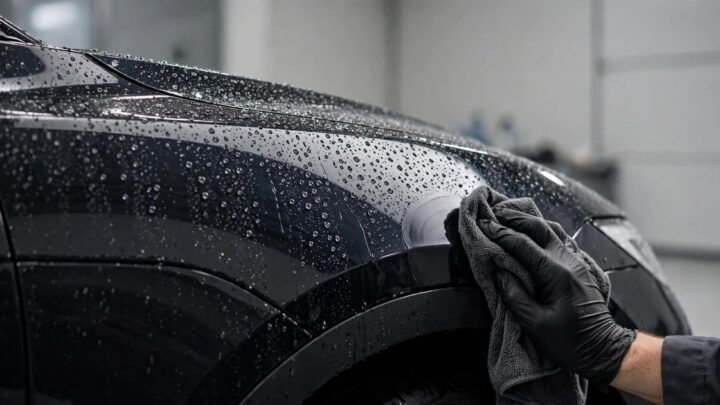
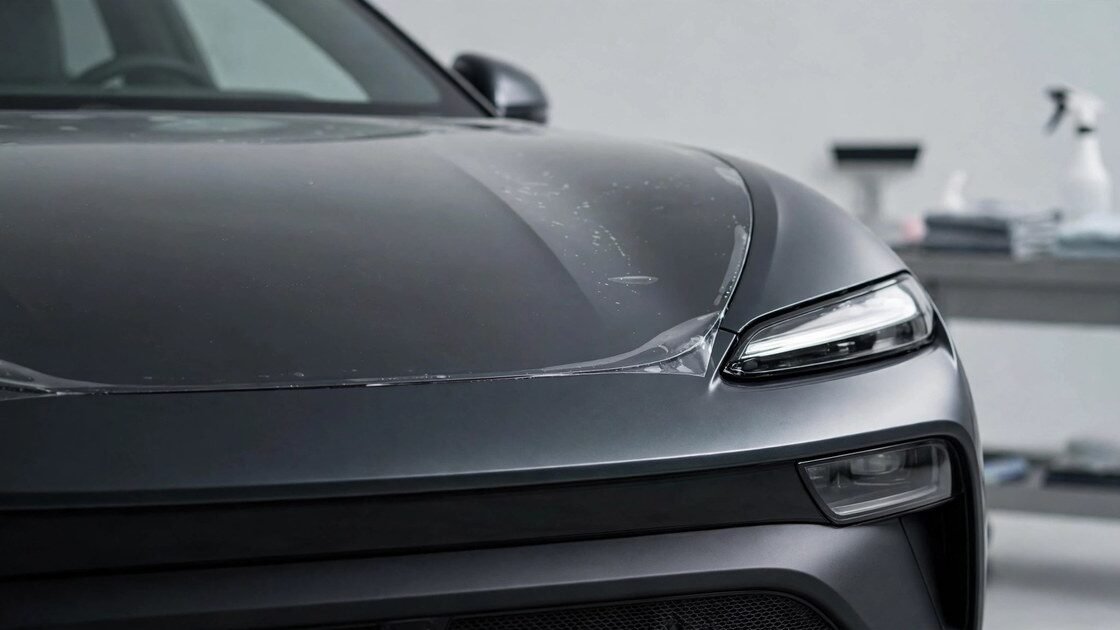
Paint protection film is a clear thermoplastic urethane film, roughly 8 mil (0.2 mm) thick, applied over painted panels — the modern “clear bra.” It absorbs rock chips, scratches, bug acids, and road salt instead of your paint. Premium films have a self-healing top coat: light swirls relax back out when the film warms up in the sun.
What it isn’t: a cosmetic upgrade. PPF doesn’t add gloss the way a ceramic coating does — it is armor, not makeup. The leading films — XPEL Ultimate Plus, 3M Pro Series, STEK, LLumar, and SunTek — carry manufacturer warranties of 5 to 10 years against yellowing, cracking, and peeling. XPEL’s 10-year warranty is transferable, which matters at resale time.
The biggest honest-beat in the whole PPF conversation: PPF prevents chips, it does not guarantee a perfect car. A hard, direct rock strike at highway speed can still mark the film — that’s the film doing its job, absorbing damage instead of the paint.
Why EVs Eat Front-End Paint
Three things stack against EV paint, and the first two are EV-specific:
- Soft factory paint is widely reported. Detailers and owner communities consistently report that Tesla paint in particular chips and swirls more easily than average — the clear coat is thin and soft. This is owner-reported and detailer-observed, not a manufacturer spec, but the consensus is broad enough to take seriously.
- Big flat front ends. Most modern EVs present a large painted front bumper and a wide, low hood to the road — one big chip-catching target with no grille to break it up.
- Highway miles. EVs are cheap per mile, so owners drive them more, often on highways where trucks throw debris.
The other side of the coin: a repaint is never as good as factory paint, and on EVs it costs more than owners expect. A single bumper repaint runs $500–$900 and a hood $800–$1,500 at typical US body shops (per a secondary pricing breakdown from calgaryppfpros.ca — US shops quote similar bands).
2026 PPF Prices by Package
Coverage area is the single biggest price driver — more than brand or region. Here are the current US market bands from multiple 2026 price guides (secondary sources, consistent with each other — see Capital Wrappers’ 2026 guide and ThePricer’s XPEL breakdown):
| Package | What it covers | 2026 price range | Who it suits |
|---|---|---|---|
| Partial front | Bumper + partial hood + mirrors | $900–$1,500 | City drivers on a budget |
| Full front | Full hood, bumper, fenders, mirrors, headlights, A-pillars | $1,800–$3,000 | Highway commuters — the sweet spot |
| Track / extended | Full front + rockers, door edges, roofline | $2,500–$4,000 | Debris-heavy roads, gravel regions |
| Full body | Every painted panel | $5,500–$9,000+ | Long-keep owners, perfectionists |
One caveat: if your paint already has swirls or chips, the shop must correct it before the film goes on — billed separately, often hundreds of dollars. And large SUVs and trucks use more film and labor, so expect quotes above these bands.
The Tesla Angle: Shop Prices and the DIY Kits
Tesla owners have one option nobody else gets: Tesla sells XPEL paint protection film directly through its own shop. Per the current Tesla Shop listing, the XPEL program ranges from $400 for small coverage packages up to $6,500, with the Model 3/Y full-body XPEL Ultimate Plus package listed at $5,500–$6,000 — product, installation by a local certified XPEL dealer, and XPEL’s 10-year transferable warranty included. It’s a fixed nationwide price with no haggling, which is the honest appeal: you skip the quote-shopping lottery.
Second, Tesla also sells DIY precut PPF kits: $50 for the Model Y rear-door kit and $80 for the Model 3 rear-fender kit, squeegee included. These cover small high-contact zones — not the front end — but they’re the cheapest genuine entry point to film protection.
If you drive a non-Tesla EV, the same films are available through any certified installer — the Tesla program is just pre-packaged. Ask for a quote itemized by panel so you can compare like with like.
EV-Specific Details Most Guides Skip
Range and weight. The question every EV owner asks — and the answer is reassuring. Our calculation puts a full-body wrap at roughly 5–8 lb of film (about 9 m² of painted surface × 0.2 mm thickness × ~1,150 kg/m³ TPU density ≈ 2–3.5 kg): under 0.2% of a typical EV’s curb weight, with no change to the car’s shape, so aerodynamics are untouched. Any shop claiming a range benefit is selling you something; any owner worrying about a range penalty can stop.
Sensors and cameras. Installers cut film around Autopilot cameras, radar, and ultrasonic sensors — film never goes over sensor lenses. Ask a shop to show you the cut patterns for your exact model, and verify driver-assist behaves normally before you leave.
Charge-port surround. A genuinely EV-specific wear point: the area around the charge port gets scratched by daily cable insertion, and frunk/trunk sills get scuffed by loading. Good installers film these contact zones — ask for them by name if they’re not in the quote.
Timing. Film goes on before the damage, ideally within the first weeks of ownership. Film over existing chips seals the damage in — shops will want to correct first, which costs extra.
PPF vs. Ceramic Coating: The Honest Comparison
These two get confused constantly, so here’s the straight version. Our ceramic coating cost breakdown covered coating in depth; the short version: ceramic is a thin chemical layer that adds gloss and easy-clean behavior for $500–$3,000+, lasting about 3–5 years on a daily driver. PPF is a thick physical barrier that stops rock chips for $1,800–$9,000+, warrantied 5–10 years. Ceramic can’t stop a rock; PPF can’t make water bead like ceramic does.
| Paint protection film | Ceramic coating | |
|---|---|---|
| Stops rock chips | Yes — that’s its job | No — too thin |
| Typical pro cost | $1,800–$3,000 (front); $5,500–$9,000+ (full) | $500–$3,000+ (whole car) |
| Real-world lifespan | 7–10 years (warranty-backed) | 3–5 years (owner-reported) |
| Hydrophobic / easy wash | Moderate (depends on top coat) | Excellent |
| DIY-friendly | Small kits only; full panels need a pro | Sprays and kits exist |
The “gold standard” stack: PPF on the high-impact front areas, ceramic coating over the whole car including the film — chip protection where it matters, easy washing everywhere. It’s also the most expensive option.
Does PPF Pay for Itself? Run Your Numbers
PPF Payback Estimator
How the math works (our calculation, assumptions labelled): chip frequency = (annual miles ÷ 10,000) × (0.4 + 3.2 × highway share) chip events per year — our assumption, since no public dataset tracks chips per mile. Each event is valued at $550, the midpoint between a $150 touch-up and a $900 bumper repaint — a labelled assumption, not a quote. Coverage factors (partial front 50%, full front 75%, full body 100%) are our estimates of where chips land. Resale uplift and the value of driving a clean car are real but unquantifiable here, so the estimator ignores them.
Who Should Buy It — and Who Should Skip It
Buy front-end PPF if: you commute on highways, live where roads are salted or graveled, own a dark color that shows every chip, or plan to keep the EV 5+ years.
Consider full body if: you’re keeping the car 8–10 years or cosmetic perfection genuinely matters to you. Financially it’s a luxury — say so honestly before you sign.
Skip it if: you lease for 3 years and return the car (the film’s value walks away with it — check your lease’s excess-wear terms first), you drive 5,000 city miles a year, or the money would be better spent on things that change ownership cost — like a home charger or winter tires.
Buying Smart: Installer Checklist
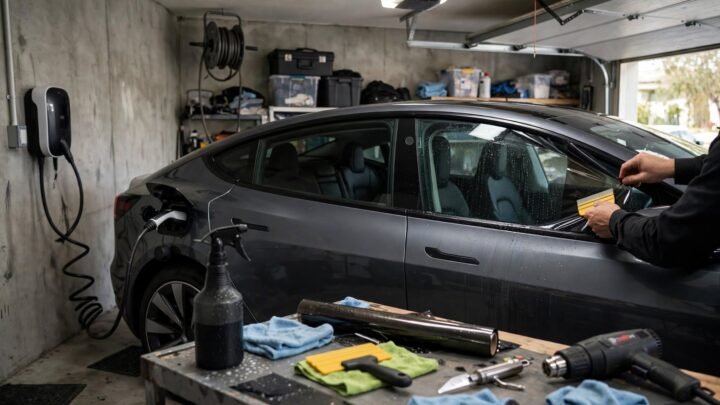
Many owners schedule PPF and window tint together — different films, similar installer vetting. Either way:
- Film brand in writing. XPEL, 3M, STEK, LLumar, SunTek — get the product name on the invoice, not just “premium film.”
- Panel-by-panel quote. Compare what’s covered (edges wrapped? headlights? rockers?) — a cheap quote that skips panels isn’t cheap.
- Edge work. Wrapped edges (film tucked around panel edges) outlast cut edges. Ask which panels get wrapped.
- Warranty paperwork. Get the manufacturer’s warranty registered in your name — that’s what makes it transferable at resale.
- EV experience. Ask whether they’ve filmed your exact model, and how they handle sensor zones and the charge-port area.
If resale is the motive, read how EV depreciation really works — paint condition helps, but it’s one line in a bigger equation. And if a rock finds your glass instead of your paint, windshield replacement costs are the number to know.
Frequently Asked Questions
Does PPF void my EV’s warranty?
No — professionally installed film doesn’t void the factory warranty. In the US, the Magnuson-Moss Warranty Act bars manufacturers from voiding coverage over aftermarket parts unless the part caused the failure (per a secondary legal summary from ceramicpro.com — confirm with your dealer for edge cases). A bad install that damages paint during removal is the real risk.
Does PPF turn yellow?
Modern TPU films are built with UV inhibitors, and premium warranties cover defects for up to 10 years — the older PVC films were the ones that yellowed. A yellow-looking modern film is usually surface contamination that washes off.
Can PPF be removed without damaging paint?
Yes, when removed properly — slow, with heat, ideally by a professional. Factory paint in good condition comes through clean. The risk case is paint that was already failing or resprayed before the film went on.
How long does PPF last on an EV?
Premium films carry 5–10-year manufacturer warranties, and 7–10 years of real service is the common expectation with normal care. Budget films may start failing — lifting edges, hazing — in 3–5 years.
Can I install PPF myself?
Small precut kits — Tesla’s $50–$80 rear-door and fender kits, door-edge strips — are genuinely DIY-able. A full hood or bumper is a different craft: positioning a large sheet without contamination takes practice and a clean bay. Most owners DIY the small stuff and hire a pro for the front end.
Does PPF protect against key scratches or door dings?
Lightly. The film absorbs minor abrasion and its self-healing top coat erases fine swirls, but a deliberate deep key scratch cuts through 8 mil of film without noticing it. PPF is rock-chip armor, not vandalism insurance.
The Bottom Line on PPF
Paint protection film is the rare accessory whose value you can actually calculate: front-end coverage at $1,800–$3,000 guards the panels that take nearly all the damage, carries a warranty that outlasts most ownership periods, and costs less than two bumper repaints. Full-body film is superb protection at a luxury price — buy it for love of the car, not the spreadsheet. Install it early, buy it from a certified installer with the film brand in writing, and pair it with ceramic coating if you want the easy-wash gloss that film alone doesn’t give.
Safety note: film never goes over cameras, radar, or sensor lenses — confirm driver-assist systems behave normally after installation. Warranty-law summaries above are general information, not legal advice.
About the author
Written by Shurah, who researches and writes independently on the real cost of EV ownership — charging, maintenance, and total cost of ownership — backed by primary data and original calculations rather than recycled lists.