EV All-Weather Floor Mats Cost: Are They Worth It?
The Numbers at a Glance
- $70–$345 is the real price range for a full EV set, from budget TPE to Tesla’s liner bundle with frunk and rear-well pieces.
- $240 buys Tesla’s Model Y All-Weather Interior Liners (first and second row, 2025+) — about what one professional interior detail costs.
- $150–$350 is the going rate for a professional full interior detail in the US (HomeGuide, 2026) — skip one a year and the mats pay for themselves fast.
- ~15 months is the break-even in our worked example: $240 mats, $150/year of avoided detailing, $200 of preserved resale value over five years.
- Lifetime warranties are standard on the mid-tier brands (TuxMat, Husky); Tesla’s own liners carry standard Tesla accessory coverage.
Short Answer
EV all-weather floor mats cost $70–$345 for a full set, and for most owners they are worth it: at $150–$350 per professional interior detail, mats that prevent a single detail a year break even in roughly 12–18 months, while preserving the carpet condition buyers judge at resale. Choose TPE over old-style rubber for lower odor and better temperature stability, and confirm fitment for your exact model year — redesigned interiors like the 2025+ Model Y “Juniper” need their own mats.
Picture a February morning: road salt and half-melted snow riding in on your boots, pooling on the thin factory carpet of your EV. In a petrol car that’s a nuisance. In an EV it’s a line item — professional detailing runs $150–$350 a pop, and stained carpet is one of the first things a buyer notices when you sell. All-weather floor mats are the cheapest interior insurance you can buy, and the payback math fits on a napkin. This article covers what the mats cost across the major brands, what TPE versus rubber means, the fitment traps that waste money, and a calculator for your own break-even.
What EV All-Weather Floor Mats Actually Cost
Prices were checked against manufacturer and retailer pages in October 2026. EV-specific mats cost the same as petrol-car equivalents — no “EV tax” — but EVs get model-specific laser-measured sets, and a few brands sell bundles covering the frunk and rear cargo well, which exist only because the car is electric.
| Brand / set | Coverage | Price (USD) | Warranty |
|---|---|---|---|
| Tesla All-Weather Interior Liners (Model Y, 2025+) | 1st + 2nd row | $240 | Tesla accessory coverage |
| Tesla All-Weather Interior Liners (Model Y, 2020–2024) | 1st + 2nd row | $225 | Tesla accessory coverage |
| Tesla All-Weather Liner Bundle (Model Y) | Interior + frunk + rear well | $345 | Tesla accessory coverage |
| TuxMat (Model Y 5-seater) | 1st + 2nd row | $229.80 | Limited lifetime; 30-day guarantee |
| WeatherTech FloorLiner DigitalFit (Model Y) | Front $132.95 + rear $103.95 | ~$237 full set | 3 years |
| Husky Liners X-act Contour (Model Y) | From 2-row sets | From $99.99 | Guaranteed for life |
| Husky Liners Weatherbeater (Model Y) | From 2-row sets | From $69.99 | Guaranteed for life |
| 3D MAXpider Kagu (Model Y) | 1st + 2nd row | $198–$228 (retailer variance) | Per retailer terms |
| Budget full-coverage TPE sets | 1st + 2nd row | ~$100–$120 | Varies (often 1 year) |
A few things the table hides. Tesla’s own liners sit in the middle of the market at $240 — no real OEM premium — per the Tesla shop listing. TuxMat is $229.80 for the 5-seater set with the tallest side walls in the class and a limited lifetime warranty, per TuxMat’s own product page. WeatherTech sells by the row — $132.95 front plus $103.95 rear at retail — so its ~$237 “full set” total rarely appears as one advertised number. Husky is the value play with a lifetime guarantee, from $99.99 (X-act Contour) and $69.99 (Weatherbeater) on Husky’s official fitment pages. The 3D MAXpider Kagu floats between $198 and $228 by retailer, so shop around.
The logic behind the spread: you are paying for fit precision and coverage height, not raw material. A laser-measured liner with tall side walls costs more to tool than a flat universal mat, and that tooling spreads over fewer units for EV-specific footprints. Budget TPE sets at ~$100–120 use the same class of material as the $230 sets; what you give up is edge height, exact contour, and warranty length.
TPE vs Rubber: What the Material Labels Actually Mean
Nearly every listing now says “TPE” instead of “rubber” — and the distinction is worth understanding.
| Property | TPE (thermoplastic elastomer) | Traditional rubber / PVC |
|---|---|---|
| Odor | Low to none; BPA-free formulations common | Noticeable “new mat” smell that can linger for weeks |
| Temperature behavior | Stays flexible in cold, doesn’t go gummy in heat | Can stiffen in winter, soften and off-gas in summer |
| Weight | Lighter for the same coverage | Heavier; full sets add several pounds |
| End of life | Recyclable in principle | Landfill in practice |
Why does this matter for EVs? The cabin is sealed tighter and quieter than a petrol car’s, so rubber off-gassing becomes the first thing you smell every morning. That’s the real reason TPE won: lower odor in a sealed cabin, plus flexibility at 10°F that keeps meltwater channeling instead of running off a stiffened edge. Garage-kept in a mild climate? Cheaper rubber is fine.
The Fitment Traps That Waste Money
This is where buyers actually lose money — not on the brand, but on buying the wrong version of the right brand.
Redesigned interiors need redesigned mats. The 2025–2026 Model Y “Juniper” refresh changed the interior footprint, and pre-refresh mats don’t fit — Tesla sells separate SKUs for 2020–2024 ($225) and 2025+ ($240) for exactly this reason. If you buy a used 2023 Model Y and order “Model Y floor mats” without checking the year split, you can end up with liners that rock on the floor pan and gap at the edges. Always filter by exact model year, and distrust listings claiming one set fits 2020–2026.
Row coverage is sold separately more often than buyers expect. WeatherTech’s per-row pricing is the clearest example: $132.95 front, $103.95 rear at retail. Budget listings that look dramatically cheaper are often first-row-only. When comparing prices, normalize to the same coverage — first plus second row minimum.
EV-only cargo areas are a separate purchase. The frunk and rear underfloor well exist because there’s no engine or exhaust tunnel, and Tesla’s $345 bundle covers interior plus frunk plus rear well. If you haul muddy gear or groceries in the frunk, the bundle — not an upsell — is the honest comparison against a $230 interior-only set.
If your EV sleeps outside in a cold climate, pair the liners with a garage heater or battery blanket setup — the heater protects charging performance, the mats protect the carpet.
Do the Math: When $240 Pays for Itself
Here is the napkin logic the “worth it” question rests on. A full interior detail averages $150–$350 in the US, interior-only $80–$160, per HomeGuide’s 2026 detailing data — an independent ~$230 interior average lines up with that band. One detail costs about what Tesla’s own liners cost. So the question is: how many details do the mats let you skip, and how much carpet condition do they preserve for resale?
Our calculation, with conservative inputs: $240 mats, $150/year of avoided detailing (less than one full detail), $200 of preserved resale value over five years ($40/year). Annual benefit $190, monthly $15.83, break-even $240 ÷ $15.83 ≈ 15 months, five-year net (5 × $190) − $240 = $710. One secondary estimate puts annual detailing savings at $100–$200 — an estimate, not a measured figure, which is why the calculator uses your own number.
Floor-Mat Payback Calculator
Enter your own numbers. Defaults are examples, not facts.
Break-even: –
Net benefit over ownership: –
How the calculator works: it spreads your resale-preservation estimate across your ownership years, adds your annual avoided-detailing figure, then divides the mat price by the monthly benefit. Break-even (months) = price ÷ ((detailing avoided/year + resale preserved ÷ years) ÷ 12). Net = (annual benefit × years) − price. Set every benefit to zero and it reports the mats never pay back — the right answer for a garage-kept show car. The resale input is the softest number: stained carpet rarely appears as an appraisal line item, but it shapes the first impression behind a private buyer's offer. Our EV depreciation and resale value breakdown covers the bigger factors — mats protect the small but visible slice.
Who Should Not Buy Them
Honesty requires the other side. Skip all-weather mats if your EV lives in a garage in a mild climate and you rarely carry passengers — the payback math collapses to zero. Skip them if you are selling within a year; you won't own the car long enough to skip a detail cycle. And skip them if the carpet is already destroyed — mats preserve condition, they don't restore it, so put the $240 toward a detail first. The buyers who benefit most are the opposite: daily drivers in four-season climates, parents, dog owners, rideshare drivers, and anyone who parks outside.
Buying Checklist: Five Things to Verify Before You Pay
- Exact model-year fitment. Filter by year, not just model — the Juniper split is the current trap, and there will be others.
- Coverage in writing. Confirm first row, second row, and whether the price includes frunk and cargo well — "full set" means different things to different sellers.
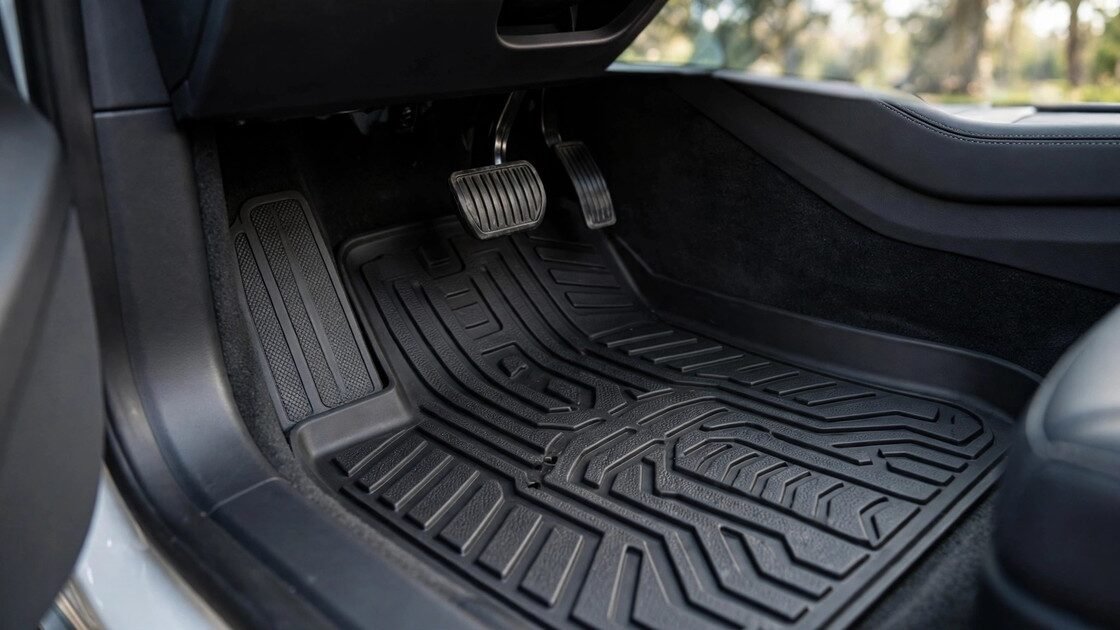
- Edge height and drainage. Look for raised edges of at least 2–3 inches and channels that move liquid toward the door side, not the seat rails.
- Retention and pedal clearance. Mats must lock onto the factory retention posts and sit flat with full pedal travel. A mat sliding forward under the accelerator is a safety hazard — check it before every drive for the first week.
- Warranty length. Lifetime (TuxMat, Husky) vs. 3 years (WeatherTech) vs. accessory terms (Tesla) tells you how confident the maker is. At $230, the warranty is part of what you're buying.
Mats belong to the small club of EV accessories that earn their keep — like portable EV chargers, charging adapters that unlock other networks, and window tint, which blocks the UV that fades dashboards while the mats handle everything coming in on shoes.
Frequently Asked Questions
Are Tesla's own all-weather mats worth it compared to aftermarket?
Yes, for most buyers — at $240 for the current Model Y they sit mid-market, not at a premium, and the fit is guaranteed for your exact year split. The aftermarket case is specific: TuxMat's higher side walls for heavy slush, or Husky's lower price with a lifetime guarantee.
Do all-weather floor mats actually increase resale value?
Not as a line item — no appraiser adds $240 for mats. What they do is preserve the carpet condition that shapes a buyer's first impression; one honest secondary assessment notes they won't "raise the selling price dramatically." Think of mats as protecting a few hundred dollars of perceived condition, not adding it.
Is TPE really better than rubber for floor mats?
For an EV daily driver, yes: lower odor in a sealed cabin and better cold-weather flexibility are the two honest advantages, and TPE is lighter and recyclable. For a garage-kept car in a mild climate, traditional rubber costs less and works fine.
Will pre-2025 Model Y mats fit the 2025+ Juniper refresh?
No — the Juniper refresh changed the interior footprint, which is why Tesla sells separate part numbers for 2020–2024 ($225) and 2025+ ($240). Filter listings by your exact model year, and avoid universal "2020–2026" claims.
Do I need all-weather mats if my EV is always garaged?
Probably not. Garaged cars in mild climates barely wear factory carpet, and the calculator will show a break-even of "never" with realistic inputs. Spend the money on something with a real return.
How do you clean all-weather EV mats?
Pull them out, hose them down, scrub with mild soap and a stiff brush for salt film, and let them dry fully before reinstalling — trapped moisture under a mat defeats the purpose. Skip silicone dressings: they make the surface slippery underfoot, the opposite of what a driver's mat should be.
The Short Version
All-weather floor mats are one of the rare EV accessories where the math is unambiguous: $70–$345 upfront against $150–$350 per avoided detail, with break-even typically inside 18 months for a daily driver. Buy TPE for low odor and cold-weather flexibility, match the set to your exact model year — the Juniper split catches careless shoppers — and compare prices on equal coverage, since per-row pricing hides the real totals. A $240 decision that protects a five-figure asset's interior: few accessories clear that bar.
Fitment caution: only use mats designed for your exact model and year, secured on the factory retention posts, with full and unobstructed pedal travel. A loose or sliding mat under the pedals is a genuine safety hazard — if a mat shifts, remove it before driving.
About the writer
Written by Shurah, who researches and writes independently on the real cost of EV ownership — charging, maintenance, and total cost of ownership — backed by primary data and original calculations rather than recycled lists.