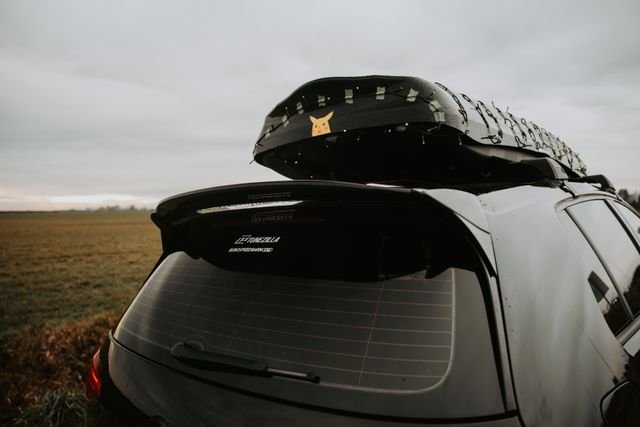
Two bikes on the roof of an EV don’t just add drag — at highway speed, a controlled test found they cut range by more than a Tesla loses in a genuinely cold winter.
AVILOO, a battery diagnostics company, ran a fixed 60km round-trip route in Vienna at night to strip out traffic and wind variables, testing a Volkswagen ID.4 at 75mph with no rack, a roof-mounted bike carrier, and a rear hitch-mounted carrier — each loaded with three 28-inch trekking bikes. The unloaded car returned 3.5 miles per kWh. With the roof rack loaded, that dropped to 2.3 miles per kWh: a 34% efficiency loss, and roughly 92 fewer miles of range on a full charge. The rear-mounted carrier barely moved the number.
That gap — roof versus hitch — is the entire article in one sentence, and almost nobody selling roof racks tells you about it.
The key numbers
- 34% — efficiency loss with a loaded roof bike rack at 75mph, controlled test
- 9% — the same test, same bikes, on a rear hitch-mounted rack instead
- 4x — how much worse a roof rack is than a hitch rack, for identical cargo
- 5–10% — drag increase from an empty roof rack, before anything is loaded onto it
- ~$32 a month — extra electricity cost from a loaded roof rack at average US driving and rates
- 4x — how much faster air resistance grows as speed doubles (it’s a square-law relationship, not linear)
Why this hits an EV harder than a petrol car
Roof racks slow petrol cars down too — Car and Driver’s own testing found a rooftop box cutting a Toyota Grand Highlander’s highway mileage from 25 to 21 mpg, a 16% loss, while a hitch carrier left it unchanged. But the effect is sharper on an EV, for a reason baked into physics rather than the car’s design.
Aerodynamic drag rises with the square of speed — double your speed and the drag force roughly quadruples. At the low speeds where most petrol cars post their best fuel economy, drag is a small share of total resistance next to rolling resistance and driveline losses. EVs are typically most efficient at moderate speeds too, but they carry far less rolling and mechanical loss to begin with, so drag makes up a proportionally larger share of what’s fighting the car at highway speed. Add a roof rack at 75mph and you are adding the one resistance an EV was least equipped to absorb.
What it costs you, in money
At the US average residential rate of 18.44 cents per kWh and 1,150 miles a month — the baseline used across our state-by-state charging cost guide — here is what the AVILOO numbers translate to:
| Configuration | Efficiency | Monthly electricity cost |
|---|---|---|
| No rack | 3.5 mi/kWh | $60.59 |
| Rear hitch rack, loaded | 3.2 mi/kWh | $66.27 |
| Roof rack, loaded | 2.3 mi/kWh | $92.20 |
The roof rack costs about $32 a month more than driving without one, and about $26 more than the hitch-mounted alternative carrying the identical bikes. That is not a one-off; it applies every highway mile the rack stays loaded.
Even an empty rack costs you something
You do not need cargo on top for the drag to start. Multiple independent measurements put an empty roof rack at a 5–10% drag increase on its own, before a single bike or box goes on it. On a typical 300–325 mile EV, industry testing cited by BGR found a bare rack cutting more than 35 miles of range, and a fully loaded one cutting over 90 — roughly 11% and 28% respectively.
The practical rule that follows directly from the physics: take the rack off when it is not in use. Not just the cargo box — the crossbars themselves. A rack sitting empty on the roof for months of commuting is a small, permanent tax on every highway trip for a feature you are using two weekends a year.
Speed matters more than almost anyone accounts for
Because drag scales with the square of speed, the range penalty from a roof load is not a fixed percentage — it grows sharply as you go faster. One tester’s back-to-back highway comparisons on a conventional car found a loaded roof rack costing about 10% at 55mph and over 20% at 75mph, on identical cargo. AVILOO’s own finding puts a number on just how steep that curve is: a driver used to cruising at 81mph would need to slow to 60mph — a 33km/h (about 20mph) drop — to match the energy consumption they’d get at 81mph with nothing on the roof at all.
That is a genuinely useful piece of practical advice hiding inside a physics finding: if you must run a roof-loaded EV on the motorway, slowing down does more for your range than almost anything else you can control — more than eco mode, more than climate settings, more than tyre pressure.
Speed matters even more than accessories: see why your EV loses so much range at highway speed.
Hitch rack versus roof rack: the choice that changes everything
If the AVILOO test proves one thing, it is that “roof rack” and “bike rack” are not the same purchase decision, and the format matters far more than the brand.
| Roof rack | Hitch/rear rack | |
|---|---|---|
| Range impact (2–3 bikes, highway) | ~34% loss | ~9% loss |
| Load height | High — awkward for shorter drivers, garage clearance risk | Low, easy to load |
| Access to rear hatch/boot | Unaffected | Often blocks it, depending on model |
| Requires | Roof rails or fitted crossbars | A tow hitch, which some EVs need retrofitted |
| Best for | Kayaks, cargo boxes, more than 2–3 bikes | 1–4 bikes, most everyday cycling use |
For the large majority of people who occasionally throw one or two bikes on the car, a hitch rack is the better answer on every axis that matters — range, ease of loading, and cost per mile. Roof racks earn their place for genuinely roof-shaped cargo: a cargo box, a kayak, a roof tent, or more bikes than a hitch rack can hold. If your EV does not already have a hitch and you are choosing between installing one and buying a roof rack purely for bikes, the maths above says get the hitch.
Aerodynamic crossbars: a real improvement, not a fix
Manufacturers sell shaped, low-drag crossbars — Thule’s WingBar Edge and Yakima’s JetStream among the better-known options — as an upgrade over plain square or round bars. Independent back-to-back testing on a conventional car found aerodynamic crossbars cutting the drag penalty roughly in half compared with basic bars, carrying identical cargo.
That is a genuine, worthwhile improvement, and worth the premium if you keep a rack mounted for extended periods. It is not a way around the underlying problem. Half of a 34% loss is still a 17% loss — better, not solved. The AVILOO test’s own framing is the right one to keep in mind: rear-mounted loads have a minimal effect regardless of bar shape, while anything on the roof is working against the car’s aerodynamics no matter how it’s packaged.
What actually changes the number, in order of impact
- Move the load off the roof if the cargo allows it. This is worth more than every other item on this list combined — a roughly 4x difference in the controlled test above.
- Remove the rack when not carrying anything. An empty rack still costs 5–10% in drag. If it lives on the car permanently for convenience, that convenience has a running cost.
- Slow down on the highway when loaded. Because drag scales with the square of speed, dropping from 75 to 65mph recovers meaningfully more range than any accessory choice below it.
- Choose aerodynamic crossbars if the rack stays mounted for weeks at a time. Worthwhile, but a partial fix rather than a full one.
- Load position matters too. Mounting bikes as far forward and low as the rack allows, and orienting cargo boxes to taper toward the rear, both reduce turbulence versus a boxy, high, rear-loaded profile.
Planning a trip with a roof rack fitted
Budget for the loss before you leave rather than discovering it at 40% battery on the motorway. If your EV normally does 300 miles, plan on roughly 200 with a loaded roof rack at typical highway speeds, and treat that as your real range for stop-planning purposes — not the number on the dash, which is calculated from recent driving and will overestimate what a rack-loaded highway stretch actually delivers.
The same aerodynamic penalty applies to fast-charging stops: a less efficient car covering the same trip needs more charging stops, and each stop takes charging-curve time on top of the driving time already lost to drag. Our charging time guide covers how charging speed and efficiency interact, and our public charging cost guide is worth a look before a trip where you know you’ll be stopping more often than usual.
Frequently asked questions
How much range do you lose with a roof rack?
In a controlled test, a loaded roof bike rack cut efficiency by 34% at highway speed, versus about 9% for the same bikes on a rear hitch rack. Even an empty roof rack costs roughly 5–10% in drag before anything is loaded.
Is a hitch rack better than a roof rack for an EV?
For carrying bikes specifically, yes, by a wide margin — roughly four times less range impact in controlled testing. Roof racks remain the right choice for cargo boxes, kayaks, or more bikes than a hitch rack can carry.
Do aerodynamic crossbars solve the range loss?
They roughly halve it compared with plain square bars, which is meaningful, but a 34% loss becoming a 17% loss is still a significant hit. They reduce the problem; they don’t remove it.
Should I remove my roof rack when not using it?
Yes. An empty roof rack still adds 5–10% drag, which is a permanent cost on every highway mile for a feature used occasionally. Removing crossbars entirely between uses is the better habit if your rack system allows it.
Does driving slower help with a loaded roof rack?
Significantly, because aerodynamic drag scales with the square of speed. One test found that matching the energy consumption of an unloaded car at 81mph required slowing to about 60mph with a roof rack loaded — a meaningfully bigger lever than most other efficiency habits.
How much does a roof rack cost me in electricity?
At average US driving and electricity rates, a loaded roof rack adds roughly $30 a month in charging cost compared with no rack, and about $25 more than the same cargo on a hitch rack, based on the efficiency figures above.
The short version
A loaded roof bike rack cut a test EV’s highway efficiency by 34% in a controlled comparison — the same bikes on a rear hitch rack cost only 9%. That is because aerodynamic drag rises with the square of speed, and an EV has less other resistance to dilute it against at highway speed than a petrol car does. If your cargo can go on a hitch instead of the roof, that single choice is worth more than every other efficiency habit combined. If it has to go on the roof, remove the rack when it’s empty, fit aerodynamic crossbars if it stays mounted for weeks at a time, and slow down on the motorway — dropping from 75 to 65mph recovers real range on a loaded rack in a way almost nothing else on this list does.