Can a Portable Power Station Charge Your EV? The Honest Math
The 30-Second Numbers
- ~3 miles of range from a 1kWh station (EcoFlow Delta 2 class, $999)
- ~6 miles of range from a 2kWh station (Jackery Explorer 2000 v2 class, $999)
- Your mobile charging cable pulls about 1.44kW — a 2kWh station is empty in roughly 90 minutes
- Many EV chargers refuse to start on a power station: no ground connection, no charge
- Cost per “rescue mile”: roughly $150–$300
Short answer: Yes, a portable power station can charge an EV, but the payoff is tiny. Plugged into your mobile charging cable, a 2kWh station holds enough energy for about five to seven miles of real range — and many chargers refuse to even start because the station has no proper ground connection. At roughly $1,000 for six miles, it is an expensive rescue tool. It makes sense as a home-backup box you already own, not as something you buy for your EV.
How the setup actually works
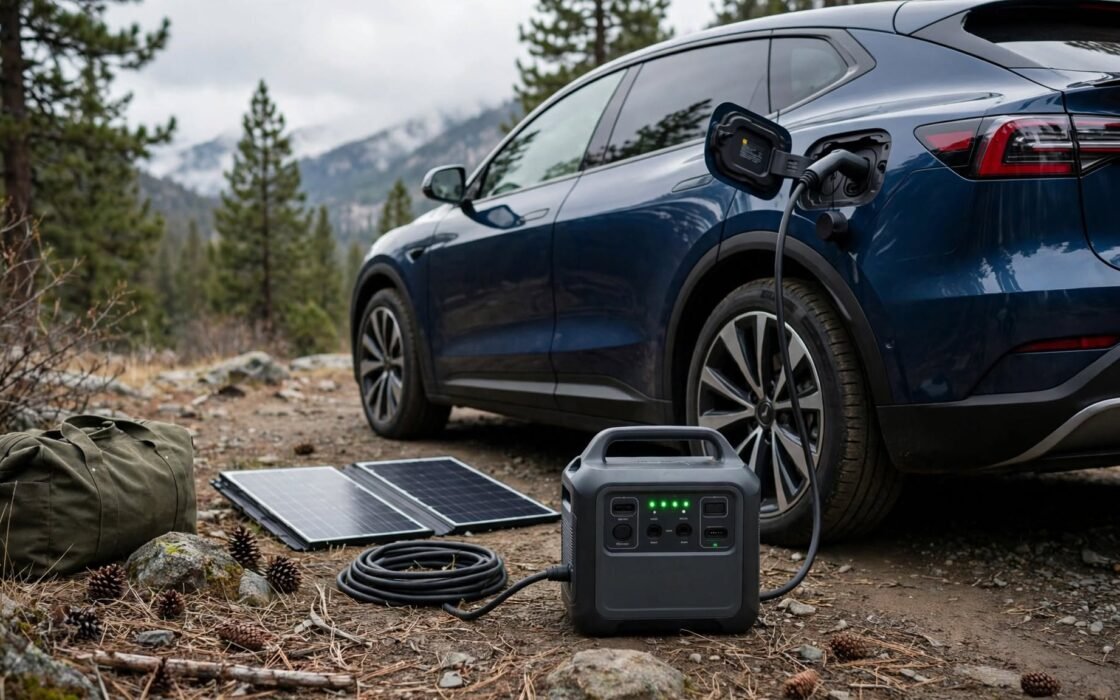
A portable power station is a big lithium battery with a built-in inverter and standard wall outlets. The idea is simple: plug your mobile EV charging cable (the one that came with the car, or an aftermarket portable EVSE) into the station’s 120V outlet, plug the other end into the car, and charge — the same as a wall outlet, just with a battery in between.
Three things have to line up for this to work:
- The station must output enough continuous power. A mobile connector on a standard 5-15 plug draws about 12 amps at 120V — roughly 1.44kW, nonstop, for as long as it runs. Most 1kWh-and-up stations are rated for 1,800W or more continuous, so this is fine, but cheap small stations can trip or overheat under a continuous load.
- The output must be pure sine wave. All three stations in the comparison below are. A modified-sine inverter can confuse an EVSE or the car’s onboard charger.
- The EVSE has to accept the power. This is where the plan usually dies, and it deserves its own section.
If you already carry a portable EV charger for travel, the cable side of this setup is covered — the station just replaces the wall outlet. The difference between this and ordinary Level 1 charging is only the power source.
The ground problem: why your charger may refuse to start
EV charging cables are paranoid about safety, and rightly so. Before an EVSE energizes the cable, it runs a ground check — it wants to see a proper earth/ground path back through the outlet. Portable power stations are floating, ungrounded devices. There is no earth rod, no panel, no neutral-ground bond. Plenty of owners have learned this the hard way: they plug in, and the charger blinks red and refuses to start.
This is a well-documented problem in the DIY solar community. Tesla’s Mobile Connector is especially strict — owner reports describe the red “ground fault” blink when running off inverters and power stations without a bonded neutral. Tesla’s own Wall Connector manual lists a “ground assurance fault” (two red blinks) as a condition that disables charging entirely, which tells you the ground check is a deliberate safety feature, not a bug. On forums, the common workaround is a neutral-ground bonding plug: a dummy plug that ties neutral to ground inside the station’s outlet, which satisfies the EVSE’s check (owner discussion on diysolarforum.com, secondary source).
Be careful here. A bonding plug tells the charger “all good” when there is no real earth connection. That check exists to protect you from a fault energizing the car’s body. If you go down this road, have a licensed electrician confirm the setup rather than trusting a $10 plug from the internet. Electrical safety is one of those places where a shortcut can hurt you, so treat any workaround as something to verify, not a given.
The math: how many miles does a station really hold?
Marketing math says a 2,042Wh station holds “2kWh, and your car does 4 miles per kWh, so that’s 8 miles.” The real number is roughly a quarter lower, because energy leaks out at every step. Here is the chain, with our own calculation spelled out:
- Station to AC outlet: the inverter is about 90% efficient. 2,042Wh becomes ~1,838Wh of usable AC.
- AC to battery: Level 1 charging is lossy. Our earlier analysis of Model Y home charging put losses at about 12%, and that was on a wired wall circuit — a station will not do better. 1,838Wh becomes ~1,617Wh stored in the battery.
- Battery to miles: a Model Y does about 4.1 mi/kWh in real-world testing (Green Cars Compare, secondary tracker). 1.617kWh × 4.1 ≈ 6.6 miles.
So the honest rule of thumb: a station delivers about 3–3.5 miles per kWh of its rated capacity, once conversion and charging losses are counted. There is a second reason Level 1 numbers look worse than the arithmetic suggests: at 1.44kW the car’s fixed overhead — computers awake, battery thermal management — eats a meaningful share of the incoming power. That is why real-world 120V charging lands around 3 miles per hour even though the raw math says 5+.
| Station (rated capacity) | Price class (US) | Energy reaching the battery* | Rescue miles (≈4.1 mi/kWh) | Time to drain at 1.44kW |
|---|---|---|---|---|
| EcoFlow Delta 2 class (1,024Wh, 1,800W) | ~$999 | ~0.81kWh | ~3.3 miles | ~40 min |
| Jackery Explorer 2000 v2 (2,042Wh, 2,200W) | ~$999 list | ~1.62kWh | ~6.6 miles | ~85 min |
| Anker Solix C2000 Gen 2 (2,048Wh, 2,400W) | ~$1,499 list | ~1.62kWh | ~6.6 miles | ~85 min |
| EcoFlow Delta 2 Max (2,048Wh, 2,400W) | ~$1,029 | ~1.62kWh | ~6.6 miles | ~85 min |
*Our calculation: rated Wh × 0.90 inverter efficiency × 0.88 Level 1 charging efficiency. Station specs from the manufacturers: EcoFlow Delta 2 Max and Jackery Explorer 2000 v2 (official pages); Anker Solix C2000 Gen 2 figures from launch coverage (secondary source). Prices are list prices and move constantly — treat them as examples, not quotes.
Now put a price on those miles. A $999 station buying you 6.6 miles works out to about $150 per rescue mile. The 1kWh class is worse: about $300 per mile. That is the number the ads never print.
Try it with your own numbers
Emergency-miles calculator
Enter your station’s rated capacity, your car’s efficiency, and what you paid. Defaults are examples only.
How the formula works. We start with the station’s rated watt-hours and apply two losses: 10% for the DC-to-AC inverter, then 12% for Level 1 charging overhead (matching our earlier Model Y charging-loss analysis). The surviving energy, in kWh, is multiplied by your car’s efficiency in miles per kWh. Drain time assumes the mobile connector’s standard 12A draw on a 120V outlet (1.44kW). Your car may do better or worse — efficiency swings with temperature, speed, and model — so treat the result as a planning number, not a promise.
When it actually makes sense (and when it doesn’t)
It makes sense if you already own the station. A 2kWh box you bought for home outages, camping, or a worksite is a perfectly good last-resort EV top-up. Six miles is the difference between reaching the next charger and calling a tow truck. In that role, the station costs you nothing extra, and the ground-bonding caveat is just something to test at home before you need it on the road.
It makes sense for off-grid trips. If you camp far from chargers, a station plus solar panels becomes a slow trickle charger for the car while you do other things. “Slow” is the operative word — a few hundred watts of solar buys you a couple of miles per hour at best — but over a weekend it adds up to real range.
It does not make sense as EV insurance you buy new. Spending $1,000+ to carry 40 pounds of battery for six miles of range is a bad trade. The same money buys years of roadside assistance, and a tow truck moves you ten miles in twenty minutes with zero ground-fault drama. Name the buyers who should skip it: anyone whose plan is “I’ll keep this in the frunk just in case.” The frunk space, the weight, and the self-discharge of a stored battery all work against you.
One more honest limit: none of these stations output 240V in the US, so you are stuck at Level 1 speeds. You cannot series two of them for 240V, and you should not try. If faster backup charging is the goal, a gas generator delivers far more energy per dollar — with noise, fumes, and fuel to deal with, which is exactly the trade-off that article walks through.
Better backup plans than a power station
| Option | What it buys you | Rough cost | Catch |
|---|---|---|---|
| Roadside assistance (AAA, insurer, automaker) | A tow to the nearest charger, sometimes mobile charging | $60–$120/yr (examples) | Wait time; coverage varies by plan |
| Portable power station (2kWh) | ~6 miles, self-serve | ~$1,000 one-time (example) | Ground-fault refusals; heavy; slow |
| Gas generator + mobile connector | Unlimited miles while fuel lasts | ~$500–$1,000 (example) | Noise, fumes, same grounding issue |
| Another EV with vehicle-to-load | A few miles from a friend’s car | Adapter ~$100–$300 (example) | Needs a willing friend nearby |
Frequently asked questions
Will charging from a power station damage my EV battery?
No. Slow AC charging is the gentlest kind of charging a battery can get — far easier on it than DC fast charging. The risk is not to the battery; it is the practical stuff: tripping the station’s overload protection, the grounding issue above, and draining the station faster than you expect.
Can I charge faster with a bigger or 240V power station?
Residential-class portable stations sold in the US output 120V only. A few large home-backup units can be wired for 240V, but those are installed systems, not something you toss in the trunk. For portable use, 1.44kW is your ceiling.
How long does it take to add those six miles?
The station drains in about 85 minutes at full draw, and the car gains range at roughly 3–4 miles per hour of charging. So: about an hour and a half of sitting with the cable plugged in for six miles. Plan a coffee stop, not a quick top-up.
Can solar panels refill the station while it charges the car?
Technically yes, practically no. A 400W panel setup in good sun adds energy at maybe a quarter of the rate the car draws it. It stretches the station’s runtime a little; it does not turn the setup into a meaningful charger. Overnight camping is the one scenario where the trickle matters.
Is a gas generator a better emergency charger?
On pure economics, yes: a generator holds far more energy per dollar and can run for hours. On everything else — noise, exhaust, fuel storage, maintenance — the battery station wins. Note the generator has the same grounding problem with EVSEs, so neither option is plug-and-play.
The bottom line
A portable power station is a legitimate piece of emergency gear that happens to be able to feed your EV — six-ish miles from a 2kWh unit, three from a 1kWh one, after real-world losses. What it is not is an EV accessory worth buying on its own. The cost per rescue mile is brutal, the ground-fault issue means you must test your exact charger-and-station combination at home first, and a roadside assistance plan covers the same emergency for a tenth of the price.
If you already own the box, by all means test the setup this weekend: plug in your mobile connector, see whether your charger starts or blinks red, and sort the grounding question while you are in your driveway — not on a dark roadside. That single dry run is worth more than any spec sheet.
Electrical work and EV charging involve real risk. If anything about grounding or adapters is unclear, have a licensed electrician confirm your setup before relying on it.
Charging speeds and range figures here are estimates from manufacturer specs and our own calculations; your car and conditions will differ.
Who wrote this
Written by Shurah, who researches and writes independently on the real cost of EV ownership — charging, maintenance, and total cost of ownership — backed by primary data and original calculations rather than recycled lists.