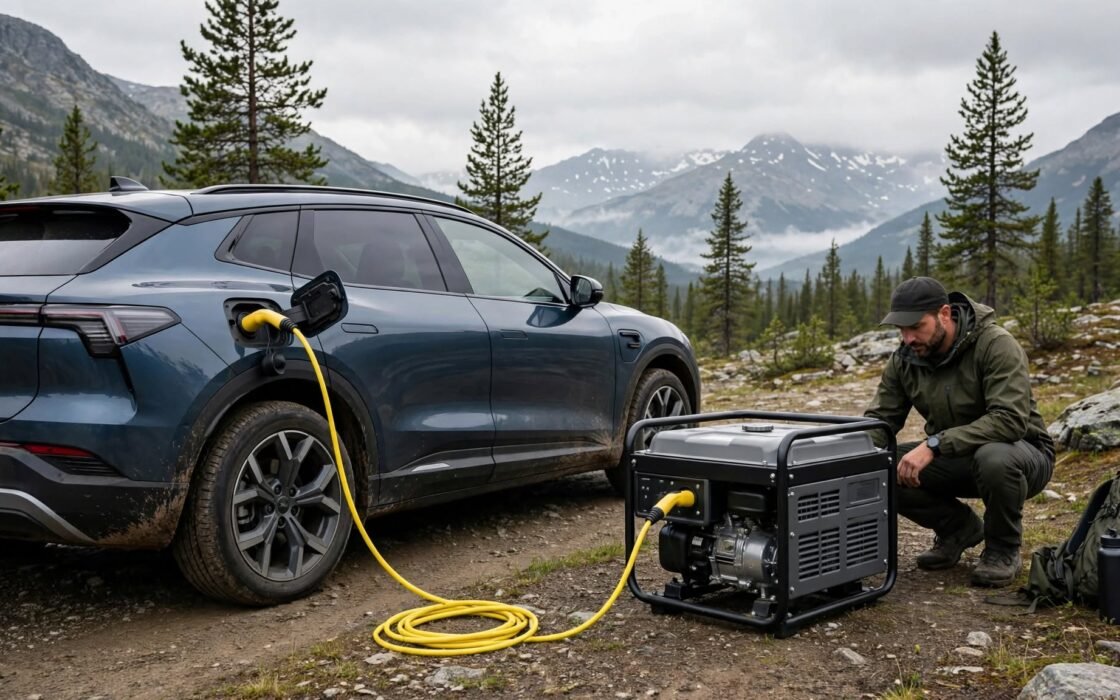
Could a portable generator stand in for a charger when the power is out, or keep an EV going on a camping trip far from any plug? People ask every storm season, and the honest answer has three parts. The charger may refuse the power. If it accepts it, the trickle is very slow. And the fuel math turns a 3.5-miles-per-kWh EV into something like an 18-mpg car.
The verdict
It can work, but it’s an emergency move, not a plan. Many inverter generators have a “floating” neutral, which a charger can read as a missing ground, so it refuses to start. Tesla’s Mobile Connector manual says not to use private generators at all. When it does work, a typical 2,200-watt generator adds roughly 4 miles of range an hour. Each gallon of gasoline turns into about 18 miles of driving.
Where the numbers land
- Tesla Mobile Connector on a 120V (5-15) outlet: 12A, 1.3 kW
- Honda EU2200i: 1,800 W rated, 3.2 hours at rated load on a 0.95-gallon tank
- Electricity per gallon, from those Honda figures: about 6 kWh at rated load, under 4 kWh at quarter load
- Range added per hour at 1.3 kW: about 4 miles (our worked example)
- Driving per gallon of gasoline: about 18 miles (our worked example)
- CPSC rule for running a generator: at least 20 feet from the house, never in a garage
- US deaths a year from generator carbon monoxide: about 85 (CPSC, 2017–2019 average)
Problem one: the charger may refuse
An EV charger isn’t a dumb plug. Before it sends any current to the car, it checks the supply, and one of the checks is whether the outlet is properly grounded. Tesla’s Gen 2 Mobile Connector manual lists a “ground loss” fault, signalled by two flashes, for exactly that case. It also says plainly: “Do not use private power generators as a power source for charging.”
Why would a working generator look ungrounded? In a house, neutral and ground are bonded together at one point, the main panel. Many portable inverter generators leave the neutral “floating,” meaning not bonded to the frame or ground, because they’re meant to plug into systems that already have their own bond, such as an RV.
RV electrical writer Mike Sokol explains it for RV owners. Many popular Honda and Yamaha inverter generators have floating neutrals, and Honda’s engineers confirmed it for the EU3000. A device that compares neutral with ground sees no bond and won’t connect. An EV charger running a ground check behaves the same way, and it shows up as a fault rather than a charge.
The workaround people use is a neutral-ground bonding plug, a small plug that joins the two inside the generator’s spare outlet. It’s common in the RV world, but it goes against what Tesla tells owners, and it makes the charger see a bond, not a true earth ground. We’re not recommending it. If you’re thinking about it, check your generator’s manual and talk to a licensed electrician first.
Contractor-style “open frame” generators are more often bonded from the factory, Sokol notes. That can get you past the ground check. It doesn’t make the setup something Tesla approves of.
Problem two: the fuel math
Suppose the charger accepts the power. How much driving does a gallon of gasoline buy? Generator makers don’t publish “kWh per gallon,” but you can work it out from the run times they do publish.
Honda’s EU2200i spec sheet gives 1,800 W rated output, 3.2 hours at rated load, and a 0.95-gallon tank. That’s 1.8 kW × 3.2 h = 5.76 kWh from 0.95 gallons, or about 6.1 kWh per gallon. At quarter load the same sheet says 8.1 hours, which works out to 0.45 kW × 8.1 h = 3.6 kWh, or about 3.8 kWh per gallon. A lightly loaded generator wastes more fuel for every kWh it makes.
The bigger Honda EU7000is, per Equipment World’s spec report, is rated 5,500 VA with a 5.1-gallon tank. It runs about 6 hours at rated load and an estimated 18 at quarter load. That gives roughly 6.5 kWh per gallon flat out and 4.9 at quarter load.
Then come two more losses. Some energy is lost between the plug and the battery. Our Model Y charging cost analysis found about 12% lost in home charging. We assume 15% here, because a slow charge keeps the car’s electronics awake for longer. Finally the car turns kWh into miles. We use 3.5 miles per kWh as a round example.
| Generator and load | kWh per gallon | Miles per gallon of gasoline* |
|---|---|---|
| EU2200i, rated load (1.8 kW) | 6.1 | 18 |
| EU2200i, quarter load (0.45 kW) | 3.8 | 11 |
| EU7000is, rated load (5.5 kVA) | 6.5 | 19 |
| EU7000is, quarter load (1.4 kVA) | 4.9 | 14 |
*Our calculation: kWh per gallon × 85% charging efficiency × 3.5 miles per kWh. The kWh figures come from the makers’ rated-load and quarter-load run times. Real results will vary with temperature, altitude and generator condition.
So the best case is around 18–19 miles per gallon. The EV hasn’t become inefficient. A small gasoline engine turning a generator just isn’t a very efficient way to make electricity. You’re paying for every gallon and then losing more at the charger.
The cost follows from that. With about 6 kWh per gallon, each kWh costs roughly your gas price divided by six. At $3 a gallon that’s 50¢ per kWh. At $4 it’s about 67¢. That’s fast-charger money, not home-charging money: the big fast-charging networks we tracked in August 2026 charged from the mid-50s to the mid-60s in cents per kWh, as our public charging cost guide shows.
Problem three: it’s slow
A small generator can only feed a Level 1 charge. Tesla’s manual lists 12A and 1.3 kW for its 120V adapter. That’s about 72% of the EU2200i’s 1,800 W rating, which is reasonable headroom. Put it through the same losses and you get about 1.3 × 0.85 × 3.5 ≈ 4 miles of range per hour. A tank lasts roughly four hours at that load, so each tank is worth something like 15–17 miles.
Level 2 needs a 240V generator with real capacity. The rule we’d apply is the same 80% continuous-load margin the electrical code uses for EV chargers, explained in our home charger sizing guide. For a 5,500 VA generator that means at most about 4.4 kW, so set the charger to 16–18A rather than 32A. At 16A (3.8 kW) you’d add about 11 miles an hour and burn about 0.6 gallons an hour. One 5.1-gallon tank then gives roughly 100 miles.
Many EVs and chargers let you lower the charging current in the car’s settings or the app. That’s the main control you have for keeping the load inside what the generator can supply. The formula behind all of these figures is in our guide to how long it takes to charge an EV.
Run your own numbers
Find your generator’s rated output, run time at rated load and tank size on its spec sheet. Enter the charging power you’ll draw and your local prices. The gas and electricity prices are filled in as examples only, so change them to yours. The tool works out kWh per gallon from the rated-load figures. Those are the generator’s best case, so it warns you when your load is too light or too heavy for that to hold.
Generator charging calculator
Defaults are the Honda EU2200i’s published figures, Tesla’s 1.3 kW 120V charging rate, and example prices. Swap in your own.
The arithmetic, so you can check it: kWh per gallon = rated kW × hours at rated load ÷ tank gallons. Miles per gallon = that × charging efficiency × your miles per kWh. Range per hour = charging kW × efficiency × miles per kWh. The light-load warning comes from Honda’s own figures, which show the EU2200i making about a third less electricity per gallon at quarter load than at full load.
Running one safely
The CPSC estimates about 85 people die each year in the US from carbon monoxide from gasoline-powered portable generators. Its safety guidance is to run a generator only outdoors, at least 20 feet from the house, with the exhaust pointed away from doors and windows. Never run one in a garage, basement, shed or on a porch. That rules out the obvious setup, with the car in the garage and the generator just outside.
The distance creates a second conflict. A generator 20 feet from the house usually needs a long cord to reach anything, and Tesla’s connector manual also says not to use extension cords. Our guide on charging an EV with an extension cord explains why. In practice that means parking the car outside next to the generator, in the open, well away from the house.
Carbon monoxide has no smell and can kill within minutes, so never run a generator in or near an enclosed space. Use battery CO alarms in the home and get any bonding or wiring changes checked by a licensed electrician.
When it actually makes sense
Despite all that, there are a few honest uses:
- Getting out of a jam. A few hours on a small generator can add the 10–20 miles needed to reach a working charger after an outage. That’s the realistic best case.
- Off-grid sites you visit often. If you regularly park somewhere with no power, a properly sized 240V generator charging at 16A adds a meaningful amount overnight. It’s still at fast-charger prices, though.
- Keeping the car’s battery from dropping too low. During a long outage, a little charge is enough to stop the battery sitting near empty.
Prefer batteries over fuel? See whether a portable power station can charge your EV — the honest math on rescue miles.
It doesn’t make sense as everyday charging, or as a reason to choose an EV for somewhere without power. If the worry is outages, our vehicle-to-home guide covers the opposite direction: the car powering the house.
Quick questions
Will charging from a generator damage my EV?
We haven’t found manufacturer data showing damage from generator charging. The charger’s own checks block many supply problems, which is exactly why it refuses some generators. The bigger risks are carbon monoxide and setups that get around those checks. Tesla says not to use private generators. Your own car’s manual is the only way to know your maker’s position.
Do I need an inverter generator?
Inverter generators are popular for this because they’re quiet and compact. But many of them have the floating neutral that makes chargers refuse, so “inverter” doesn’t mean “will work.” Check how your model handles neutral and ground before you depend on it.
What size generator do I need?
For Level 1, a generator rated around 1,800 W or more running 1.3 kW keeps you near 72% load. For Level 2, you need a 240V output, and the charging current should be set so the load stays at about 80% or less of rated output. That’s 16–18A on a 5,500 VA unit.
Is it cheaper than a gas car?
Rarely. About 18 miles per gallon in the best case is worse than many gasoline cars manage. It’s a way to get moving, not a way to save money.
The takeaway
A generator can charge an EV, but slowly, expensively, and only if the charger accepts its power. Expect about 4 miles an hour on a small unit, about 18 miles per gallon at best, and a cost per kWh close to fast-charger prices. Keep it for real emergencies. Run it outdoors and well away from the house, and treat any ground or neutral fix as a job for an electrician.
About the author
Written by Shurah, who researches and writes independently on the real cost of EV ownership — charging, maintenance, and total cost of ownership — backed by primary data and original calculations rather than recycled lists.