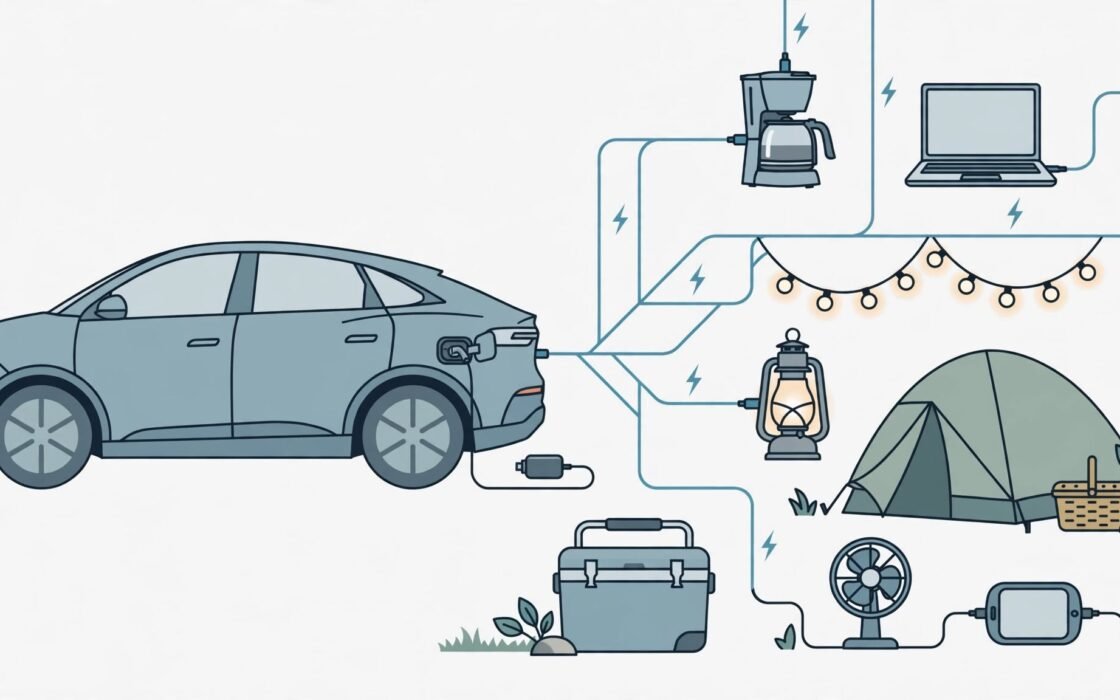
Picture this: you’re at a campsite, or a job site with no outlet in sight, and your EV is sitting there with 60+ kWh unused. A small adapter turns your charging port into a wall outlet. That’s the pitch behind Vehicle-to-Load, and it’s mostly true — but the number on the box and the number you actually get to use aren’t the same thing.
Key Figures
- A Hyundai/Kia V2L adapter plugs into the charge port and outputs up to 15A/120V — about 1.8 kW — even though the car’s total V2L rating is often quoted as 3.6 kW.
- Ford’s F-150 Lightning needs no adapter at all: its Pro Power Onboard system delivers up to 9.6 kW through built-in outlets in the frunk, cab, and bed.
- Chevy Silverado EV / GMC Sierra EV: 7.2 kW through built-in outlets, or up to 10.2 kW with the optional Power Bar accessory.
- Not every EV gets meaningful V2L: the Cadillac Lyriq offers just one outlet at 150W, and the Hummer EV two outlets totaling 400W.
- The official Hyundai adapter runs about $550; a third-party equivalent (Lectron) with the same 1.8 kW output runs $130-185.
- Safe practice is to stay under about 80% of the rated output continuously, per Clean Energy Reviews’ V2L explainer.
Quick answer: V2L adapters let your EV act as a portable power source through its charge port, but most passenger EVs cap out around 1.8-3.6 kW — enough for tools, a fridge, or camping gear, not a house. Trucks like the F-150 Lightning and Silverado EV go much higher (7-9.6 kW) through built-in outlets that need no adapter. The accessory itself costs $130-550 depending on brand and whether you go OEM or third-party.
V2L vs. V2H: Two Different Things Wearing Similar Names
It’s easy to conflate this with our V2H coverage, but they solve different problems. V2H is whole-home backup: it needs dedicated hardware, an electrician, and typically $5,000-15,000 in installation. V2L is the opposite — a portable accessory you plug in wherever you happen to be, with no installation at all. Think generator replacement, not home backup system.
What Each EV Actually Delivers
| Vehicle | Output | How you access it |
|---|---|---|
| Ford F-150 Lightning | Up to 9.6 kW | Built-in outlets (frunk, cab, bed) — no adapter needed |
| Chevy Silverado EV / GMC Sierra EV | 7.2 kW (10.2 kW with Power Bar) | Built-in outlets, optional charge-port accessory |
| Hyundai Ioniq 5/6, Kia EV6 | Up to 1.8 kW per adapter (vehicle rated to 3.6 kW total) | Charge-port adapter (OEM or third-party) |
| Cadillac Lyriq | 150W | Single built-in outlet |
| Hummer EV | 400W combined | Two built-in outlets |
That gap between “vehicle rated to 3.6 kW” and “adapter outputs 1.8 kW” is worth sitting with. Per CleanTechnica’s coverage of the Hyundai dongle, the standard 120V adapter is limited to 15A — 1.8 kW — regardless of what the car’s total V2L capability is quoted at elsewhere. You’d need a different setup entirely to pull the full 3.6 kW. If a listing or forum post quotes the bigger number, that’s the vehicle’s ceiling, not what the $550 accessory in your hand delivers.
What 1.8 kW to 9.6 kW Actually Runs
A rough guide, so the kW numbers mean something:
- Under 500W: laptop, phone chargers, small fridge, lighting — the Lyriq/Hummer range
- 1-2 kW: a full-size fridge, a drill, a projector and speakers — what a Hyundai/Kia adapter covers
- 3-4 kW: a window AC unit, a space heater, a decent power tool combo
- 7-9.6 kW: a job site running multiple tools at once, or most of a small home’s essential circuits during an outage — Lightning/Silverado EV territory
Is It Worth It Over a Generator or Power Station?
Here’s where the accessory earns its keep. A 3,000W gas generator runs $300-800 plus fuel, fumes, and noise. A comparable-capacity Jackery or EcoFlow power station with 1-2 kWh of storage runs $800-2,000 — and that’s a fraction of what’s sitting in your EV’s pack already. A $130-185 Lectron adapter (or the $550 OEM version) unlocks access to 60-100+ kWh you already paid for, silently and with no fumes. The trade-off is portability in the other direction: you’re bringing the whole vehicle, not a 30-lb box.
The honest caveat: pulling meaningful power does draw down your battery, and running it for extended periods burns range you might want for driving. Treat it as “free” power only in the sense that the hardware cost is low — the energy itself still comes out of your next charge.
Using It Safely
A few things worth confirming before you rely on this for anything important, per the general V2X safety guidance summarized on Wikipedia and vehicle-specific sources:
- Stay under roughly 80% of the rated continuous output — pushing right to the stated max risks tripping the vehicle’s internal protection or overheating the adapter.
- Official adapters are typically brand- and model-specific (a Hyundai/Kia adapter won’t work on a Ford or a GM truck) — check compatibility before buying.
- Some setups can trip household GFCI/RCD safety circuits if you try to feed V2L output back into home wiring informally — that’s a V2H job, not a V2L one.
- Confirm your specific trim actually includes V2L — it’s sometimes an option, not standard, even within the same model line.
Calculate Your Runtime
Using our amp/kW math from the home-charger sizing piece, here’s the same logic applied to V2L output:
How Long Could You Run a Device?
FAQ
Does using V2L void my EV’s warranty?
Not for using a manufacturer-approved adapter as intended. Using an incompatible third-party adapter, or exceeding the rated output, is the kind of misuse that could complicate a warranty claim — stick to what your owner’s manual specifies.
Can I power my whole house with a V2L adapter?
Not safely or practically. That’s what V2H hardware is for. V2L is built for portable, single-device or small-multi-device loads, not a home’s electrical panel.
Do I need the expensive OEM adapter, or is third-party fine?
For the same output spec (1.8 kW/15A on Hyundai/Kia platforms), a reputable third-party adapter like Lectron’s performs the same function at a third of the price — you’re mainly paying extra for the OEM’s cord-lock feature and brand backing.
Will running V2L drain my 12V battery too?
No — V2L draws from the main traction battery, not the 12V auxiliary battery. That’s a separate system entirely.
Does every EV trim come with V2L, or is it optional?
It varies by manufacturer and sometimes by trim level within the same model — always confirm your specific configuration includes it before assuming you can buy an adapter and go.
Where This Leaves You
V2L is a genuinely useful accessory, not marketing vapor — but the number that sells the feature (3.6 kW, 9.6 kW) is often bigger than what the actual adapter in your hand delivers. Match the vehicle and adapter to what you actually plan to run, budget $130 on the low end or $550 for OEM peace of mind, and treat it as generator-replacement, not home-backup.
About the author: Written by Shurah, who researches and writes independently on the real cost of EV ownership — charging, maintenance, and total cost of ownership — backed by primary data and original calculations rather than recycled lists.