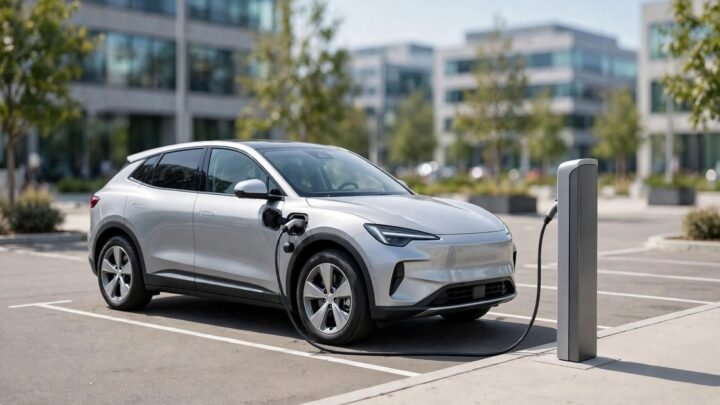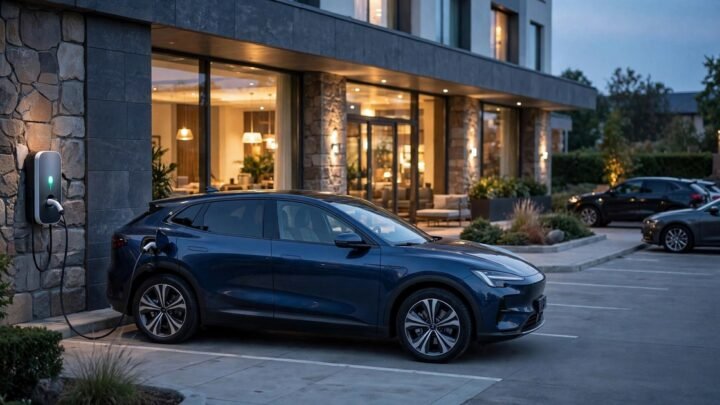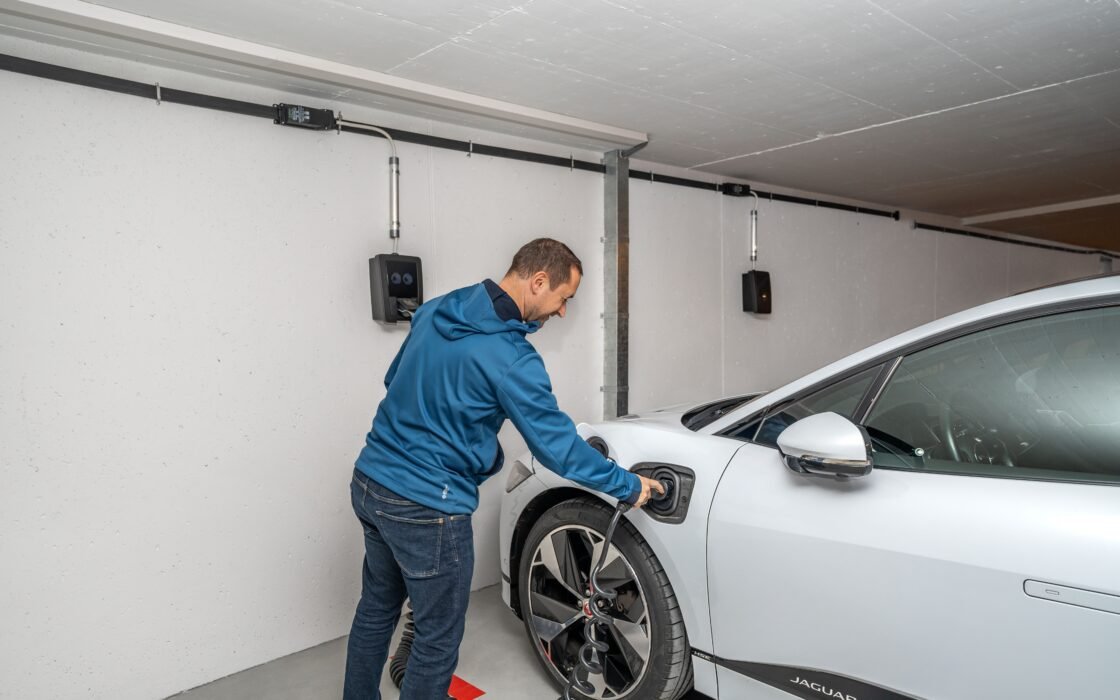
Your EV came with a charging cable in the boot. It plugs into any ordinary wall socket, it works, and it cost you nothing. Then you plug in overnight, wake up, and the battery has crawled from 40% to 65% — and every forum, dealer and charger company tells you the same thing: you need a Level 2 charger.
Maybe you do. But a lot of people spend $1,500 solving a problem they never actually had. This guide gives you the arithmetic to find out which group you’re in, and a four-night test that answers it for free before you call an electrician.
What Level 1 actually is
Level 1 is the cable that shipped with the car. It plugs into a standard three-prong 120-volt outlet and draws around 12 amps, which works out to roughly 1.4 kW going into the battery. There is no installation, no permit, no electrician and no hardware cost, because you already own it.
The US Department of Energy puts the practical result at about 3 to 5 miles of range per hour. Its own benchmark: eight hours on a 120V outlet replenishes roughly 40 miles of range in a mid-size EV.
The catch is not the speed. It’s the circuit. A Level 1 charge is a continuous load running for ten or twelve hours straight, and a lot of older garage outlets share a circuit with other rooms. Share that line with a freezer or a workshop tool and the breaker will eventually trip — usually at 3am, usually on the night you needed the range.
Put a number on it before you dismiss it: a standard socket adds about 40 miles overnight, which is slightly more than the average American drives in a day.
What Level 2 actually is
Level 2 runs on a dedicated 240-volt circuit, the same kind of supply feeding an electric dryer or range. It arrives either as a hardwired wallbox or as a plug-in unit on a NEMA 14-50 outlet, and most home units deliver somewhere between 7.2 and 11 kW.
In range terms that is roughly 25 to 40 miles per hour, depending on the car’s onboard charger and the amperage of the circuit. A 48-amp station refills a 75 kWh pack from 20% to full in about five to six hours — plug in at 7pm, done by midnight, and the charger sits idle for the rest of the night.
The overnight arithmetic
A car parked from 7pm to 7am gets twelve hours. At Level 1 speeds that is 36 to 60 miles put back into the battery every single night.
| Your daily miles | Is Level 1 enough? | What actually happens |
|---|---|---|
| Under 35 | Yes, comfortably | You gain range every night. Battery drifts upward across the week. |
| 35–50 | Usually | Roughly break-even. Winter and a long Saturday will eat your buffer. |
| 50–70 | Marginal | You lose a little every night. Fine for a week, not for a month. |
| Over 70 | No | You fall behind by Wednesday and end up at a public charger. |
Set against that, the national average driving distance is 19.9 miles per day — 24.3 in rural areas, 17.8 in dense urban ones. Most drivers, most days, are nowhere near the line where Level 1 breaks down. One seasonal caveat: consumption rises in the cold, so a car that keeps pace comfortably in July can fall slightly behind in January. See why EV range drops in winter for how much margin to allow.
The four-night test
Before spending anything, run this. It costs nothing and it answers the question with your car, your driving and your house rather than an average.
- Monday evening: plug in on Level 1 when you get home. Write down the battery percentage.
- Tuesday morning: write down the percentage before you unplug. The difference is what your outlet actually delivers overnight — not what a spec sheet claims.
- Repeat for four nights, driving normally. Don’t change your routine to make the numbers look good.
- Friday morning: compare Friday’s starting percentage with Monday’s. Higher means Level 1 covers your life. Lower means you now know exactly how much you’re losing per week.
When Level 2 is genuinely worth it
Five situations where the upgrade earns its money rather than just feeling good:
- You regularly drive more than 50 miles a day. Level 1 cannot keep pace, and you will end up buying expensive public charging instead.
- Your utility has time-of-use rates. Cheap overnight windows are often only four to six hours long. Level 1 cannot fit a meaningful charge inside that window; Level 2 can, and the savings are real and recurring.
- You have a large battery. A 100 kWh pack that has run low takes several days to recover on Level 1. That turns one bad week into a fortnight of anxiety.
- Your driving is unpredictable. If you can’t tell on Monday what Thursday looks like, the buffer is worth paying for.
- Two EVs, one house. Level 1 for two cars almost never works.
Notice what is not on that list: “because it’s better.” It is faster. Faster is only worth money when slow is costing you something.
And if you have no plug where you park at all, that’s a different problem — see our guide to owning an EV in an apartment.
For backup power on the go, we worked out how many miles a portable power station really adds to an EV.
What Level 2 actually costs
Hardware runs from a few hundred dollars upward, and a complete installation commonly lands between $800 and $2,700. It swings on things you can check before getting a quote: the distance from your electrical panel to the parking spot, whether the panel has spare capacity, and whether your local authority requires a permit and inspection. We break every line item down in our guide to home EV charger installation cost. For the hardware itself, see our picks for the best home EV chargers under $500.
Get the panel checked first. A service upgrade — if your panel is full or undersized — is the single item most likely to turn a modest job into a large one, and it is the thing quotes most often leave out until the electrician is standing in your garage.
The thing Level 2 does not do
It does not make your electricity cheaper. Both levels draw from the same meter at the same residential rate, so the cost per mile is identical. At the EIA’s US residential average of about 18.6 cents per kWh, that’s roughly $5 to drive 100 miles whether the power arrives at 1.4 kW or 11 kW.
The one genuine cost advantage of Level 2 is indirect: it lets you fit a full charge inside a cheap off-peak window. If your utility charges a flat rate all day, that advantage doesn’t exist for you, and Level 2 buys you convenience only.
The short version
If you drive under 35 miles a day and park at home overnight, the cable in your boot is very probably all you need — and the four-night test will prove it in a week. If you drive over 50, or your utility rewards off-peak charging, Level 2 pays for itself in avoided public charging and cheaper kilowatt-hours.
Between those two, run the test. It is free, it takes four mornings, and it is the only piece of data in this entire decision that describes your actual life instead of an average.
If you do move up to Level 2, a portable unit caps out at 40 amps — and needs a receptacle most electricians will not fit by default.
Sources
US Department of Energy / Alternative Fuels Data Center — charging levels and range-per-hour benchmarks. National Household Travel Survey — average daily driving distance. US Energy Information Administration — average residential electricity price. Installation cost ranges reflect commonly reported 2026 US figures and vary by panel condition, run distance and local permitting.