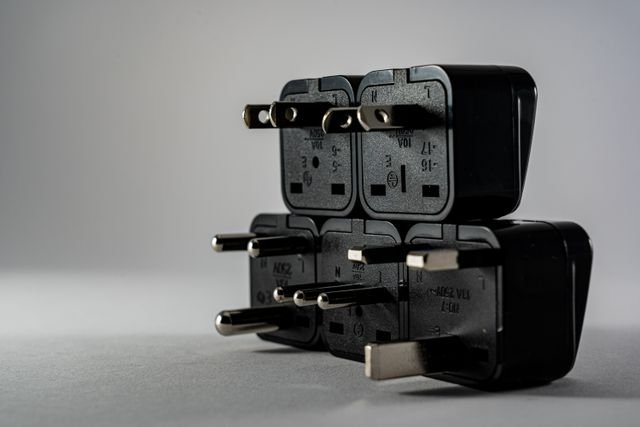
Buy the wrong EV adapter and you will not find out at home. You will find out at a Supercharger, 200 miles from anywhere, holding a plug that physically fits and refuses to start a session.
This happens constantly, and the reason is that there are four different adapters in common use, they all connect a Tesla-style plug to a non-Tesla car or the reverse, and the industry names them so similarly that two of them are routinely sold under nearly the same title. One brand’s own catalogue lists a “NACS to CCS Adapter” and a “CCS to Tesla (NACS) EV Adapter” — those are opposite products for opposite cars.
Here is how to work out which one you need, what the real prices are, and the certification detail that separates a safe adapter from a melted one.
The key numbers
- 4 — distinct adapters in common use, two AC and two DC
- $0 — what most owners of a 2024-or-newer EV should pay, because the automaker ships one
- UL 2252 — the DC fast-charging safety standard to demand by name
- $150–$250 — realistic range for a certified DC adapter, August 2026
- 500 A / 1,000 V — the rating a DC adapter needs to avoid throttling at a V3 or V4 stall
- 25,000+ — Supercharger stalls a DC adapter opens up to a CCS car
Start here: you probably should not buy one
Before anything else, check whether you already have one coming. Two situations mean you buy nothing:
Your car has a NACS port from the factory. Most 2025 and 2026 models from Hyundai, Kia, Genesis, Lucid, Rivian, Nissan, Chevrolet and others now ship with the NACS inlet, the connector standardised as SAE J3400. Those cars plug directly into a Supercharger. For CCS stations they need an adapter in the other direction, and many ship with one.
Your automaker is supplying one. Ford, GM, Rivian, Hyundai, Kia, Polestar, Volvo and several others have shipped free NACS adapters to owners of eligible CCS cars as part of gaining Supercharger access. Check your brand’s owner portal before buying anything, and cross-check station types on the Department of Energy’s Alternative Fuels Data Center map. This matters beyond the money: automakers publish approved-adapter lists, and a DC adapter that is not on your brand’s list can simply fail to negotiate a session at the station.
Every Tesla, meanwhile, already comes with a J1772-to-NACS adapter in the boot for Level 2 AC charging. If you have lost it, a replacement is far cheaper than a DC adapter — they are not the same product and not interchangeable.
The four adapters, and why the names mislead
The naming convention nobody agrees on is whether the adapter is named for the plug it accepts or the car it serves. That single ambiguity causes most wrong purchases. Work from this table instead, which names them by what you drive and where you are trying to charge.
| You drive | You want to charge at | What you need | Type |
|---|---|---|---|
| CCS1 car (most 2018–2024 non-Teslas) | Tesla Supercharger | NACS plug → CCS1 car adapter | DC |
| Tesla or NACS-port car | Electrify America, EVgo, ChargePoint DC | CCS1 plug → NACS car adapter | DC |
| Tesla or NACS-port car | Any Level 2 public or home charger | J1772 plug → NACS car adapter | AC |
| CCS1 car | Tesla Destination charger / Wall Connector | NACS plug → J1772 car adapter | AC |
The two rules that prevent almost every mistake:
- A Supercharger adapter and a Tesla Destination charger adapter are different products. Destination chargers are Level 2 AC, the same class as a home wallbox. Superchargers are DC. An AC adapter at a Supercharger does nothing.
- Direction matters more than the brand names in the title. Before you buy, say out loud: “the cable at the station ends in X, my car’s port is Y.” The adapter you want converts X to Y.
The certification detail almost nobody explains
For a DC adapter, the standard you want is UL 2252. AC adapters fall under UL 2594 or equivalent. This is not a nice-to-have. A DC adapter carries up to 500 amps through a hand-held plastic housing, and uncertified units built with thin pins and inadequate temperature sensing have overheated and melted in service.
But there is a subtlety worth more than every other tip in this article. Look closely at how a product describes itself, because “UL 2252 compliant” and “UL 2252 certified” are not the same claim. Compliant means the manufacturer says it meets the standard. Certified means an independent laboratory tested it and says so.
This is not a theoretical distinction. Lectron, one of the largest third-party brands, sells two very similar DC adapters — and its own product pages describe the cheaper Vortex Plug as adhering to UL 2252 design standards, while the Vortex Plus is described as carrying official UL 2252 certification by SGS, an independent testing house, plus an automaker-approved automatic interlock. Same brand, same catalogue, different level of proof. Read the wording, not the badge graphic.
Two more hardware details worth checking:
- Temperature sensing. Better adapters carry two sensors — one that derates the charging current as heat builds and a second that stops the session outright. A2Z’s DC adapters, for instance, describe exactly this two-stage arrangement.
- The latch. The station’s plug latches to your car; the adapter sits in between. Some adapters add their own lock so nobody can pull the assembly out mid-session. At an unattended urban station that is worth paying for.
What they actually cost
Prices as listed on the manufacturers’ own sites in August 2026. Adapter pricing moves a lot — discounting is aggressive in this category — so treat these as the current shape rather than a fixed rate.
| Adapter | Type | Listed price | Notes |
|---|---|---|---|
| Lectron Vortex Plug (NACS plug → CCS car) | DC | $169.99 (list $249.99) | 500 A / 1,000 V, manual locking latch |
| Lectron Vortex Plus (NACS plug → CCS car) | DC | Higher tier | SGS-certified UL 2252, automatic interlock |
| Lectron NACS → J1772 (AC) | AC | $149.99 | 240 V / 80 A |
| Tesla official CCS Combo 1 adapter | DC | Reported around $230–$250 | Check Tesla’s shop; older cars may need a retrofit |
| Unbranded listings | DC | $25–$60 | Avoid. This is where the failures come from. |
The gap between a $40 listing and a $170 one is not margin. It is copper cross-section, contact plating, thermal sensors and a test report. On a component that sits in your hand at 500 amps, that is the wrong place to save $130.
Will an adapter void your warranty?
You will find both answers online, stated with equal confidence. The honest version sits in between.
Under the Magnuson-Moss Warranty Act, a manufacturer cannot void your entire vehicle warranty simply because you used an aftermarket accessory. That protection is real, and adapter sellers cite it correctly.
What it does not do is make the automaker liable for damage the adapter causes. If a non-approved adapter overheats and damages your charge port or onboard charger, the manufacturer can decline that specific repair and point at the adapter — and it will be their engineers examining the melted part. That is why brands maintain approved-adapter lists, and why buying from that list is worth more than any legal argument. AC adapters are far less restricted than DC ones, because the currents involved are an order of magnitude lower.
A non-approved adapter is one of the quieter causes of a session that simply refuses to start.
Five checks before you buy
- Check your automaker’s owner portal first. Free adapters are still being distributed, and the approved list tells you what will actually negotiate a session.
- Confirm AC or DC. Superchargers and Electrify America stalls are DC. Destination chargers, workplace chargers and your garage are AC. The wrong type is a total loss, not a compromise.
- Demand UL 2252 by name for anything DC, and read whether the listing says certified or merely compliant.
- Check the rating: 500 A and 1,000 V. Anything lower can throttle you on a V3 or V4 stall, which defeats the purpose of fast charging.
- Buy where you can return it. Compatibility between a specific car and a specific charger cabinet is not always clean, even with an approved adapter. A 30-day return policy is part of the product.
Does an adapter slow your charging down?
A properly rated one does not. A 500 A / 1,000 V adapter is specified well above what any current public charger delivers — V3 and V4 Superchargers top out around 250 kW, and most CCS stations sit below that. The limit on your charging speed is your car’s battery, its state of charge and the ambient temperature, not the adapter in between.
What an adapter cannot do is exceed your car’s own capability. A vehicle that peaks at 150 kW peaks at 150 kW at a Supercharger too. If you want a sense of how that plays out in practice, our breakdown of charging a Hyundai Ioniq 5 walks through what an 800-volt car actually achieves.
Is it worth it financially?
This is the question the adapter reviews never ask. A DC adapter is a $170 purchase that buys you access, not cheaper electricity — so whether it pays depends on which network it opens up.
For a CCS driver, an adapter unlocks over 25,000 Supercharger stalls. That is worth having for coverage alone. On price it is roughly neutral: Tesla’s standard rate averaged 60.1 cents per kWh in August 2026 against Electrify America’s 61.7 cents and EVgo’s 64.1. The networks are within four cents of each other at default rates, so nobody should buy an adapter expecting to save money on energy.
Where it does pay is reliability and availability — more stalls, shorter queues, fewer broken chargers on a route. And if you take Tesla’s paid membership, the member rate of 43.3 cents becomes the cheapest widely available fast charging in the country, at which point a $170 adapter pays for itself in a few thousand miles of road-tripping. Our public charging cost guide covers where the memberships break even.
For most people, though, the adapter is a road-trip insurance policy that lives in the boot and gets used four times a year. That is a perfectly good reason to own one. It is just not a saving.
Frequently asked questions
Which adapter do I need for a Tesla Supercharger?
If you drive a CCS1 car, you need a DC adapter that accepts the Supercharger’s NACS plug and fits your CCS port. It must be DC-rated and on your automaker’s approved list. An AC adapter will not work at a Supercharger.
Can I use one adapter for everything?
No. AC and DC adapters are separate products, and the two directions are separate again. Most owners end up with one or two, not all four.
What does UL 2252 mean?
It is the safety standard covering DC fast-charging adapters. Look for the word “certified” alongside a named test house rather than just “compliant”, which is a manufacturer’s own claim.
Do I need an adapter if my car has a NACS port?
Not for Superchargers — you plug in directly. You may want one for CCS stations, since a large share of public DC infrastructure still uses CCS1 plugs. Many NACS-equipped cars ship with that adapter included.
Will an adapter reduce my charging speed?
Not if it is rated 500 A / 1,000 V. That exceeds the output of every public charger currently deployed. Your speed is set by your battery and the station, not the adapter.
Are CHAdeMO adapters worth buying?
Generally no. CCS-to-CHAdeMO adapters are expensive, capped at low power, and translate between two incompatible communication protocols. Nissan Leaf owners are better off planning routes around existing CHAdeMO stalls.
Why are cheap adapters risky?
DC adapters handle up to 500 amps. Cheap units cut cost on contact material and temperature sensing, which is exactly where failures show up as heat. This is the one EV accessory where the budget option is a genuine safety question.
The short version
Check your automaker’s owner portal before you buy anything, because free adapters are still being handed out and the approved list matters more than the price. There are four adapters, not one: AC and DC, in two directions, with confusingly similar names — work out what plug the station has and what port your car has, and buy the thing that converts between those two. For anything DC, insist on UL 2252 and read whether the seller says certified or just compliant, because those are different claims and the same brand sells both. Expect to pay $150 to $250 for a good one, avoid the $40 listings entirely, and buy it for coverage rather than savings, because the big networks all charge within four cents of each other anyway.