You’ve probably seen the headline version of this story: mountains of dead EV batteries piling up, an environmental disaster waiting to happen. The real story, as of 2026, is close to the opposite. Several well-funded battery recycling companies have gone bankrupt in the past year — not because they couldn’t recycle batteries, but because there aren’t enough dead ones to recycle yet.
That gap between the fear and the reality is the actual story here.
Fast Facts
- Modern hydrometallurgical recycling recovers roughly 95% of lithium and cobalt and about 97% of nickel from a spent pack — when a pack actually reaches a recycler.
- EV batteries typically last 10–20 years; some 2026 industry analysis now points to 20+ years for well-managed packs.
- The International Council on Clean Transportation estimates existing U.S. recycling capacity can already handle end-of-life batteries through 2036 — 2044 once announced-but-unbuilt plants are counted.
- Battery recycler Li-Cycle collapsed into bankruptcy in 2025, and Ascend Elements followed in April 2026 — both had secured hundreds of millions in DOE backing.
- Colorado became the first U.S. state to set hard EV battery recovery targets in law: 90% of cobalt and nickel and 50% of lithium recovered by 2031, per SB 26-003.
- The EPA classifies spent lithium-ion batteries as hazardous waste under federal law, manageable under the streamlined “universal waste” rules.
Quick answer: Right now, almost no EV batteries are being recycled for end-of-life reasons — most on the road today are simply too new. When a pack is finally retired, recyclers can recover 95%+ of its lithium and cobalt and about 97% of its nickel. The process happens through the dealer/dismantler network, not something an owner personally handles or gets paid for, and it isn’t optional — spent lithium-ion batteries are legally hazardous waste.
What “Recycling” Actually Means
There are three real approaches in use, and they’re not interchangeable:
| Method | How it works | Trade-off |
|---|---|---|
| Pyrometallurgical (smelting) | High-temperature furnace recovers metals from the pack | Well-established and scalable, but energy-intensive and doesn’t recover lithium efficiently |
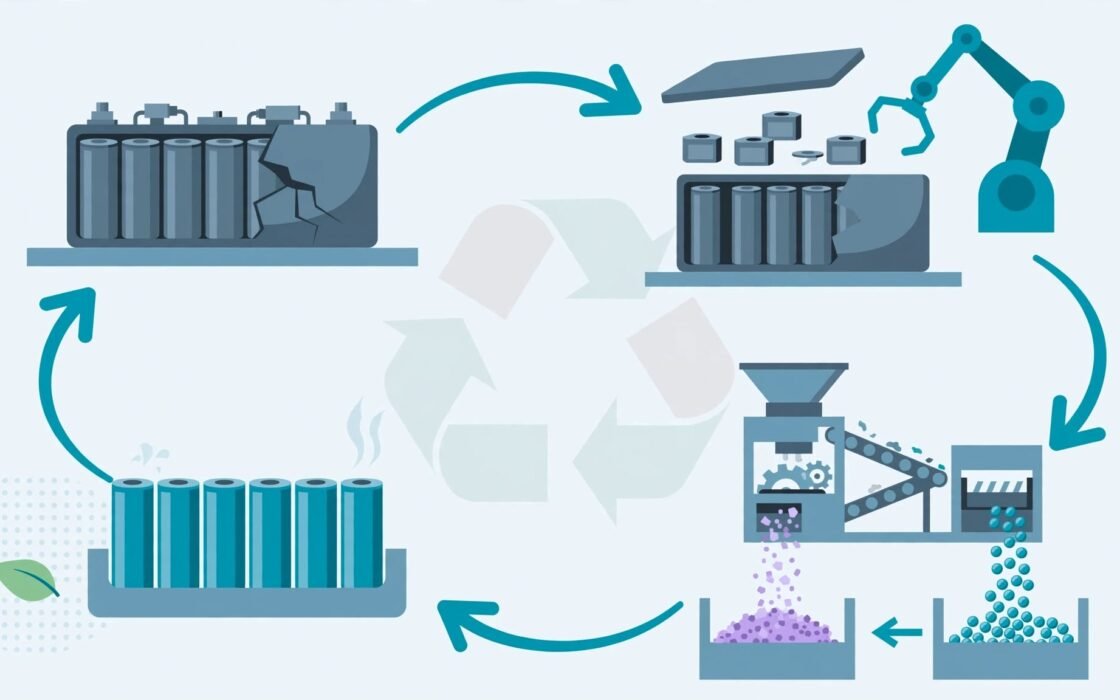
| Hydrometallurgical (leaching) | Acid/solvent process dissolves and separates materials | Recovers ~95% lithium/cobalt and ~97% nickel — the current commercial standard |
| Direct/CAM recycling | Cathode material is recovered intact and “relithiated” for reuse | Highest value retention, but still early-stage and needs battery designs built for easy disassembly |
Hydrometallurgical recovery is what companies like Redwood Materials run at commercial scale today, and it’s the reason a “dead” pack isn’t really waste — it’s closer to unrefined ore.
Where Your Battery Actually Goes
If your EV’s battery genuinely reaches end of life — not “reduced range,” but truly done — you don’t ship it off yourself. Redwood’s own battery portal makes this explicit: EV and hybrid packs are classified as hazardous materials and must be removed from the vehicle and shipped by someone trained under DOT hazmat rules. In practice, that means the battery moves through your dealer or an auto dismantler, not through you personally, similarly to how a State of Health check happens at a shop rather than at home.
That also answers a question a lot of owners ask: no, there’s currently no simple way for an individual to “cash in” a used EV battery for scrap value. The commercial channels (Redwood, and what’s left of Li-Cycle’s assets under Glencore) work with automakers and licensed recyclers, not consumers.
The Waste Wave That Hasn’t Shown Up Yet
This is the part the “coming crisis” narrative usually skips. The ICCT’s own modeling puts global end-of-life battery volume at roughly 1.2 million packs by 2030, climbing to 14 million by 2040 and 50 million by 2050. That’s a genuine long-term ramp — but it means the real volume is a 2030s-and-beyond problem, not a today problem. Most EVs on the road are under a decade old, and batteries are proving to hold up far longer than the industry originally planned for.
Recyclers built capacity for a wave that was supposed to arrive this decade. It didn’t, and the financial damage has been real: Li-Cycle burned through a $475 million DOE loan commitment it was never able to draw down before filing for bankruptcy protection in 2025, and Ascend Elements filed for Chapter 11 in April 2026 after the DOE cancelled roughly $480 million in combined grants tied to its Kentucky facility. Redwood Materials has stayed afloat mainly because it also processes battery manufacturing scrap and has direct supply deals with automakers — not because it’s swimming in retired EV packs.
None of this means recycling doesn’t work. It means the industry is currently overbuilt relative to actual feedstock, which is a very different problem than “we can’t handle the batteries.”
Why LFP Batteries Change the Math
Not every battery is worth the same amount to a recycler, and this matters more every year as battery chemistries shift.
| Chemistry | Roughly how common | Cobalt/nickel content | Recycling economics |
|---|---|---|---|
| NMC (nickel-manganese-cobalt) | Majority of EVs on the road today | Yes — meaningful cobalt and nickel | Recoverable materials genuinely offset recycling costs |
| LFP (lithium iron phosphate) | Fast-growing share of new EVs, including base Model 3/Y | None | Low material value — often routed to second-life storage reuse instead of shredding |
| NCA | Premium, high-density applications | Yes, plus aluminum | Requires specialized separation, similar economics to NMC |
An LFP pack has no cobalt or nickel to recover, so the material-value side of recycling barely covers costs. That’s part of why the industry increasingly treats a retiring LFP pack as a candidate for second-life home or grid storage first, and true recycling only once it’s genuinely spent.
It’s Not Optional, Either Way
Federally, the EPA’s position since 2023 has been clear: spent lithium-ion batteries generally qualify as hazardous waste under the ignitability and reactivity rules, though they can be managed under the lighter-touch “universal waste” standard rather than full hazardous-waste handling. States are starting to layer their own rules on top — Colorado’s new law is the first to set actual recovery percentages recyclers must hit, and it’s a reasonable bet other states follow.
When Will This Actually Matter for Your Car?
Given our EV battery degradation research‘s Geotab-sourced average of about 2.3% capacity loss per year, most owners are decades away from their pack reaching a genuine end-of-life threshold. Here’s a quick way to see where you stand:
When Will Your Battery Reach End-of-Life?
This uses a straight-line estimate, not a curve — real degradation tends to slow after the first couple of years — so treat the output as directional, not a warranty prediction.
FAQ
Do I have to pay to recycle my EV's battery?
No. When a pack is genuinely retired, the cost is absorbed across the automaker/dealer/recycler chain, not billed to the owner directly.
Can I sell my old EV battery for cash?
Not as an individual, in practice. Redwood's EV battery portal is built for auto recyclers and dismantlers shipping hazmat-compliant freight, not for a consumer mailing in a pack.
What happens to the battery if my EV is totaled?
It follows the insurer's dismantler, the same path covered in our total-loss threshold piece — from there it's either resold intact, stripped for parts, or forwarded to a recycler depending on its condition.
Is my EV battery legally hazardous waste?
Yes. The EPA's guidance treats it that way due to ignitability and reactivity, though it can move through the streamlined universal waste process rather than full hazardous-waste handling.
Will LFP batteries like those in base Model 3/Y be recycled the same way as other packs?
Not really. Without cobalt or nickel, there's little material value to recover, so LFP packs are more likely to be reused in stationary storage first and recycled only once truly exhausted.
Bottom Line
EV battery recycling works technically — recovery rates in the mid-90s to high-90s percent range are real, not marketing. What's overstated is the urgency: the actual volume of dead batteries is still years, not months, away, and the companies that bet big on an early flood have been the ones going bankrupt, not the ones overwhelmed with feedstock. For your own car, the honest answer is that this is a problem for whoever owns it a decade or more from now — check our depreciation curve piece if you're weighing how long to hold on before that becomes relevant.
Proper care delays that day considerably — see what EV battery maintenance actually involves.
A note before publishing: state-level EPR rules are moving fast and currently only cover a handful of states (Colorado being first) — worth a quick date check before this goes live in case another state has since followed. The federal universal waste rulemaking for lithium batteries was also still in progress as of this research; if it finalizes, cite the final rule instead of the guidance memo.
About the author: Written by Shurah, who researches and writes independently on the real cost of EV ownership — charging, maintenance, and total cost of ownership — backed by primary data and original calculations rather than recycled lists.