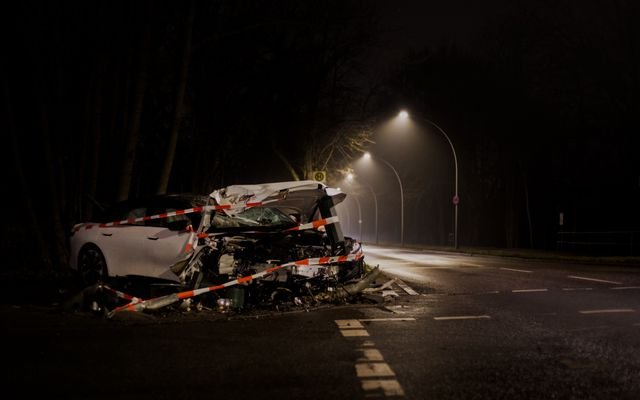
A three-year-old EV worth $28,000 gets rear-ended at 15mph. The bumper is scuffed, the paint is cracked, nothing looks serious. On the lift, the shop finds a dent in the battery casing. The estimate jumps from what looked like a $2,000 fix to $10,000–$15,000, because a compromised battery pack can’t just be patched — it has to be replaced, on safety grounds, whether or not it’s still working. The car crosses the total-loss line before the shop has finished the teardown.
This isn’t a rare edge case. Total-loss frequency across all vehicles hit a record 23.1% of claims in 2025, according to CCC Intelligent Solutions’ 2026 Crash Course report — nearly one in four crashed cars is now written off rather than repaired. EVs sit above that average, and the reason isn’t that they’re more fragile. It’s a specific piece of arithmetic that most drivers have never had explained to them, and that arithmetic is exactly what decides whether your car gets fixed or written off.
The key numbers
- 23.1% — record total-loss rate across all vehicles in 2025, the highest ever recorded
- $10,000–$25,000+ — typical EV battery pack replacement cost
- 30–40% — the share of an EV’s total value the battery pack alone represents
- 70–80% — the repair-to-value threshold most states use to decide total loss
- 15.6 vs 12.7 days — average EV repair time versus a gas car’s
- $1,030+ — how much higher the average EV repair bill runs versus a comparable gas vehicle
Check your own numbers first
Before the explanation, the calculator. This runs the same formula an insurer applies — repair cost as a percentage of your car’s value against your state’s threshold — so you can see exactly where your own situation sits rather than reading a general rule and guessing whether it applies to you.
Total-Loss Threshold Calculator
Enter your car’s actual cash value, the repair estimate, and your state’s total-loss threshold percentage. This runs the exact formula an insurer uses — not a guess.
Not your insurer’s actual valuation — state formulas and how insurers calculate ACV vary. Use this to understand the maths, not as a guaranteed outcome.
Why the threshold exists, and how it actually works
Every state sets a rule — usually expressed as a percentage — for when an insurer must declare a vehicle a total loss rather than pay for repairs. The logic is straightforward: if fixing the car would cost more than some fraction of what the car is actually worth, the insurer pays out the car’s value instead and keeps the wreck (or lets you keep it, in a “retained salvage” deal, usually for less money).
Most states set that threshold somewhere between 70% and 80% of the vehicle’s actual cash value, though a handful use a “total cost” formula with no percentage at all — any repair over 100% of value totals the car outright. The formula itself hasn’t changed for EVs. What’s changed is how often EVs cross it, and that’s a story about the numerator, not the rule.
Why EVs cross that line so much more easily
This is the part that actually matters, and it comes down to where the value in an EV sits and how that value is engineered into the car.
The battery is both the most expensive part and the hardest to isolate from damage. In most modern EVs the pack is bonded directly into the vehicle’s structural floor — it isn’t a component sitting inside a frame, it effectively is part of the frame. That means a collision that dents or cracks the battery casing, even in a low-speed impact, forces a full pack replacement on safety grounds. Insurers and repair shops generally won’t certify a battery as safe after casing damage, whatever the cells inside are actually reading. There’s no partial fix — it’s replace the whole pack or don’t drive the car.
The pack alone is worth 30 to 40% of the car. A gas car absorbing an equivalent hit might need a bumper, a sensor, and some body work. An EV absorbing the same hit can need all of that plus a $10,000–$25,000 battery pack — on a car that might only be worth $30,000 to begin with. Run that through the calculator above and the math does the rest.
Sensor recalibration adds up fast, on top of the battery question. Cameras, radar, and ultrasonic sensors used for driver-assist features run $1,000 to $3,000 each to replace and calibrate, and EVs tend to carry more of them than older gas cars. CCC’s 2026 data found 28.3% of repairable estimates now include a calibration — a real cost most drivers don’t budget for mentally when they picture “repair.”
Import tariffs are pushing the numerator up further in 2026 specifically. About 60% of replacement parts are imported, and a 25% tariff raises repair estimates directly. That’s not an EV-specific fact, but it’s landing hardest on brands that lean heavily on imported components — industry data has flagged Hyundai, Kia, BMW and Buick among those seeing the steepest repair-cost increases this year, which pushes borderline vehicles across the total-loss line more often than it would have a year or two ago.
When a “minor” crash becomes a total loss
The pattern that catches owners off guard is always the same shape: the visible damage looks small, and the number that matters is invisible until the car is on the lift. A few worked examples, using the same formula the calculator above runs:
| Scenario | ACV | Repair estimate | % of value | Outcome at 75% threshold |
|---|---|---|---|---|
| Bumper + sensor damage, no battery involvement | $30,000 | $4,500 | 15% | Repaired |
| Rear-end hit, battery casing dented | $28,000 | $14,000 | 50% | Repaired, but close |
| Same hit, older/cheaper car | $18,000 | $14,000 | 78% | Totaled |
| Low-value EV, moderate damage | $7,000 | $4,900 | 70% | Totaled at a 70% threshold |
Notice what’s doing the work in that table: the repair cost barely moves between rows two and three, but the outcome flips entirely because the car’s value is lower. This is why total-loss risk isn’t really about how badly your car is damaged — it’s about the relationship between the damage cost and what the car is worth, which is exactly why an older or lower-value EV is more vulnerable to the same crash than a newer, pricier one. The last row is also worth remembering on its own: buying an older, cheaper used EV saves money on the purchase, but it narrows the gap to the total-loss line for any future repair.
What to actually do if your EV is in an accident
- Ask specifically whether the battery pack has been inspected, not just whether the car has been assessed. “The car looks fine” and “the battery casing is undamaged” are different statements, and the first doesn’t guarantee the second.
- Get the full written estimate, itemised. You want to see the battery line separately from body work and calibration costs, not one bundled number.
- Request the insurer’s full valuation report if your car is declared a total loss, including the comparable vehicles they used to set your payout. This is standard practice and you’re entitled to ask for it.
- Compare the offer against independent value sources rather than accepting the first number. Standard valuation tools were largely built for the gas-car market and, per the NHTSA’s own EV resources, the used-EV market is still maturing faster than most valuation databases can track — so tools can misvalue EVs on things like battery state of health, software features (FSD, premium connectivity), and fast-moving used-EV pricing that automated tools often work from stale data on.
- Get an independent appraisal if the number looks low. This gives you documented grounds to negotiate rather than a feeling that the offer seems light.
- Don’t assume “totaled” means “worthless.” In many states you can buy back the salvage title and keep the car, though this affects future insurability and resale value — worth understanding before you decide, not after.
What this means before you buy, not just after a crash
Total-loss risk is a real, quantifiable cost of EV ownership that almost never shows up in a buying guide, and it connects directly to two decisions covered elsewhere on this site. It’s part of why EV insurance runs higher than a comparable gas car’s — insurers are pricing in exactly the pattern above, not just guessing that electric cars are riskier to drive. And it’s a genuine factor in the EV-versus-hybrid decision for anyone weighing total cost of ownership rather than just fuel and depreciation, since a hybrid’s smaller, less structurally integrated battery is far less likely to turn a fender-bender into a write-off.
It’s worth being precise about what this isn’t, though: it’s not evidence that EVs are unsafe, or that they crash more often. The data behind our EV fire risk breakdown shows EVs are involved in dramatically fewer fires than gas or hybrid cars. This is a repair-economics story, not a safety one — the battery pack that makes an EV expensive to write off after a moderate crash is the same pack that makes EVs meaningfully safer to be inside during one.
Frequently asked questions
Why do insurers total EVs more easily than gas cars?
Because the battery pack — typically 30 to 40% of the car’s value — is often bonded into the vehicle’s structural floor. Even minor casing damage from a low-speed impact usually forces a full pack replacement on safety grounds, and that single cost, at $10,000 to $25,000+, can push the total repair estimate past the state’s total-loss threshold before any other damage is even counted.
What percentage of damage totals a car?
Most states use a threshold between 70% and 80% of the vehicle’s actual cash value; a handful use a total-cost rule with no percentage. If the repair estimate meets or exceeds that share of the car’s value, the insurer typically declares it a total loss rather than repairs it.
Can a low-speed crash total an EV?
Yes, and this is the case that catches most owners off guard. A parking-lot bump or a low-speed rear-end collision can dent the battery casing without leaving much visible exterior damage, and the resulting battery replacement cost alone can cross the total-loss threshold on its own.
How much does an EV battery pack cost to replace?
Generally $10,000 to $18,000 for mainstream models like a Tesla Model 3, Hyundai Ioniq 5 or Kia EV6, and $15,000 to $25,000+ for larger EVs and trucks. Add labour and body work and the total climbs further.
Should I buy back my EV after a total-loss declaration?
It’s possible in most states, but weigh it carefully. A salvage-titled EV is harder to insure at full coverage, sells for meaningfully less, and you’re taking on the battery risk the insurer just declined to. It can make sense if you’re confident in the pack’s actual condition and plan to keep the car long-term rather than resell it.
Are older or cheaper EVs more likely to be totaled?
Yes, for the same crash. Because the threshold is a percentage of the car’s value, a lower-value EV needs a much smaller repair bill to cross the same line — the calculator above shows this directly if you compare a high-value and low-value car against the same repair estimate.
Does this mean EVs are less safe than gas cars?
No — this is a repair-economics pattern, not a safety finding. EVs are involved in significantly fewer fires than gas or hybrid cars, and the same structurally integrated battery pack that drives up total-loss risk also contributes to that safety profile.
The short version
Total-loss frequency across all vehicles hit a record 23.1% in 2025, and EVs are especially exposed because the battery pack — 30 to 40% of the car’s value, often bonded into the structural floor — forces a full replacement on safety grounds even after minor casing damage. Run the numbers yourself before assuming a “small” crash means a small repair: at a typical 70–80% state threshold, a single $10,000–$25,000 pack replacement can total a car that looks barely scratched from the outside. If it happens to you, insist on a full itemised estimate with the battery inspection called out separately, request the insurer’s valuation report, and get an independent appraisal if the offer looks light. This is a cost of ownership worth knowing before a crash, not after one — and it’s one more reason the total-cost comparisons on this site treat insurance and repair risk as part of the real math, not a footnote.