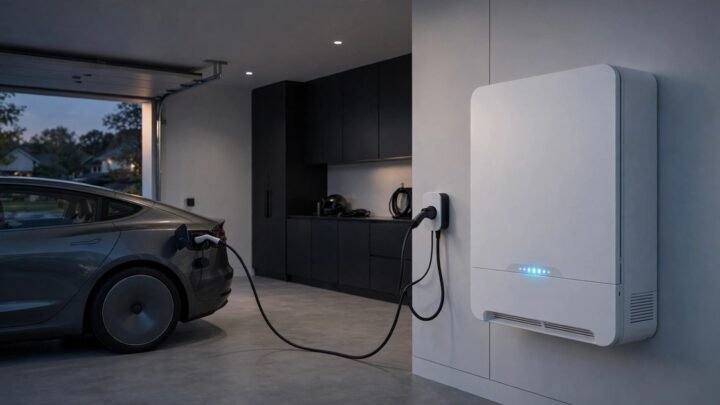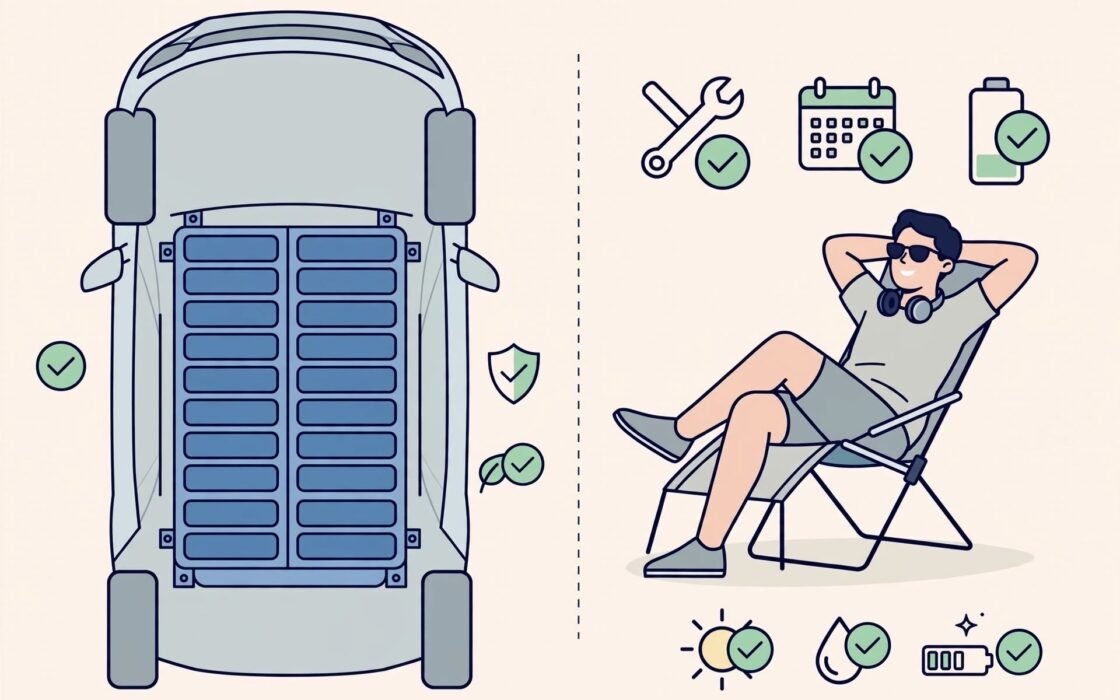
How often does an EV battery need servicing? For the pack itself, the honest answer is almost never. The one physical item that does come due is the coolant that keeps the pack at a safe temperature, and the interval depends heavily on which car you own. Tesla says never. Some Hyundai owners’ manuals say every 40,000 miles.
Where the Numbers Stand
- Tesla’s owner’s manuals state that battery coolant “does not need to be replaced for the life of your vehicle under most circumstances.”
- Hyundai’s Ioniq 5 schedule has varied by model year and region, from a 36-month/40,000-mile coolant replacement on early cars to roughly 120,000 miles reported by owners on newer ones.
- Nissan’s Leaf schedule is reported at 15 years or 120,000 miles; Chevrolet’s Bolt at about 150,000 miles; Ford at around 200,000 miles (secondary sources, check your manual).
- Where a coolant service is required, typical cost is around $300-$500 or more, according to general 2025-26 maintenance guides.
- The pack’s own health (cell balancing, temperature, charge limits) is handled automatically by the battery management system, with no owner action needed.
Quick answer: A modern EV’s high-voltage battery needs no routine owner maintenance. The only scheduled item is coolant, and Tesla says it never needs replacing, while other brands set intervals from 40,000 to 200,000 miles. Everything else that affects battery life is how you charge and park, not something you service. Follow your own manual’s coolant interval, and let the manufacturer or a qualified EV technician do the work.
What “Battery Maintenance” Actually Covers
People searching this usually picture something like an oil change. An EV has nothing equivalent for the pack. There is no oil, no filter and no spark plugs, and the cells are sealed. Tesla’s own support page puts the arrangement plainly: if the high-voltage battery needs attention, the car alerts you with a message on the touchscreen asking you to book a service visit. Maintenance is condition-driven, not calendar-driven.
The battery management system does the work an owner would otherwise do. It balances cells, limits charge and discharge power, and runs the cooling and heating loops. Tesla’s manual notes that in hot weather the air-conditioning compressor can switch on even when you’ve turned it off, because keeping the battery in its optimum temperature range takes priority. Whirring and water-circulation sounds while parked are described as normal for the same reason.
The One Real Item: Battery Coolant
Most EVs circulate liquid coolant through channels around the battery modules to move heat out during driving and fast charging. Because the loop is sealed and never touches air, the fluid doesn’t degrade the way gas-car antifreeze does. Manufacturers disagree on whether it’s lifetime fluid or a service item, and that disagreement is why the intervals below look so inconsistent.
| Brand / model | Coolant guidance | How solid is the source |
|---|---|---|
| Tesla (Model 3, Y, S, Cybertruck) | Not required for the life of the vehicle under most circumstances; opening the reservoir yourself can void warranty coverage for resulting damage | Tesla’s own owner’s manuals |
| Hyundai Ioniq 5 (2021-2022) | Low-conductivity coolant replacement at 40,000 miles | Reported from the owner’s manual by autoevolution |
| Hyundai Ioniq 5 (2025+) and other E-GMP cars | Dealer pages for the 2026 model still list 40,000 miles; owners on the Ioniq forum report about 120,000 miles | Conflicting, so check your own manual |
| Nissan Leaf | About 15 years or 120,000 miles | InsideEVs maintenance comparison (2023) |
| Chevrolet Bolt | About 150,000 miles; calendar limits quoted anywhere from 5 to 10 years | Secondary guides disagree on the time limit |
| Ford EVs | About 200,000 miles | Single secondary source |
One caution: some older maintenance guides still claim Tesla recommends coolant replacement every four years. Tesla’s current manuals say the opposite, so treat that figure as outdated. When two sources disagree, the brand’s own owner’s manual for your exact model year decides.
Coolant work on a high-voltage pack should be done by the manufacturer or a qualified EV technician. Don’t open the reservoir yourself.
When Is Yours Due?
Coolant Service Timeline
Most manuals use "whichever comes first," so the calculator takes the earlier of the mileage and calendar limits. Cost is a general estimate, not a quote.
What Actually Protects the Pack (And Isn't Maintenance)
The things that decide how long a battery lasts are habits, not service items. Our degradation research found real-world packs lose about 2.3% of capacity a year on average, and that charging behavior is the biggest lever you control. These pieces cover the rest:
- Charge limits: the old 20-80% rule doesn't apply to every chemistry, as our charging habits guide explains.
- Fast-charging temperature: a cold pack charges slowly, and the fix is preconditioning through the car's own navigation.
- The small battery that actually strands people: the 12V, covered in our 12V battery guide.
- Standby losses: features like Sentry Mode and constant app polling add up, as our phantom drain research shows.
For the wider service picture (tires, brake fluid, cabin filters), see our EV maintenance schedule. Skipping the coolant interval your manual specifies could also complicate a claim, so keep service records and read the exclusions in your battery warranty guide.
FAQ
Does an EV battery need an oil change or filter?
No. The pack is sealed, with no oil and no filter. The only fluid that serves it is the coolant loop, and on some brands that never needs replacing.
Can I replace the battery coolant myself?
It's not recommended. The loop sits next to a high-voltage pack, the coolant is often a special low-conductivity type, and Tesla says damage caused by opening its reservoir is excluded from warranty. Use the manufacturer or a qualified EV technician.
How do I know if my battery needs service?
Most EVs tell you. Tesla shows a message on the touchscreen if the high-voltage battery needs maintenance, and other brands use dashboard warnings. Don't rely on guesswork or a calendar alone.
Why does my parked EV make whirring or water sounds?
That's usually the thermal system circulating coolant to balance battery temperature. Tesla's manuals describe these sounds as normal.
Is a "lifetime" coolant claim trustworthy?
For Tesla it's written into the current manual. For other brands, intervals differ by model year and region, so look up your exact year and market instead of assuming.
If You Only Remember One Thing
Don't go looking for battery services to buy. Find the coolant line in your own owner's manual, note the interval, and book it with the manufacturer or a qualified EV shop when it's due. Beyond that, how you charge and park matters more than any scheduled service.
And when a pack truly reaches end of life, here is what actually happens in EV battery recycling.
About the author: Written by Shurah, who researches and writes independently on the real cost of EV ownership — charging, maintenance, and total cost of ownership — backed by primary data and original calculations rather than recycled lists.