How Hot Weather Affects Your EV: Range, Battery, and Real Costs
The Key Figures
- 17% — range lost at 95°F with the AC running, in AAA’s lab test of five 2017–2018 EVs.
- Under 5% — real-world range loss at 90°F across 29,700+ EVs tracked by Recurrent (2025).
- 17–18% — real-world loss at 100°F+ with the AC on, in that same dataset.
- 1.3–1.5 kW — the cooling power ADAC measured in a simulated 95°F traffic jam: about 5 miles of range per hour.
- 0.4%/yr faster — extra battery degradation for EVs in hot climates versus mild ones (Geotab, January 2026).
The Verdict
Hot weather costs EV drivers real range but far less than cold: roughly 5% less range at 90°F and 15–18% at 100°F+ with the air conditioning on, per Recurrent’s real-world data and AAA’s lab tests. Heat also slows DC fast charging and ages batteries slightly faster — about 0.4 points of extra degradation per year in hot climates. Shade parking, pre-cooling while plugged in, and evening charging erase most of the penalty.
Seventeen percent — how much range five electric cars lost in AAA’s lab at 95°F with the AC running, and, within a point or two, what Recurrent found across nearly 30,000 real EVs at 100°F. Two methods, six years apart, nearly the same number. Here is what heat actually costs an EV owner — range, charging speed, battery health, and dollars — and the habits that shrink the penalty to almost nothing.
The Numbers, Measured Three Different Ways
Heat range loss has been measured three times by serious outfits, and the results do not line up neatly — which is useful, because the disagreements reveal what actually drives the loss.
| Study | Method | 90°F | 95°F | 100°F |
|---|---|---|---|---|
| AAA, 2019 (primary source) | Lab: 5 EVs (2017–2018), dynamometer in a climate cell, 75°F baseline | Not tested | 4% (AC off) / 17% (AC on) | Not tested |
| Recurrent, 2024 (secondary reporting) | Real world: 7,500 EVs, battery readings vs. advertised range | 5% | 15% | 31%* (*tiny sample — flagged by Recurrent itself) |
| Recurrent, 2025 (secondary reporting) | Real world: 29,719 EVs, the largest heat dataset to date | Under 5% | Not broken out | 17–18% |
The 31% figure from the 2024 Recurrent analysis keeps getting quoted, but Recurrent itself warned the 100°F sample was very small. A year later, with nearly 30,000 vehicles, it measured 17–18% — close to AAA’s 17% at 95°F. Believe the bigger sample.
Our read: heat costs far less than cold — AAA measured 41% loss at 20°F with the heater on, more than double the worst heat number (see our winter range guide). Below 90°F, summer loss is background noise; past 100°F, budget roughly a sixth of your range for cooling.
Why the Studies Disagree — and Which to Trust
The test cars are from different eras. AAA tested 2017–2018 models that predate heat pumps and modern thermal management; Recurrent’s data comes mostly from current-generation cars.
The AC setting is the real variable, not the thermometer. AAA proved it cleanly: at 95°F, the same cars lost 4% with the AC off and 17% with it on. The battery chemistry barely notices 95°F; cabin cooling eats the miles. Any headline number that omits the AC setting is hiding the mechanism.
Lab miles and road miles differ. AAA ran a fixed cycle on a dynamometer; Recurrent measured real owners, many of whom pre-cool while plugged in and park in garages. Real life is kinder than the lab.
The number to carry in your head: about 5% at 90°F, 15–18% at 100°F+ with the AC on, almost nothing with it off. Note the Recurrent studies reach us through secondary reporting — Electrek’s coverage of the 29,700-vehicle 2025 study and InsideEVs’ of the 2024 one — since Recurrent’s full reports sit behind its platform.
Meet the Power Hog: Your Air Conditioner
The clearest window into the energy cost comes from Germany’s ADAC: a Tesla Model Y in a lab at 95°F outside, 68°F in the cabin, in a simulated eight-hour traffic jam. Holding that temperature took 1.3 to 1.5 kW of continuous cooling — about 2% of the battery, or 5 miles of range, per hour. Eight hours of gridlock cost 40 miles without moving an inch: the honest worst case.
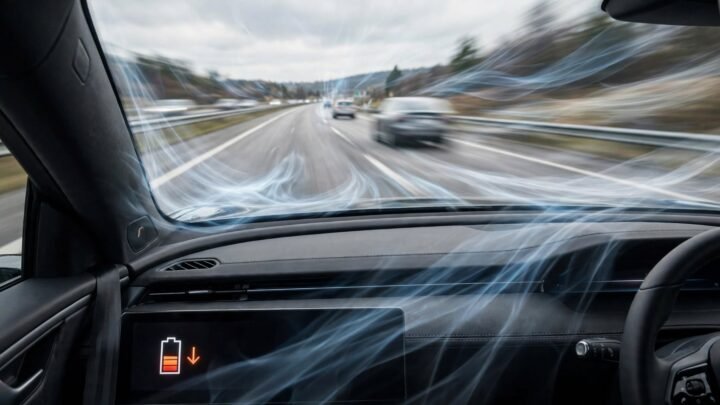
Recurrent’s data adds the second half: the compressor draws 3–5 kW for the initial cooldown, then settles near 1 kW to hold the temperature. Hence the familiar pattern — the first ten minutes of a summer drive are expensive, then consumption flattens — and why stop-and-go hurts more than highway cruising: 1.5 kW is a rounding error at 65 mph, but the whole energy budget at 5 mph.
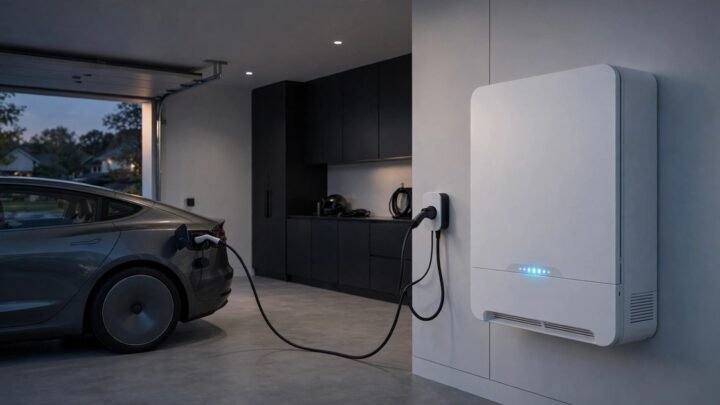
The fix costs nothing: cool the cabin while still plugged in. AAA lists it as its top hot-weather tip, and the physics is plain — every kWh of cooling from the wall outlet is a kWh that stays in the battery. Five minutes of app-triggered pre-cooling before you leave turns that brutal initial pulldown into someone else’s electricity bill.
What Does Your Summer Actually Cost? Run Your Numbers
Fleet averages are a starting point; your penalty depends on climate, AC habits, and mileage. Defaults are examples, not facts.
Summer Heat Penalty Calculator
Estimated summer range: – miles
Range lost to heat: – miles
Extra electricity per year: – kWh
Extra cost per year: –
How the calculator works: the loss bands are our synthesis of AAA’s 17%-with-AC finding and Recurrent’s 2025 fleet data — 3%/1% up to 90°F, 10%/5% for 90–100°F, 18%/12% above 100°F, higher with the AC on (informed estimates, not lab results). The cost math assumes four hot months, one-third of annual miles: extra kWh = (annual miles ÷ 3) × (1 ÷ (efficiency × (1 − loss)) − 1 ÷ efficiency), times your electricity price. Set the mildest band with eco AC and the penalty collapses to nearly zero — most of the “heat penalty” is an air-conditioning bill.
Heat Slows Your Charging, Too
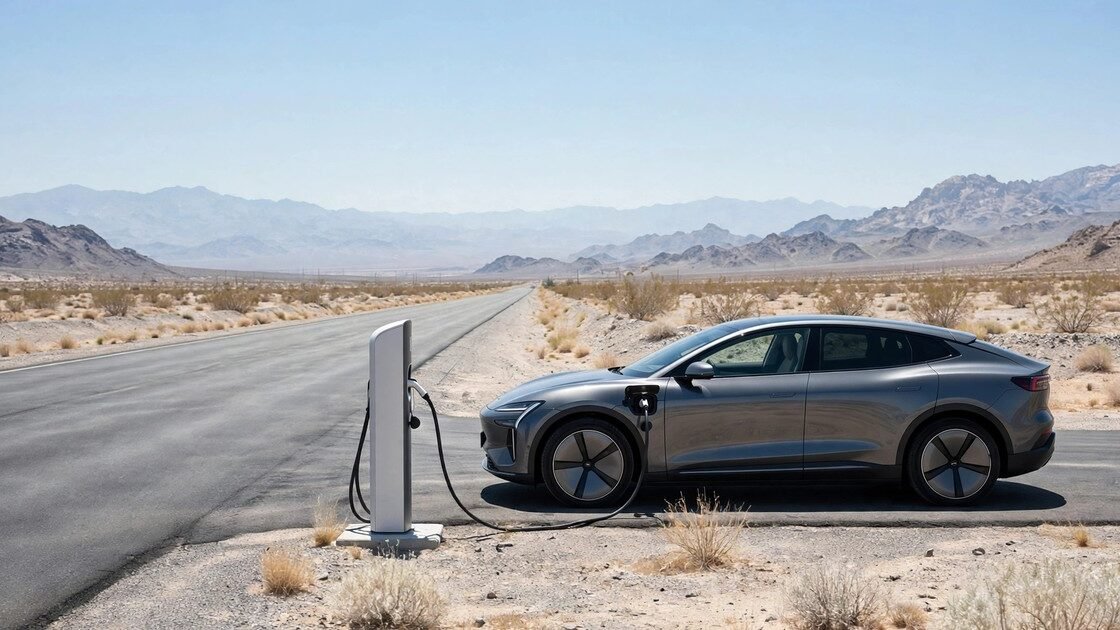
When the pack gets hot — back-to-back fast charges on a summer road trip is the classic trigger — the battery management system caps charging power to protect the cells. You plug into a 250 kW charger and the car settles at 90 kW; a 25-minute session takes 40. Nothing is broken; the car is choosing battery life over your schedule.
It gets worse with a heat-soaked battery after highway driving, a high state of charge in the heat, or arriving nearly empty on a scorching day — Recurrent warns against very low charge in extreme heat, since the car then spends its remaining energy keeping the pack cool. The counter-moves: use the built-in route planner so the car preconditions the battery before arrival, charge in the cooler morning or evening, and treat 80% as your summer road-trip target.
The Slow Burn: Heat and Battery Life
Temporary range loss washes out in autumn; degradation does not. Geotab’s January 2026 analysis of 22,700 EVs found hot-climate vehicles degrade about 0.4 percentage points faster per year than mild-climate ones, against a 2.3% average. Our calculation: over ten years, roughly 4 extra points of capacity — 12 miles on a 300-mile car, gone for good. Real, but small.
For perspective, charging behavior swamps climate: heavy DC fast charging above 100 kW pushes degradation to 3.0% per year versus about 1.5% for mostly-AC charging — a 1.5-point gap, nearly four times the climate effect. The driver who fast-charges daily in Seattle ages their battery faster than the one who home-charges nightly in Tucson. See our battery health and degradation guide for the full picture.
The Dollar Math, Worked Out
Our calculation, every assumption labeled: a 300-mile EV, 12,000 miles a year, 3.3 miles per kWh, example home rate $0.16/kWh, with four hot months (4,000 miles) driven with the AC on.
At 5% average summer loss (a typical 90°F summer): 4,000 ÷ 3.3 = 1,212 kWh normally versus 4,000 ÷ 3.135 = 1,276 kWh — 64 kWh more, or about $10 a year. At 15% (a Phoenix-grade summer): 4,000 ÷ 2.805 = 1,426 kWh, a 214 kWh difference — about $34 a year. The surcharge only stings on public fast chargers, where those kilowatt-hours cost three to four times more — see our public charging cost breakdown before a summer road trip.
Eight Habits That Beat the Heat
None of these costs money. Ranked roughly by impact:
- Pre-cool while still plugged in. Five minutes of app-triggered cooling on wall power erases the expensive 3–5 kW initial pulldown from your battery.
- Park in shade or a garage. A sun-baked cabin forces the battery’s thermal management to work overtime even when parked — energy that quietly disappears as phantom drain. A windshield sunshade is the $15 version of the same trick.
- Charge in the cooler hours. Evening or early-morning sessions start the battery cooler, throttle less, and often land on cheaper time-of-use rates.
- Do not park for days at very low charge in extreme heat. The car needs energy to keep its own battery cool — the one combination every source here warns against. The mirror rule: do not bake at 100% either; 50–70% is the happy storage zone.
- Check tire pressure monthly in summer. Heat raises pressure about 1 psi per 10°F; overinflation wears the center tread and costs grip. Tires are already your biggest recurring EV expense (our tire cost guide), and heat makes bad pressure habits pricier.
- Use ventilated seats and recirculation before max AC. Moving already-cooled cabin air takes a fraction of the energy of cooling fresh 100°F air nonstop.
- On road trips, plan for slightly longer stops. A throttled charger in the heat is the battery protecting itself — a feature, not a fault. Build the buffer into the plan.
- Keep software updated. Manufacturers quietly improve thermal-management behavior in over-the-air updates; an out-of-date car may cool its pack less efficiently.
Questions Drivers Actually Ask
Does hot weather permanently damage my EV’s battery?
No — occasional heat causes no lasting damage in a modern EV with active thermal management, but years of extreme heat add up: about 0.4 percentage points of extra degradation per year in hot versus mild climates (Geotab, 2026). Shade parking and avoiding very low charge in heatwaves matter most.
Is it safe to DC fast-charge when it is 100°F outside?
Yes, completely safe — the battery management system simply slows charging if the pack gets too hot (thermal throttling). Expect longer sessions on the hottest afternoons; charge morning or evening when you can. Never try to defeat thermal limits; they protect the battery.
Should I charge to 100% in the summer?
For daily driving, no — 80% is kinder in heat, since a fully charged pack baking in high temperatures degrades faster. Save 100% for the morning of a long road trip, when the car uses the energy right away.
Why does my range estimate plunge on the first really hot day?
The first cooldown is the expensive part: the compressor can draw 3–5 kW on a heat-soaked cabin, then settles near 1 kW. Pre-cooling while plugged in removes that spike from your battery, and the estimate recovers on later drives.
Does parking in the sun hurt the car, or just cost range?
Mostly it costs range: the battery protects itself by running its cooling system, which drains energy even while parked. But a car left for days in extreme heat at very low charge can run short of the energy to keep the pack cool — the one scenario every researcher here warns against. Shade sidesteps the problem.
Do heat pumps help in hot weather?
Barely. A heat pump’s big efficiency win is heating, not cooling — in summer it works essentially like a conventional AC compressor. Newer thermal-management software and simple habits like pre-cooling matter far more than the heat-pump badge.
The Bottom Line
Heat is a surcharge on EV ownership, not a dealbreaker: about 5% of range gone at 90°F, 15–18% at 100°F+ with the AC on, almost nothing with it off. A typical home-charging driver pays roughly $10–$35 extra per summer; the battery ages slightly faster in hot climates, but charging habits matter far more than zip code. Three free habits — pre-cool while plugged in, park in the shade, charge in the cool hours — erase most of the penalty.
Heat safety: never leave children or pets in a parked car, EV or not — cabin cooling can shut off without warning. Hot weather also means hot pavement and hot charging equipment; give the car and charger space to breathe and follow your owner’s manual.
About the writer
Written by Shurah, who researches and writes independently on the real cost of EV ownership — charging, maintenance, and total cost of ownership — backed by primary data and original calculations rather than recycled lists.