The most useful number on a used EV isn’t on the window sticker. It’s the battery’s State of Health, and most owners and buyers never look at it. You can read it for free on some cars, for about $30 on most others, and for $99-$249 with a certified test.
What’s Worth Knowing First
- State of Health (SoH) compares the pack’s current usable capacity to what it held when new. 100% means factory-fresh.
- It is not the same as the charge percentage on your dash, and it is not the same as your displayed range.
- Most EVs don’t show SoH as a big friendly number on the main screen. Tesla’s standard screens don’t, though a Battery Health page is reported in Service Mode, and some other brands show bars or a percentage in a menu.
- A Bluetooth OBD2 dongle plus an app typically costs $20-$50 in total, and independent certified tests are quoted at $99-$249 in the US and £49-£99 in the UK.
- On our own degradation research, the average pack loses about 2.3% a year, which gives you a benchmark to compare any reading against.
Quick answer: Check EV battery health in three steps, cheapest first. Look for a built-in health screen or manufacturer app. If there isn’t one, read the battery’s data with an OBD2 dongle and a model-specific app. For a used-car purchase, pay for an independent certified test. Then compare the result to roughly 100% minus 2.3% per year of age.
SoH, Charge Level and Range Are Three Different Things
State of Charge (SoC) is how full the battery is right now. Range is the car’s estimate of how far that charge will take you. State of Health is how much total capacity the pack still has compared with new. A car at 100% charge with a degraded pack still shows 100%. It just holds less energy. SoH is the number that tells you how much of the original battery you still own.
Three Ways to Check, Cheapest First
| Method | Typical cost | How much to trust it |
|---|---|---|
| Built-in screen or manufacturer app | Free | Fine for a quick look, but the number comes from the car’s own battery management system |
| OBD2 dongle plus an app (LeafSpy, Car Scanner, EVNotify and similar) | About $20-$50 | Good on supported models, and it shows more than one number |
| Independent certified test (for example the AVILOO FLASH Test) or a dealer or workshop test | $99-$249 US, £49-£99 UK | Best for buying, selling or a warranty dispute, because it doesn’t rely only on the car’s own report |
1. Start with the car itself
Look through the settings, service and vehicle-information menus and the manufacturer’s app. A 2026 guide from Recharged notes that early Nissan Leafs use a bar graph for capacity, while some Korean and European models show a percentage. One guide from iEVChina says a Ford Explorer EV has a battery SoH menu item and that Tesla’s Service Mode has a Battery Health page. Treat those as pointers rather than guarantees, because menus change with software and model year.
You can also run a rough range check. Charge to 100%, let the pack settle for a few minutes, and compare the displayed range with the car’s original rated range. Treat it as a hint only. Temperature and recent driving style both change the estimate, so it can’t stand in for a measurement.
2. Read the battery’s data with an OBD2 dongle
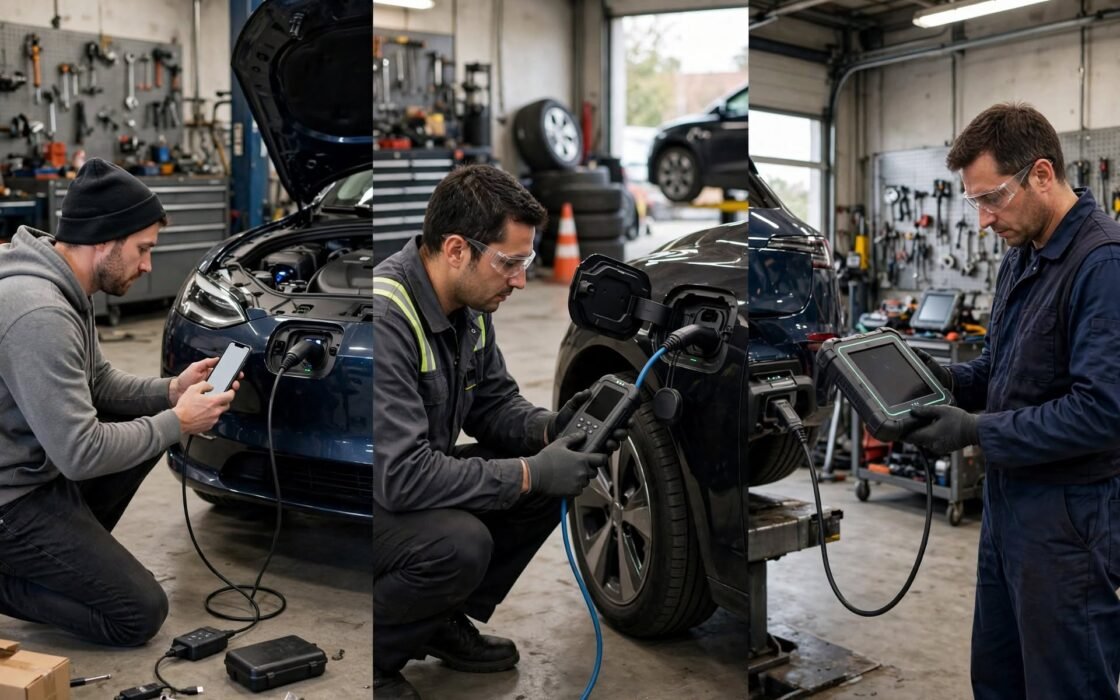
A dongle plugged into the OBD port and a model-specific app can show SoH, usable energy, cell voltages and temperatures. An iEVChina guide calls this the most cost-effective way to verify a used EV, at roughly $20-$50 all in. Ask for specifics when you use it:
- The SoH percentage itself. It is often the car’s own estimate, and a service-industry article warns that onboard battery data “lies” in some cases, which is why a second opinion is worth having.
- Cell voltage spread. The same article suggests a resting gap between the highest and lowest cell of under about 20-30 millivolts for a well-balanced pack. A much bigger gap is a reason to ask questions.
- Module temperatures. One module running much hotter than its neighbours after a hard drive can point to a weak group of cells.
3. Pay for an independent test when money is on the line
For a purchase, a sale or a warranty claim, a number from a third party carries more weight than a dashboard reading. AVILOO’s FLASH Test is a three-minute check through the OBD port. AVILOO says it calculates SoH with a statistical model trained on many vehicles instead of relying only on the dashboard figure. Those accuracy claims come from the vendor, so weigh them accordingly. Recurrent takes a different route and, according to one explainer, estimates SoH indirectly from real-world range data across its fleet. That is useful context, but it is an estimate rather than a direct reading of your pack.
What Counts as a Good Number?
One guide describes 85-95% as normal for a three-to-six-year-old EV, and under roughly 75% as worrying. Our own benchmark is simpler. If the average pack loses about 2.3% a year, a five-year-old car would be expected around 88.5%. The tool below turns your reading into a comparison. It is a straight-line rule of thumb, not a prediction, because real packs usually lose more in the early years and less afterward.
Is My Reading Typical for the Age?
No measured SoH? Use the range check instead:
When to Check
- Before buying a used EV. It is the one number our used-EV checklist treats as non-negotiable, and a certified pre-owned badge is not a substitute for a measured figure.
- Before your battery warranty ends. Most warranties use a capacity threshold, often 70%, but terms differ by brand and model year, as our warranty guide explains. A documented reading near the end of coverage is useful evidence.
- Once a year for your own records. iEVChina suggests charging to 100% in similar weather each time and saving screenshots of the range and SoH so you can see the trend.
If a result looks bad, it helps to know what the worst case would cost. Our battery replacement cost guide covers that.
FAQ
Is the range on my dashboard the same as battery health?
No. The range figure is an estimate that changes with temperature, driving style and recent use. It can hint at a problem, but SoH is the capacity measurement.
What does 90% battery health mean?
The pack can store about 90% of the energy it could when new. For a car of three to four years, that is in line with the typical figures above.
Can I trust the number on my car’s own screen?
It is a useful starting point, but it comes from the car’s own estimate. For anything involving money, such as buying, selling or a claim, a second source is worth paying for.
Do I need a professional test or is a dongle enough?
For your own car, a dongle and app are usually enough to track the trend. For a used-car purchase, an independent certified test is the safer choice, because it does not depend only on what the seller’s car reports.
Does fast charging lower battery health faster?
Charging behaviour is the biggest factor you control, according to our degradation research. Read that article before changing habits, since the right advice also depends on the battery chemistry.
The Short Version
Check the car’s own screen first, then spend about $30 on a dongle if the car doesn’t show SoH. If you are buying a used EV, pay for a certified test. Whatever you find, compare it with roughly 100% minus 2.3% per year of age. A reading well below that is the moment to ask questions.
About the author: Written by Shurah, who researches and writes independently on the real cost of EV ownership — charging, maintenance, and total cost of ownership — backed by primary data and original calculations rather than recycled lists.