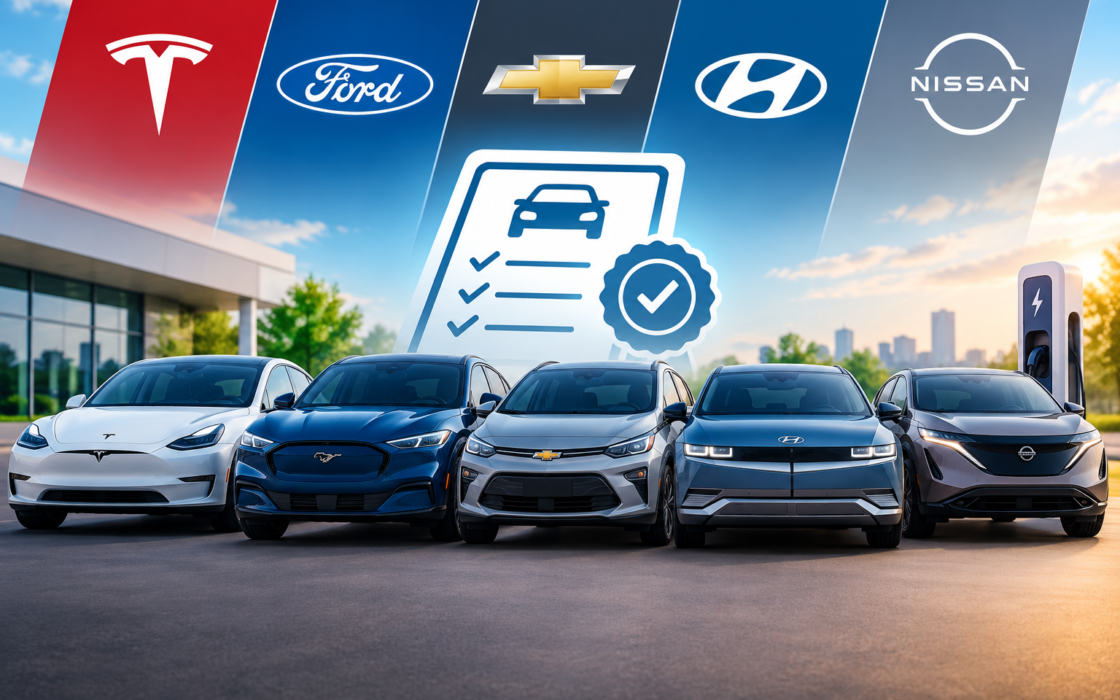
“Certified Pre-Owned” sounds like one clear thing — a used car that’s been inspected and backed by the manufacturer. In practice, five brands can mean five very different promises under that badge: different age caps, different inspection depth, and most importantly, a warranty structure that in most cases has nothing to do with the CPO badge itself. This compares what Tesla, Hyundai, Ford, Chevrolet, and Nissan actually give you, and shows the one thing almost every buyer assumes CPO changes that it usually doesn’t.
Key Numbers
- Tesla’s US CPO program: 119-point inspection, non-negotiable pricing, a $500 order deposit, and Tesla itself confirms certified vehicles can still carry open recalls at time of sale.
- Ford’s EV-specific tier (“Blue Advantage EV Certified”) requires the vehicle be under 6 years old with fewer than 80,000 miles and adds a 127-point inspection — but Ford’s lower “Blue Certified” tier (any make, older, higher mileage) gives only a 90-day/4,000-mile warranty with no EV-battery extension at all.
- Hyundai and Chevrolet both structure their EV battery warranty (10yr/100k mi and 8yr/100k mi respectively) around the vehicle’s original in-service date, not the current owner — meaning it transfers automatically to a used buyer whether or not the car carries a CPO badge.
- Nissan’s Leaf CPO program requires a minimum of 9 of 12 bars of remaining battery capacity on the dashboard gauge just to qualify — a real, checkable number, not a marketing claim.
- The average extended auto warranty in the US costs roughly $90/month — a useful yardstick for judging whether a CPO price premium is actually buying you comparable protection.
Short Answer
A CPO badge typically buys you three things: a documented multi-point inspection, a short additional bumper-to-bumper warranty (often 12 months/12,000 miles), and easier financing — not, in most cases, extra battery protection. For Tesla, Hyundai, Ford’s EV-specific tier, and Chevrolet, the EV battery warranty is tied to the vehicle’s original in-service date and transfers to any subsequent owner automatically, certified or not. Nissan is the exception, since its Leaf program adds a real battery-capacity floor as an eligibility requirement, not just a warranty term.
Brand-by-Brand: What’s Actually Included
| Brand | Age/mileage cap | Inspection | Extra CPO warranty | Battery warranty structure |
|---|---|---|---|---|
| Tesla | None published; older/higher-mileage cars get lighter cosmetic reconditioning | 119-point | Pre-Owned Vehicle Limited Warranty (reported ~1yr/10,000mi) | Remaining balance of original 8yr battery/drive-unit warranty transfers as-is |
| Ford (EV Certified) | Under 6 yrs / under 80,000 mi | 127-point, EV-specific | 12mo/12,000mi comprehensive | BaseCARE EV Limited Warranty, traction battery to 8yr/100k mi from in-service date |
| Chevrolet (Bolt EV/EUV) | Varies by dealer/state | 100+ point | 12mo/12,000mi bumper-to-bumper | 8yr/100k mi from in-service date, transfers to subsequent owners; no published capacity-floor guarantee |
| Hyundai | Varies by dealer/state | Multi-point (brand-standard) | Limited-warranty extras vary by dealer | 10yr/100k mi from in-service date, transfers to CPO owners |
| Nissan (Leaf) | Under 5 yrs / under 60,000 mi at certification | 167-point | Extended 7yr/100k mi EV system + powertrain warranty added on top | Existing 8yr/100k defect + 5yr/60k capacity-loss-below-9-bars warranties, PLUS a 9/12-bar minimum required just to qualify for CPO |
The One Thing Most Buyers Get Wrong About CPO and Batteries
For Tesla, Ford, Chevrolet, and Hyundai, the EV battery warranty is written against the vehicle’s original in-service date — the day it was first sold as new — not against who currently owns it. That’s a fundamentally different structure from a traditional powertrain warranty, which sometimes shortens or requires a transfer fee when a car changes hands. It means a non-certified 2023 Ioniq 5 with 40,000 miles carries exactly the same remaining battery protection as a certified one at the same age and mileage, because the clock started running the day it left the factory either way. One used-EV specialist summarized this bluntly in its own Hyundai coverage: don’t assume “CPO” means more battery protection — press the dealer for the actual VIN-specific coverage in writing rather than taking the badge as a proxy for it.
This isn’t a criticism of CPO programs — it’s just a reason to separate two different questions when you’re comparing a certified car against a similar non-certified one: “How much of the factory battery warranty is left?” (usually identical either way, check by VIN) and “What does the CPO premium buy me beyond that?” (inspection depth, a short bumper-to-bumper extension, and dealer financing terms — the real variables between brands).
Where the Real Differences Are
- Inspection depth and EV-specificity. Ford’s 127-point EV Certified inspection and Nissan’s 167-point Leaf inspection are explicitly built around high-voltage components; Chevrolet’s 100+ point CPO checklist is described by industry coverage as a more general body/interior/electronics/road-test process that “may not go as deep on EV battery diagnostics” as a specialist would. If battery health is your main worry, ask specifically what the inspection actually measures on the pack — a visual check and a full diagnostic readout are not the same thing.
- The two-tier trap. Ford runs two certification levels side by side — “Blue Advantage EV Certified” for EVs under 6 years/80,000 miles, and a lighter “Blue Certified” for any make, older, or higher-mileage vehicle, including used EVs from other brands. The EV-specific tier includes the 8-year BaseCARE EV warranty; the general tier gives only a 90-day/4,000-mile warranty with no EV-battery extension. A shopper who sees “certified” on an older used EV at a Ford dealer should confirm which tier it actually falls under before assuming the same battery protection applies.
- A hard eligibility bar, not just a warranty term. Nissan’s Leaf CPO program is the one case here where the CPO badge itself tells you something concrete about battery condition: a car has to show at least 9 of 12 bars on its capacity gauge to even qualify. Given how long the Leaf has been on sale, this age/mileage cap (under 5 years, under 60,000 miles at the time of certification) means the pool of currently-eligible CPO Leafs is smaller than it once was — most Leafs on the used market today are past that window and simply aren’t eligible for the CPO badge regardless of condition.
- Open recalls don’t disappear. Tesla explicitly states a Certified Pre-Owned vehicle can still be sold with open recalls that require future repair — the CPO process doesn’t automatically close them out before delivery. Whatever brand you’re buying from, check the VIN against NHTSA’s recall database yourself rather than assuming “certified” means recall-free.
Is the CPO Premium Worth It? A Way to Check
CPO vehicles typically cost more than a comparable non-certified used EV of the same age, mileage, and trim — sometimes a few hundred dollars, sometimes over a thousand. Since the battery warranty itself is usually identical either way, the honest way to evaluate a CPO premium is to price it against what the extra bumper-to-bumper coverage would cost as a standalone product. The average extended auto warranty in the US runs roughly $90 a month, though the exact figure depends heavily on the vehicle’s age, mileage, and coverage level according to FTC guidance on the product category.
Is Your CPO Premium a Good Deal?
What to Actually Check Before Paying a CPO Premium
- Pull the VIN-specific battery warranty balance yourself — ask for it in writing rather than assuming the CPO badge changed it. Our used-EV buying checklist covers how to verify this alongside State of Health.
- Ask exactly what the inspection measured on the battery — a visual/functional check is different from a full diagnostic readout of cell balance and capacity.
- Check the VIN against NHTSA’s recall database independently, since CPO status doesn’t guarantee open recalls are closed.
- Compare the CPO premium against a same-age, same-mileage non-certified listing plus what a standalone extended warranty for that vehicle would cost — the calculator above gives you a rough per-month comparison.
- Remember depreciation still applies regardless of CPO status — our EV depreciation research shows the steepest value loss happens in the first few years no matter how the car was sold.
FAQ
Does “Certified Pre-Owned” mean the battery has been tested and guaranteed?
Only in the sense that most inspections include some form of battery diagnostic. It doesn’t typically mean the battery warranty itself is any longer or stronger than what a non-certified car of the same age already carries — that’s usually set by the in-service date, not the CPO badge.
Why doesn’t Tesla call its program “Certified Pre-Owned” officially?
Tesla runs the functional equivalent — inspection, warranty, vehicle history report — but doesn’t use the traditional franchise-dealer CPO structure other automakers built over decades, since Tesla sells and services its own vehicles directly.
Is a non-certified used EV automatically a worse buy?
Not necessarily, if the battery warranty transfers the same way regardless (as it does for most major brands) and you get independent battery diagnostics done yourself. The CPO premium is paying mainly for convenience and a documented inspection trail, not a fundamentally different vehicle.
Can a CPO EV still have unresolved recalls?
Yes — Tesla explicitly states this can happen, and other brands don’t guarantee otherwise either. Always check the VIN against NHTSA’s own database rather than relying on the CPO process to have caught it.
Is the Nissan Leaf’s 9-bar requirement a big deal?
It’s a genuine, checkable eligibility bar rather than marketing language, which is valuable — but it also means many older Leafs simply won’t qualify for CPO status at all, regardless of price or otherwise-good condition.
The Short Version
Certified Pre-Owned isn’t one program — it’s five different combinations of inspection depth, warranty terms, and eligibility rules depending on the brand. The part that surprises most buyers is that for Tesla, Ford’s EV-specific tier, Chevrolet, and Hyundai, the EV battery warranty itself usually doesn’t change based on CPO status at all — it’s tied to the car’s original in-service date and transfers automatically. What you’re actually paying the CPO premium for is the inspection paperwork, a short extra bumper-to-bumper warranty, and easier financing — worth something, but worth pricing against a standalone extended warranty and a same-age non-certified listing before assuming the badge itself is protecting your battery.
About the author: Written by Shurah, who researches and writes independently on the real cost of EV ownership — charging, maintenance, and total cost of ownership — backed by primary data and original calculations rather than recycled lists.