The Chevrolet Equinox EV weighs about 4,923 pounds. The petrol version weighs 3,428. That’s 1,495 extra pounds pressing four contact patches into the road, each roughly the size of your hand.
Everything about EV tyre wear follows from that number — and from the fact that with the engine bills gone, tyres are now the largest recurring cost of running an electric car.
Three reasons they wear faster
1. Weight
EVs commonly run 20 to 50% heavier than their combustion equivalents. The battery pack is simply a large mass low in the chassis, and every pound of it presses down on the same four contact patches during acceleration, braking and cornering. More load means higher contact pressure and faster abrasion, concentrated on the driven axle and the outer shoulders of the tread.
A heavy dual-motor truck sits at the extreme end of that wear curve — see how much worse it gets on something the size of a Silverado EV.
2. Instant torque
An electric motor delivers maximum torque from zero rpm. There’s no ramp-up, no gear change, no gradual build — the twist arrives the instant your foot moves. Hyundai attributes the roughly 20% faster wear directly to this: strong instantaneous power scrubbing rubber that a petrol engine’s gentler torque curve wouldn’t touch.
This is the one factor entirely under your control, and it’s the reason two owners of identical cars can see wildly different tyre life.
3. The tyres themselves are built for range, not longevity
Most EVs ship on low-rolling-resistance tyres, chosen to squeeze extra miles from each charge. Those compounds are often softer and the tread geometry is optimised to cut energy loss — both of which trade durability for efficiency.
Tyres aren’t the only accessory decision with a real efficiency cost attached — what you put on the roof matters just as much on the highway.
So your factory tyres may wear faster than the replacement set you choose later. That’s a design decision made on your behalf to protect the EPA range figure on the window sticker.
What you’ll actually pay
Mainstream EV tyres run $150 to $300 each for quality all-season replacements, with large SUVs, trucks and performance models above that. Comparable petrol-car tyres run $80 to $170.
| EV | Petrol car | |
|---|---|---|
| Cost per tyre | $150–$300 | $80–$170 |
| Typical life | 30,000–40,000 mi | 40,000–50,000 mi |
| Sets per 100,000 miles | ~3 | ~2 |
| Tyre cost per 100,000 miles | ~$2,700 | ~$1,000 |
| Cost per mile | ~2.7¢ | ~1.0¢ |
At around 2.7 cents per mile, tyres cost roughly 44% of what electricity costs to move the same EV at average home rates. That’s a substantial line nobody mentions when they tell you EVs are cheap to run.
How this affects the maintenance saving
EVs save roughly $330 a year in maintenance against a comparable petrol car. The extra tyre cost runs about $170 a year at average mileage — so on paper it eats about half of it.
One honest caveat: AAA’s maintenance category typically bundles tyres in with servicing, so depending on which figure you’re reading, this may already be netted out rather than being a separate deduction. Don’t count it twice.
Either way the conclusion holds. EV servicing is genuinely cheaper — our EV maintenance schedule sets out how little is actually due — but tyres are where a real share of that saving goes back out the door, and they’re the largest recurring bill you’ll now face.
Tyres turn out to be the single biggest line item in our 100,000-mile EV maintenance cost comparison.
Should you buy EV-specific tyres?
Usually yes, if the car came on them.
EV-rated tyres carry higher load ratings for the weight, reinforced sidewalls, and often foam linings inside the cavity to damp road noise — which matters more than you’d think, because a silent cabin makes tyre roar the dominant sound at speed.
Fitting ordinary tyres to a heavy EV usually costs more than it saves. They can wear 5 to 20% faster under the load, feel worse, and in extreme cases run hotter than they were designed for. The upfront saving evaporates in a shorter replacement interval.
The exception worth considering: if you value tread life over maximum range, a harder-compound touring tyre with the correct load rating can last considerably longer than the factory low-rolling-resistance set. You’ll lose a few percent of range and gain thousands of miles of tread. For a high-mileage driver that’s often the better trade — just don’t drop below the load index on the door jamb placard to get it.
The effect is measurable on real cars: the Ioniq 5 XRT’s all-terrain tyres cost it 31 miles of EPA range against the identical AWD trim.
Seven habits that add thousands of miles
- Rotate every 5,000–7,500 miles. More often than the 7,500–10,000 you may be used to. EVs load the driven axle hard, and timely rotation is the highest-value habit on this list.
- Check pressures monthly. Underinflation on a heavy car means shoulder wear and heat build-up, and it costs range at the same time. It’s the cheapest thing you can do and most people don’t.
- Ease off the launches. Instant torque is addictive and expensive. Smooth acceleration dramatically reduces tread scrubbing without making the car feel slow.
- Use higher regen. Shifting deceleration to the motor rather than hard braking reduces the abrupt load changes that scrub rubber.
- Check alignment every 10,000–15,000 miles. A small misalignment ruins a $250 tyre far faster on a 4,900-pound car than on a 3,400-pound one.
- Adjust pressures seasonally. Pressure falls roughly 1 psi per 10°F drop. In winter you’re already losing range to the cold — underinflated tyres compound it and wear the shoulders.
- Buy where rotation is included. Free lifetime rotation and road hazard cover is worth real money over three sets of tyres, and it removes the excuse to skip.
EVs hide tyre problems
A worn or damaged tyre on a petrol car announces itself — you hear it over the engine, you feel it through a chassis that isn’t isolating you from the road.
An EV masks all of that. The cabin is quiet, the power delivery is smooth, and problems that would be obvious in a combustion car can go unnoticed until they’re serious. So check rather than wait:
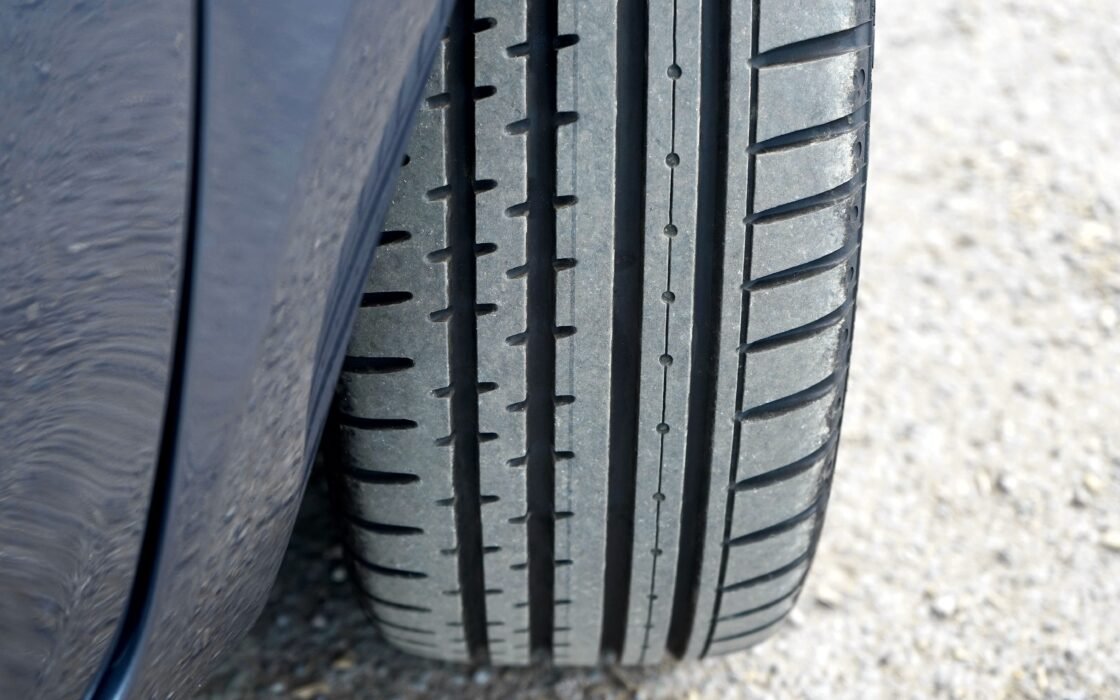
- Tread depth with a gauge or the penny test. At or below 2/32 inch the tyre is legally worn out — but grip in the wet degrades long before that.
- Uneven wear across the tread. Worn shoulders point to underinflation; a worn centre strip points to overinflation; wear on one side points to alignment.
- Sidewall bulges or cracks. Any bulge means replacement, not repair.
- All four compared side by side. A single tyre wearing faster than the others is telling you something mechanical is wrong.
Do this every time you rotate. It costs two minutes and it’s the difference between replacing one tyre and replacing four.
Tyres when buying used
A set of EV tyres is a $1,000 to $2,000 item, which makes it a real negotiating lever on a used car — and a real hidden cost if you miss it.
Check all four for tread depth and even wear before agreeing a price. Uneven wear is doubly useful information: it costs you a tyre set now, and it hints at alignment or suspension issues, or an owner who skipped rotations and may have skipped other things too. Our used EV buying checklist covers what else to verify.
Frequently asked questions
How many miles should I get from EV tyres? Plan on 30,000 to 40,000 with normal driving. A heavy performance EV driven hard can be down to 20,000–25,000. A gently driven, efficiency-focused model on rotated tyres can reach 40,000–50,000. Your right foot is the biggest variable.
Can I fit regular tyres to my EV? Physically yes, provided the load index and speed rating meet the placard specification. But they’ll typically wear 5–20% faster on the weight, and the noise difference is noticeable in a quiet cabin. The saving is usually false economy.
Why are EV tyres more expensive? Higher load ratings, reinforced construction, specialised compounds and often noise-damping foam inside the tyre. You’re buying a more heavily engineered product, not just a marketing label.
Does regenerative braking help or hurt tyre wear? Both, in different ways. It reduces hard braking events, which helps. But it shifts deceleration force through the drivetrain and tyres rather than the brake pads, with different heat and load patterns. On balance, smooth regen driving is easier on tyres than aggressive pedal work.
Should I replace all four at once? On an all-wheel-drive EV, generally yes — mismatched rolling diameters can stress the drivetrain. On single-motor cars you can replace in pairs across an axle. Never replace just one unless the others are nearly new.
Do tyres affect my range? Considerably. Rolling resistance is one of the largest energy losses at steady speed, which is why manufacturers fit low-rolling-resistance tyres in the first place. Switching to a harder-wearing touring tyre typically costs a few percent of range — worth knowing before you make that trade.
The short version
Budget 30,000 to 40,000 miles per set and $1,000 to $2,000 fitted, which works out around 2.7 cents a mile against about 1.0 for a petrol car. Over the life of the vehicle that’s a genuine cost, and it offsets a meaningful share of the maintenance saving that makes EVs cheap to run.
Two habits recover most of it: rotate every 5,000 to 7,500 miles, and stop using the full torque at every green light. Neither costs anything, and together they’re worth thousands of miles of tread. For how tyres fit into the complete picture, see our five-year cost comparison.
Cost is only half the decision — Consumer Reports’ 2026 testing found that a conventional all-season can beat an EV-specific tire outright, which changes what you should actually buy.
Sources
Kelley Blue Book — EV tyre replacement guidance and Hyundai’s 20% faster wear estimate. Michelin industry estimates on EV tyre life. Vehicle weight comparisons from manufacturer specifications. EPA / DOE FuelEconomy.gov — tyre pressure and rolling resistance effects on efficiency. AAA Your Driving Costs — EV versus petrol maintenance spending. Tyre life and pricing vary widely by model, size, driving style and region; these are typical ranges rather than guarantees.