Hotel EV Charging: What It Actually Costs and How to Use It
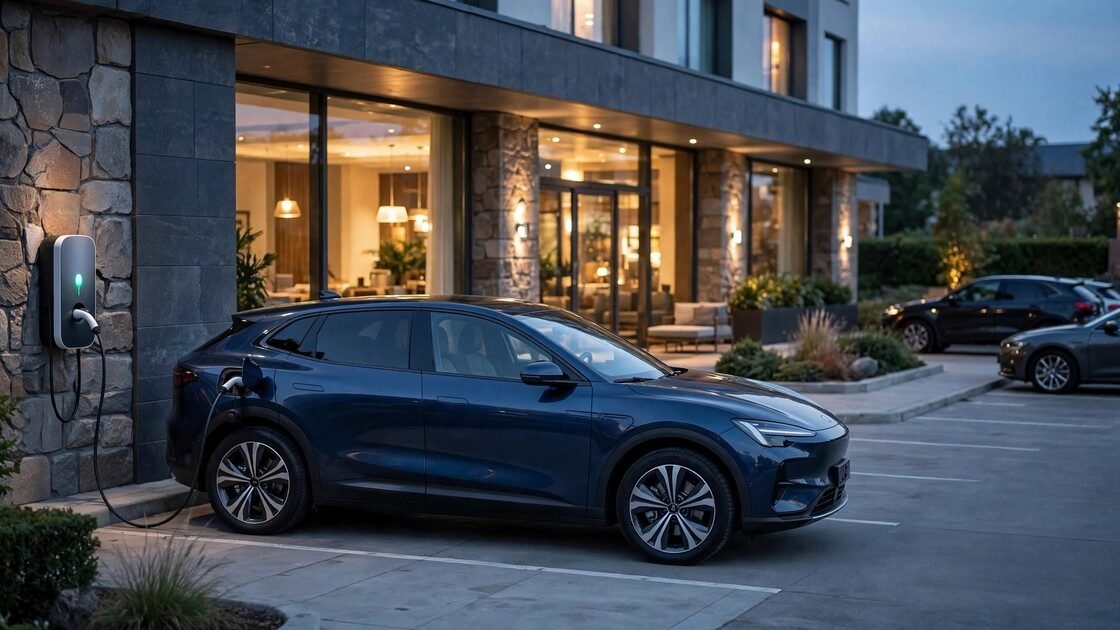
You roll into the hotel parking lot at 9:47 PM with 34 miles of range left and a 210-mile drive ahead tomorrow morning. In the corner of the lot, two wall-mounted chargers glow green under a little sign: EV Charging — Guests Only. You plug in, go to sleep, and wake up to a full battery. The bill shows $0 for charging.
That overnight trick is one of the cheapest ways to run an EV on a road trip — and one of the least understood. This guide covers how hotel and vacation-rental charging actually works, what it really costs, and how to plan a trip so you never pay fast-charger prices for energy you could have collected overnight.
The 60-Second Version
- Scale: Tesla says there are over 40,000 Wall Connectors at destination-charging locations as of October 2026 (Tesla’s figure, via a secondary source). Hilton’s 2023 deal with Tesla is putting up to 20,000 Universal Wall Connectors at 2,000 hotels in the US, Canada, and Mexico.
- Speed: up to 11.5 kW — about 44 miles of range per hour on a Model 3/Y at best — but shared circuits and 208-volt hotel wiring often deliver roughly half.
- Cost to the hotel: a full overnight session of roughly 56 kWh costs the property about $10 at US average residential rates. That is why so many hotels give it away. (Our calculation.)
- Cost to you: often $0 for guests — but Tesla-billed sites charge per kWh through the app, and third-party posts on hotel property charge standard network rates.
Short Answer
Hotel EV charging is usually a Level 2 charger you use overnight: up to 11.5 kW, good for 200–350 miles over a full night, and frequently free for registered guests. Confirm the price, guest-only rules, and connector type before you book — chargers are often shared between cars, and vacation rentals have no standard rule at all. One free hotel night typically replaces $10–$20 of paid fast charging.
How hotel charging actually works
There is no single “hotel charging” product. Walk a hotel parking lot and you will find one of three setups.
1. The host-run Level 2 charger. The classic case: the hotel bought a charger — often a Tesla Wall Connector, sometimes a ChargePoint or other unit — and sets its own rules. Most set the price at zero for guests, treating roughly $10 of electricity as a room-night amenity cheaper than the minibar restock.
2. A third-party public charger on hotel property. Owned by networks like Electrify America or EVgo, open to anyone, billed at the network’s normal rates — sometimes a premium. Our public EV charging cost guide covers those rates.
3. The Tesla-billed destination site. Tesla lets some businesses meter and bill destination charging through the Tesla app, per kWh, price shown on the site’s map pin. These sites can levy idle fees — $0.50 per minute, $1.00 when fully occupied, only when the site is at least half full, waived if you move within five minutes.
The confusion to avoid: destination chargers look like fast chargers on the car’s map but are different hardware. A destination charger is AC Level 2, capped by your car’s onboard charger at 11.5 kW. A Supercharger is DC, feeding the battery directly at up to 250 kW. One is for sleeping through; the other is for stopping for coffee. Mixing them up is how people plan routes around the wrong charger — a theme we return to in our EV road trip charging cost breakdown.
The cost math: who really pays for “free” charging
“Free” is a pricing choice, not a property of the electricity. Someone always buys the kilowatt-hours. The numbers show why hotels are happy to be that someone — and why the arrangement is fragile.
A Tesla Wall Connector on a full 48-amp, 240-volt circuit delivers 11.5 kW — up to 44 miles of range per hour for a Model 3/Y. At real hotels, three things cut that: Tesla’s sample host design shares two or three units on one 100-amp breaker (continuous-load rules cap it at 80 amps, so three cars split about 27 amps / 6.4 kW each, roughly 25 miles per hour); commercial buildings often run 208 volts, shaving about 13%; and the host can commission a smaller breaker. Realistic overnight: 6–8 kW — plenty while you sleep, since eight hours at 7 kW is about 56 kWh, roughly 190 miles for a Model 3.
At the US average residential rate of 18.31¢/kWh (EIA, July 2026), those 56 kWh cost the hotel about $10.25 — our calculation, and the whole business model: a $10 perk that books a $150 room is cheap marketing. It also explains why the model is drifting toward paid — as more guests arrive with EVs, hotels that once absorbed two sessions a week now face twenty a night.
The guest-side comparison is stark. A 150-mile top-up at roughly 261 Wh per mile including charging losses needs about 39 kWh of wall energy (our approximation from Tesla’s 48-amp figures). At a typical Supercharger member-level rate of about 43.4¢/kWh, that is roughly $17; at home at 18.31¢/kWh, about $7.14; free at the hotel: $0. The strategy follows directly: Supercharge only enough to reach the hotel, then let the overnight charger finish the job. Over five nights, the savings against fast-charging-only easily clear $50–$80.
Overnight vs fast-charge trip calculator
Plug in your own trip numbers. The model is simple: each free overnight replaces up to 40 kWh that you would otherwise buy at fast-charger prices (an example value — set it to your typical overnight top-up). Savings = overnight kWh × fast-charger price. Our calculation, your inputs.
(example: 3.4)
(example — US average is about 55¢)
(example)
How the formula works: total energy = trip miles ÷ your efficiency. Hotel nights contribute nights × overnight kWh, capped at the trip total. The rest is priced at your fast-charger rate. Charging losses are folded into your efficiency figure.
What the big hotel chains actually offer
Chain policies are moving targets — franchises decide individually — but the broad picture as of late 2026 looks like this:
| Chain | Program | Typical cost to guest | Booking tip |
|---|---|---|---|
| Hilton | Tesla Universal Wall Connectors at up to 2,000 properties (deal announced Sept 2023); ~1,850+ properties already listed with charging | Often free for guests; some properties bill | Filter by “EV Charging” on Hilton.com; confirm with the front desk |
| Marriott | Property-level decision; ChargePoint and EVgo units common at higher-end brands | Rarely free; usually metered through the network app | Check Bonvoy app filters; Courtyard and Residence Inn are most reliable |
| Hyatt | Select urban and resort properties, mixed providers | Occasionally complimentary | Call ahead — listings are inconsistent |
| IHG | Limited rollout, mostly Holiday Inn Express | Usually metered | Verify the specific property; don’t assume |
Three notes on that table. First, the Hilton–Tesla announcement dates to September 2023 and 20,000 connectors is the plan — availability is still spotty at many franchise locations (Skift’s coverage of the announcement). Second, “Universal” means any North American EV can use the connector — though host-run units can be access-limited to Teslas. Third, EV charging is reportedly one of Hilton’s most-used booking filters, second only to airport-shuttle access; expect free charging to keep drifting toward paid.
Airbnbs and vacation rentals: no standard rule at all
Hotels at least have signs and filters. A vacation rental has whatever the host decided, and the default in most listings is silence — which is where the money arguments start. Host forums are full of them: a guest plugs into an outdoor outlet overnight without asking, the host watches the hourly usage spike on their smart meter, and the checkout review turns into a dispute over a $10–$20 bill. Owner-reported, secondary evidence — but the pattern is consistent enough to plan around.
A 40 kWh overnight charge costs the host about $7.30 at the US average residential rate of 18.31¢/kWh (our calculation) — but a California host paying 33–50¢/kWh (owner-reported) faces $13–$20 for the same session, a conflict Airbnb hosts describe repeatedly.
As a guest, the rule is simple: never plug in without asking. A regular 120-volt outlet adds only 3–5 miles of range per hour — about 40–45 miles overnight. Enough for local driving, not a road-trip fill-up. Unknown outlets and daisy-chained extension cords are also a genuine fire risk.
Listings with a proper Level 2 charger are the gold standard — 20–40 miles per hour, with the fee model usually disclosed upfront: bundled into the nightly rate, a flat fee of roughly $15–$30 per night, or metered per-kWh billing (a host guide documents all three). Hosts considering an install face average costs of about $1,800 for a Level 2 unit (Argonne National Laboratory estimate, via the same secondary source), and the federal 30C charger credit expired on 30 June 2026. If you are comparing install math for your own home, our home EV charger installation cost guide runs the full numbers, and the same state-by-state charging cost math applies to rental hosts.
When hotel charging is NOT the answer
- You arrive nearly empty, late at night. A destination charger adds roughly 25–40 miles per hour on a shared circuit. If you need 150 miles by 7 AM, do the arithmetic before skipping the fast charger on the way in.
- You are not a guest. Most hotels reserve host-run chargers for registered guests. Pulling in for a “quick top-up” without a room key often ends at the front desk being told no.
- The site is full or the stalls are iced. Two chargers, four EVs, and a pickup in one of the spots is a normal Friday night at a busy hotel. Keep a fast-charger backup within range.
- You need a receipt for business travel. Free charging produces no receipt. A metered third-party post or Tesla-billed site gives you documentation to file; a free hotel plug gives you nothing.
Before you book any stay for its charger, call the front desk — not the central reservations line — and confirm the price, the guest-only rules, and the connector type. For vacation rentals, ask whether charging is included in the nightly rate or billed separately, and which outlet to use. Our EV charging etiquette guide covers the unwritten rules once you are plugged in.
Frequently asked questions
Is hotel EV charging really free?
Often, but never assume it. Host-run chargers are frequently free for guests because the electricity costs the property roughly $10 a night (our calculation). But Tesla also runs billed destination sites that charge per kWh through the app, third-party posts on hotel property charge standard network rates, and the trend is drifting from free toward paid as utilization rises. The price is set by the property — confirm before you book.
How long does it take to charge an EV overnight at a hotel?
Eight to ten hours at a typical hotel Level 2 charger adds roughly 200–350 miles for a Tesla at full 48-amp power, less on shared circuits or 208-volt wiring — figure roughly 25 miles per hour with three cars splitting one circuit (our calculation). For most EVs, one overnight stay takes the battery from low to your set limit.
Can I charge my EV at an Airbnb?
Only with the host’s permission, arranged before you plug in. Some listings bundle charging into the nightly rate, some charge a flat nightly fee, and some have no charger at all. A regular outlet gives you only about 40–45 miles overnight (our calculation) — enough for local driving, not a road-trip fill-up. Plugging in unannounced is the single most common EV-related host dispute.
Does Hilton charge for Tesla charging?
It depends on the property. Hilton’s 2023 deal with Tesla is bringing up to 20,000 Universal Wall Connectors to 2,000 hotels in the US, Canada, and Mexico, and many properties offer charging free to guests — but each hotel sets its own policy and some bill per kWh. Use the EV-charging filter when booking, then confirm with the front desk directly.
The Bottom Line
Hotel charging is the closest thing road-tripping EVs have to a free lunch: a roughly $10 electricity perk folded into your room rate that replaces $15–$20 of fast charging per night. Confirm the price, access rules, and connector before you book, keep a fast-charger backup in your pocket, and never plug in at a vacation rental without asking. The cheapest electrons of your trip are the ones you collect while you sleep.
Safety note: only charge from outlets and circuits rated for the load — overloaded circuits and long extension-cord runs are a fire risk. Ask the host or front desk which outlet to use, and have a licensed electrician check any outlet you plan to use regularly.
Written by Shurah, who researches and writes independently on the real cost of EV ownership — charging, maintenance, and total cost of ownership — backed by primary data and original calculations rather than recycled lists.