23.7 against 80.8. Those are brake-related MOT failures per 1,000 tests for electric and petrol cars in the UK, from a CarHunch analysis of 10 million DVLA MOT records published in March 2026. Regenerative braking does most of the slowing in an EV, so the pads and rotors hardly wear.
The same data hides a catch. When an EV does fail on brakes, the most common defect wording isn’t “pads worn”. It’s “service brake excessively binding”: a caliper stuck on its slides, most often at the rear. The brakes didn’t wear out. They seized from lack of use.
Below: why it happens, how to tell harmless rust from the expensive kind, what Tesla and Chevrolet advise, and a quick check for your own car before salt season.
Where the numbers stand
- Brake-related MOT failures per 1,000 tests (UK): EV 23.7, hybrid 29.3, petrol 80.8, diesel 126.7
- Corrosion or seizure failures at a car’s first MOT, per 1,000: EV 0.64, petrol 1.57, diesel 2.20
- Share of EV first-MOT brake failures caused by corrosion or seizure: 6.9% (petrol 6.6%)
- Tesla’s interval where roads are salted: clean the brake calipers every year or 12,500 miles
- Chevrolet’s advice for its EVs: inspect and clean calipers and rotors once a year
- Speed a Jaguar service bulletin suggests for rust-clearing stops: 30–35 mph, moderate deceleration
The quick answer
Yes, EV brakes rust more easily than a petrol car’s, not because they work harder but because they barely work at all. Regenerative braking means the pads rarely sweep the iron rotors clean, so rust bonds to the surface and caliper slides stiffen. Light orange rust after rain is normal. Grinding that doesn’t clear, pulling, or a hot wheel is not. A few firm stops each week, plus an annual caliper clean in salted-road areas, prevents most of it.
Why a part you barely use still goes bad
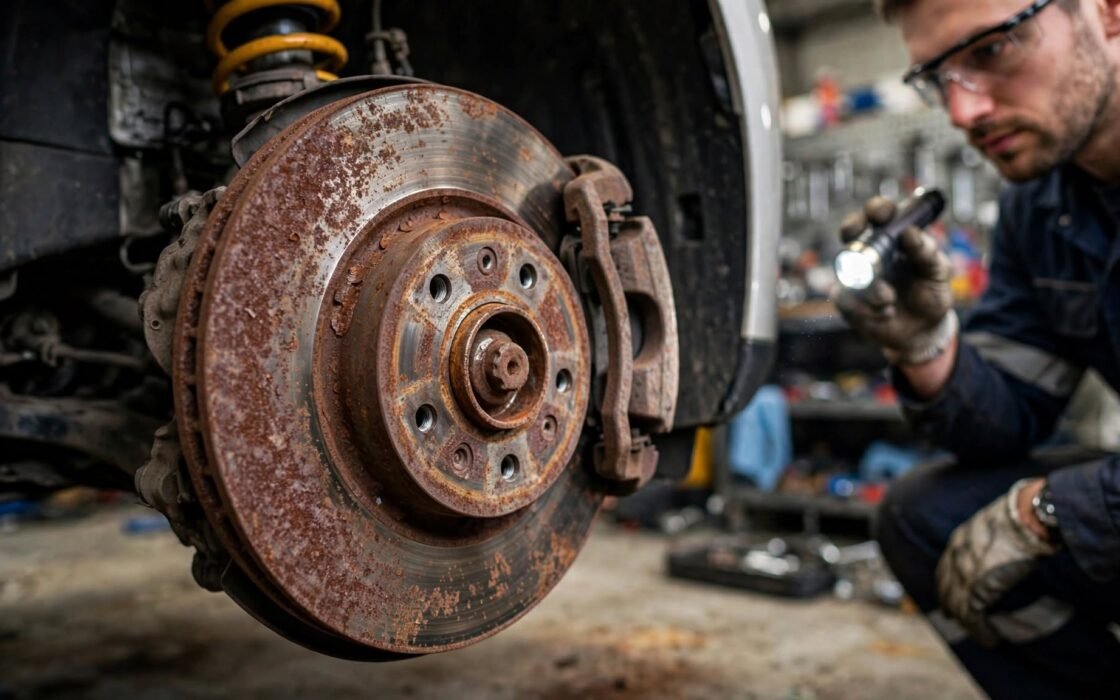
Brake rotors are cast iron, and bare iron can start rusting within hours of getting wet. That’s the orange film you see on any car after rain. On a petrol car it never settles, because every stop drags the pads across the rotor and scrapes it off, and the heat dries everything out.
An EV breaks that cycle. Lift off the accelerator and the motor slows the car while sending energy back to the battery. A light press on the brake pedal often does the same, because most EVs blend the two systems: motor first, friction brakes only when you ask for more stopping force than the motor can give. How much pedal it takes before the pads clamp varies by car, and few manufacturers publish it.
So the rust stays, and three things follow:
- Rust bonds to the rotor face, building up in patches and around the edge until normal stops can’t clean it off.
- Caliper slides and pad seats corrode. Pads are meant to move freely in their brackets. Once rust and dried grease stop them, a pad either stays lightly pressed on the rotor (binding) or applies unevenly.
- The parking brake stiffens on cars where it works through the rear calipers.
The rear axle usually comes off worst. Weight shifts forward under braking, so cars do most friction braking at the front. In an EV that rarely uses its friction brakes anyway, the rear ones get the least work of all, which is where the UK failure data clusters.
The awkward part: the EV most at risk often looks best on paper. Low mileage, gentle driver, washed every week. That’s a car whose brakes almost never get a hard, dry stop.
Normal rust or a real problem? Start with the symptom
| What you notice | What’s probably going on | What to do |
|---|---|---|
| Orange film on the rotors after rain, a wash or a night outside | Flash rust: bare iron reacting with water | Nothing. It wipes off in the first few stops |
| Scraping or light grinding on the first stops, then it fades | Surface rust being scraped away | Normal if it fades. If it lingers, do a few firm stops |
| A pulse or judder through the pedal at low speed | Uneven rust patches or deposits on the rotor face | Firm stops from 30–35 mph. If it stays, get the rotors checked |
| The car pulls to one side under braking | A caliper sticking on one side | Inspection. Usually a clean-and-lube job if caught early |
| One wheel hot or smelly after a drive, or efficiency quietly drops | A binding caliper dragging its pad on the rotor | Get it checked soon. A dragging brake turns battery energy into heat |
| A rough rust ring, with only a narrow shiny band where the pads touch | Heavy corrosion; the pads only reach part of the rotor | Rotors, and often pads, likely need replacing |
| Grinding or vibration that firm stops don’t fix, with visible pitting | Corrosion past the point braking can clear | Replace the discs |
The last row isn’t forum folklore. A Jaguar service bulletin on file with NHTSA splits disc corrosion into two cases: surface rust with some grinding improves with normal use and needs no replacement, while heavy corrosion with grinding or vibration means new discs. Jaguar wrote it for petrol cars that sat unused. An EV can get there while driven daily.
How common is it, really?
Less common than the forum threads suggest. The CarHunch figures, which run to January 2026, cut both ways.
On brake failures overall, EVs are far ahead: 23.7 per 1,000 tests against 80.8 for petrol and 126.7 for diesel. That diesel number also undercuts the idea that battery weight wrecks brakes. Diesels are heavy and have no regen, and they fail on brakes about five times as often as EVs. Extra weight shows up far more in suspension and tyre wear.
On corrosion, CarHunch isolated cars taking their very first MOT in 2025. EVs failed for brake corrosion or seizure at 0.64 per 1,000, against 1.57 for petrol, about 2.4 times lower. But when an EV did fail for a brake reason, corrosion or seizure was behind it 6.9% of the time, almost the same as petrol’s 6.6%.
Read together, brake corrosion in EVs is a real pattern, not an epidemic. The difference is the cause: a three-year-old petrol car with rusted brakes has usually been left sitting, while an EV can get there being driven every day.
One limit: this is British data, from a damp, salted-road climate with a compulsory yearly test. Where there’s no regular safety inspection, nobody else checks your calipers. That’s our inference, not part of the dataset.
What the manufacturers actually say
| Source | What it says | Who it applies to |
|---|---|---|
| Tesla Model Y owner’s manual | Clean the brake calipers every year or 12,500 miles (20,000 km) where roads are salted in winter. Separately, press the brake pedal frequently to apply the mechanical brakes, which dries the pads and rotors. | Interval: salted-road areas. Pedal advice: all owners |
| Chevrolet EV guidance | Inspect and clean calipers and rotors annually, because rust builds up when friction brakes are used less. Brake fluid every 2–3 years or per the manual. | All Chevrolet EVs |
| Jaguar bulletin SSM73929 | Clear surface rust by braking from 30–35 mph with moderate deceleration, rather than coasting to a stop. | Written for lightly used petrol cars; the same mechanism applies to EVs |
| Volkswagen ID.4 | Rear drum brakes, partly because drums respond better after long periods of disuse caused by regen. | ID.4 rear axle |
The Tesla Model Y manual ties its interval to winter road salt. Chevrolet’s EV maintenance guidance applies the annual clean to every EV it sells, the Equinox EV included. If your manual is silent, Chevrolet’s approach is the safer default in snowy, coastal or humid areas. That’s our view, not a manufacturer rule.
Volkswagen chose hardware. A VW spokesman told The Drive the ID.4’s rear drums were picked mainly to cut rolling resistance, but also because drums respond better after the long idle spells regen creates. An enclosed drum keeps its friction surface out of road spray. The fix exists; most cars just don’t have it.
The two-minute weekly habit
The cheapest fix is the one Tesla lists in its daily checks: use the friction brakes on purpose.
- Find a quiet, dry road with nothing behind you.
- Get up to about 30–35 mph.
- Brake firmly with the pedal, harder than a normal stop but well short of an emergency stop, down to walking pace.
- Repeat two or three times.
Why firm and not gentle? Blending again. A light press may be handled almost entirely by the motor, so the pads never touch the rotor. A firmer stop asks for more than regen can supply, so the pads clamp and sweep the surface. Turning regen down for these stops, if your car allows it, helps.
Two smaller habits help. After a wash or a wet drive, a couple of firm stops before parking dries the pads and rotors. In salt season, rinsing the wheels with plain water now and then keeps salt from sitting on the brakes for weeks.
Only do test stops where it’s safe and legal, with nothing behind you. If the pedal ever feels soft or braking feels weak, stop driving and get the car inspected.
Check your own car
Enter how and where you drive. The tool scores your corrosion risk, estimates when a caliper clean is due on the common 12-month / 12,500-mile interval, and compares a cleaning quote with a replacement quote. The score is our own rule of thumb, not a manufacturer formula, and your owner’s manual overrides it.
EV brake corrosion check
The two quote fields start with example numbers only, not market prices. Replace them with real quotes from your shop. Miles since the last clean assume you drive evenly through the year.
The logic: salt and damp supply the corrosion, strong regen and low mileage remove the pad contact that would scrape it off, and firm stops put that contact back. The cost line is plain division. If a clean costs a quarter of an axle job, one avoided replacement covers four years of cleaning.
What a brake clean involves, and what it costs
Shops call it a caliper clean and lube: pads out, corrosion cleaned off the brackets, slides and pad seats, high-temperature lubricant on the contact points, rotor faces cleaned, everything refitted. It’s labour, not parts, so it costs a fraction of a replacement that adds new rotors and pads on top of the same time.
CarHunch puts freeing a single seized slide at around £80 when it’s caught at a service, and warns that leaving it until the annual test can mean a retest and a bigger bill. Four-wheel quotes vary widely by brand and shop, so get one in writing.
When you book, ask for the job by name and for the slides, guide pins and parking brake to be checked, not just pad thickness. EV pads last a long time, so “pads look fine” says nothing about whether they move freely.
Buying used? Low mileage doesn’t mean healthy brakes and can mean the opposite. Look through the spokes for a rough rust band on the rotors, listen for scraping on the test drive, and ask whether the brakes were ever cleaned. Our used EV buying checklist covers the rest of the inspection.
Questions owners ask
Does one-pedal driving cause brake rust?
It adds to the risk. The stronger the regen, the less the pads touch the rotors. That’s no reason to give up one-pedal driving. Just add a few deliberate firm stops to your week.
Does a Silverado EV need brake service?
Yes. Chevrolet’s guidance calls for a yearly inspection and cleaning of calipers and rotors on all its EVs, and a brake fluid change every 2–3 years or per the manual. A heavy truck that slows mostly on regen is exactly the case it’s written for. The rest of the schedule is in our Silverado EV maintenance guide.
Can a sticking brake cut my range?
It can. A binding caliper keeps a pad pressed on the rotor and turns battery energy into heat at that wheel. If efficiency drops for no clear reason and one wheel feels warmer after a drive, get the brakes checked. Ordinary winter range loss is a different thing, mostly cabin heating, as our cold-weather range guide explains.
Will my EV ever need new pads and rotors?
Eventually, though often far later than a petrol car would. The CarHunch data shows EV brake failures are often about parts that stick rather than parts that wore out: the top EV defect wording is a binding brake, not worn pads. The full service picture is in our EV maintenance schedule.
If you remember one thing
EV brakes rarely wear out. They seize from neglect. The fix costs almost nothing: a few firm stops a week, a dry stop before parking a wet car, and a yearly caliper clean if your roads see salt. Skip it, and the most durable part of the car becomes a surprise bill, usually right before an inspection.
About the writer
Written by Shurah, who researches and writes independently on the real cost of EV ownership — charging, maintenance, and total cost of ownership — backed by primary data and original calculations rather than recycled lists.