Ask a mechanic who services both gas cars and EVs whether suspension parts wear out faster on the electric side, and you’ll get a fairly consistent answer: yes, generally, for two separate reasons — not one. Neither reason is exotic engineering. Both are physics anyone can follow, and neither means an EV’s suspension is unusually expensive or fragile once you know what’s actually driving it.
Key Numbers
- EVs commonly weigh 1,000 to 3,000 pounds more than a comparable gas vehicle, almost entirely from the battery pack.
- Depending on the specific model comparison, that works out to roughly a 20–30% weight increase, with the battery alone frequently adding 200–600+ pounds.
- Electric motors deliver their full peak torque instantly from a standstill, unlike a gas engine that builds torque gradually through the rev range — a mechanical “whiplash” effect trade publications specifically flag as a suspension-loading factor.
- Premature control arm, ball joint, and front-link wear on the Tesla Model S is common enough that multiple aftermarket suppliers now manufacture reinforced replacement parts specifically for it — a real signal from the repair industry, not a formal study.
- At least one trade publication’s honest counterpoint: well-designed EV suspension hardware doesn’t show a dramatic replacement-frequency difference from gas vehicles in practice — the parts themselves are the same conventional components, not something EV-specific.
Short Answer
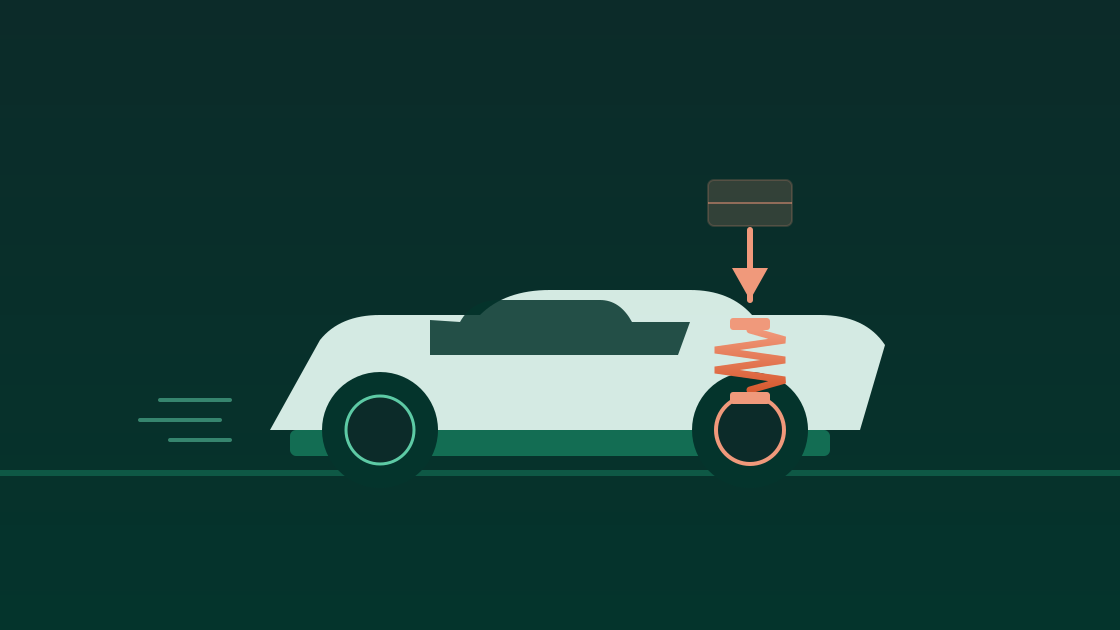
Yes, generally — but the effect comes from two separate mechanisms working together, not one, and it’s a matter of degree rather than EV suspension being a different or more fragile category of part. Static weight loads bushings, ball joints, and springs harder on every mile; instant torque delivery adds a dynamic “whiplash” loading pattern under acceleration that a gradually-building gas engine doesn’t produce. Both effects are real and widely reported across the repair industry, but the actual components are identical to what’s under a gas car, and driving style and road conditions matter as much as the weight itself.
Two Different Mechanisms, Not One
It’s worth separating these clearly, because they behave differently and respond to different driving habits:
- Static/dynamic weight loading. Control arms, ball joints, bushings, springs, and shocks all support the vehicle’s mass on every mile driven, over every bump. More weight means more constant load on rubber and polyurethane bushings specifically — one repair-industry analysis notes this causes bushings to crack and degrade meaningfully faster under sustained heavier loads, independent of how the car is driven.
- Instant-torque “whiplash” loading. A gas engine’s torque builds progressively as RPMs climb; an electric motor delivers its peak torque the instant the accelerator is pressed. Kwik Fit’s technical writeup describes this as a whiplash-like effect transmitted through suspension bushings and mounts specifically during hard acceleration — a loading pattern gas vehicles simply don’t produce in the same way, regardless of weight.
Where the Extra Weight Actually Comes From
The gap isn’t spread evenly across the car — it’s concentrated in one place. In a gas vehicle, mass is distributed around the engine bay, transmission, fuel tank, and exhaust system. In an EV, the single heaviest component — the battery pack — sits low and flat between the axles. That changes the load path through the suspension geometry compared to a gas car of similar overall weight, on top of simply being heavier in total. The lower, more centered mass is genuinely good for handling and rollover resistance, but it still means the suspension components bearing that load are working under a different distribution than they were originally designed around in a conventional platform.
The Tesla Model S: A Real, If Informal, Case Study
The clearest evidence this isn’t just theoretical comes from the aftermarket parts industry itself. One trade publication notes that premature wear of front control arms, links, and ball joints on the Tesla Model S is common enough that specialty manufacturers now produce reinforced replacement parts specifically engineered for it — a business only makes sense to build if mechanics are actually seeing the failure pattern repeatedly in the field. That’s meaningful real-world signal, though it’s worth being precise about what it is: evidence from industry response and shop experience, not a controlled comparative study with hard failure-rate numbers.
The Honest Counterweight
It’s not universally “EVs destroy suspensions.” Tire Review’s own service-industry coverage makes a point of noting there isn’t a dramatic difference in how often ride-control parts actually get replaced on EVs versus gas vehicles in practice, despite the added stress from weight. The components themselves — control arms, bushings, ball joints, springs, shocks, struts — are the same conventional hardware used across the industry, engineered by each manufacturer to handle their specific vehicle’s mass and torque figures. A well-engineered EV platform accounts for this in its suspension tuning from the start; the wear pattern shows up more in specific models (like early Model S examples) and specific driving styles than as a blanket rule for every EV on the road.
What Actually Accelerates the Wear
- Repeated hard acceleration from a stop — exploiting the instant-torque launch feel regularly compounds the whiplash-style loading on front suspension mounts specifically.
- Rough roads and potholes — the same factor that ages any car’s suspension, but a heavier vehicle transmits more force through the same impact.
- Heavy regenerative braking habits — one-pedal driving shifts more of the vehicle’s deceleration load through the motor and drivetrain mounts on every stop rather than friction brakes alone, a genuinely different cyclic loading pattern worth being aware of, though this is reasoning rather than a separately measured effect.
- Skipping alignment checks after a hard hit — a single significant pothole impact can knock a heavier vehicle’s alignment out further than it would a lighter one, which then accelerates uneven tire wear on top of the suspension wear itself, exactly the mechanism covered in our EV tire wear research.
What Symptom Points to What?
What This Means for Maintenance
Because the components are conventional, not EV-specific or exotic, the fix is inspection cadence, not different parts. If you’re following a model-specific interval — as in our Silverado EV and Equinox EV maintenance schedules — suspension and alignment inspection is already built into those recurring intervals precisely because of this weight/torque mechanism. There’s no separate “EV suspension maintenance plan” to follow beyond paying attention to the same tire-rotation and inspection intervals a well-designed schedule already includes.
FAQ
Are EV suspension parts more expensive to replace than gas car parts?
Generally no — they’re the same category of conventional component (control arms, bushings, ball joints, struts), not EV-specific hardware, so cost is driven by the specific make and model rather than by the vehicle being electric.
Does one-pedal driving specifically wear the suspension faster?
It’s a plausible contributing factor given the different braking-load pattern it creates, but it isn’t separately measured against traditional braking in the sources available — treat it as a reasonable consideration, not a settled finding.
Do all EVs show the same wear pattern as the Tesla Model S example?
No — that’s a documented pattern for a specific model and generation, not a universal EV finding. Suspension tuning and component sizing vary significantly by manufacturer and platform.
Should I drive more gently to protect my EV’s suspension?
Smoother acceleration and braking is a reasonable habit that plausibly reduces cumulative stress, alongside the more clearly established benefits for tire wear and range — it’s a sensible precaution rather than a strict requirement.
Is a heavier EV less safe because of suspension wear?
Wear affecting ride quality and component longevity is a maintenance and cost consideration, not inherently a safety defect — a worn component should simply be addressed through normal inspection and repair, the same as on any vehicle.
The Short Version
An EV’s extra weight and instant torque delivery do put more load on suspension components than a comparable gas car, through two separate mechanisms — constant weight-driven stress on bushings and joints, and a torque-driven whiplash effect under acceleration. The Tesla Model S’s well-documented aftermarket replacement-parts response shows this is a real pattern in at least some models, but it isn’t a universal EV rule, and the components themselves are ordinary, not exotic or unusually costly. The practical takeaway is inspection cadence and driving habits, not a fundamentally different suspension category to worry about.
About the author: Written by Shurah, who researches and writes independently on the real cost of EV ownership — charging, maintenance, and total cost of ownership — backed by primary data and original calculations rather than recycled lists.