If you’ve owned a gas car, you probably know the drill: park it for a few weeks, come back to a dead battery, hook up a trickle charger next time. It’s reflexive advice that a lot of new EV owners carry over — and for most EVs, most of the time, it’s unnecessary. The real answer is more specific than “yes” or “no.”
The Short List
- Most modern EVs automatically top off their 12V battery from the main traction pack on a periodic schedule, even when parked, unplugged, and not driven for weeks.
- That auto-maintenance can stop working if the high-voltage pack itself drops to a low state of charge — Tesla owners have reported the threshold sitting around 20%.
- A real compatibility trap exists on some EVs: certain Tesla configurations use a 15-16V lithium auxiliary battery instead of a standard 12V lead-acid — and a normal lead-acid maintainer simply won’t charge it (the BMS rejects it).
- Some visible “jump points” on EVs — like the wires behind Tesla’s frunk tow-hook cover — don’t connect directly to the 12V battery at all. Clamping a maintainer there does nothing.
- Our own 12V battery research found this small, unglamorous battery causes roughly 50.5% of EV roadside breakdowns — it’s a real failure point, just not usually one a maintainer prevents.
Quick answer: Most EVs don’t need a 12V maintainer for normal storage, because the car maintains it automatically from the main battery. You may want one if you’re storing the vehicle for months with the high-voltage pack left low, if you run accessories that drain the 12V faster than the car replenishes it, or if the 12V is already aging and you want to extend it. If you do use one, confirm your EV uses a standard 12V lead-acid/AGM battery (not a lithium aux battery) before connecting anything.
Why Most EVs Don’t Need One
The 12V battery in an EV runs low-voltage systems — infotainment, door locks, the contactors that let the high-voltage system engage — but unlike a gas car, it’s not the only thing keeping the vehicle’s electronics alive. The car’s DC-DC converter periodically pulls power from the main traction battery to top off the 12V, on its own schedule, whether or not the car is plugged in. Documented owner experience on Tesla Motors Club describes exactly this: the car checks and recharges the 12V periodically without any external maintainer, for as long as the high-voltage pack has adequate charge.
That’s a genuinely different situation from a gas car, where the battery only gets charged while the engine runs. It’s also why blanket “always use a maintainer” advice, lifted straight from gas-car culture, doesn’t automatically apply here.
When You Actually Might Want One
| Situation | Why it matters |
|---|---|
| Extended storage (months) with the HV pack left low | Auto-maintenance of the 12V can stop once the main battery itself drops to a low threshold |
| Heavy accessory drain | Dash cams, Sentry-style monitoring, or frequent app polling can outpace what the car replenishes — see our dash cam drain and phantom drain research |
| Aging 12V battery | A maintainer can extend a weakening battery’s useful life before it needs replacement |
| Vehicle sitting unregistered/unused long-term | Dealerships and long-term storage facilities do use maintainers on EV inventory for exactly this reason |
The Compatibility Trap Nobody Warns You About
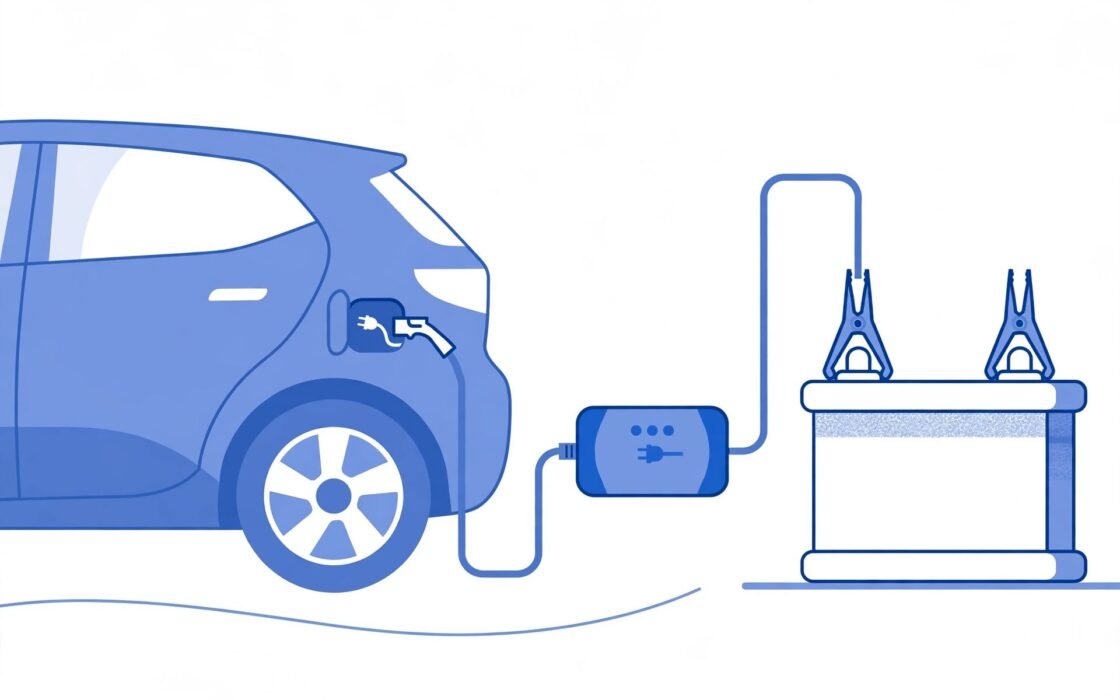
Here’s where generic “car battery maintainer” shopping advice breaks down for EVs. A standard 12V lead-acid/AGM maintainer is designed for lead-acid chemistry. Some EVs — notably certain Tesla configurations — use a 15-16V lithium auxiliary battery instead, which our jump-starter research already flagged as a real voltage-mismatch trap for jump-starting. The same trap applies here: as owners have reported on Tesla’s owner forums, a lithium battery’s BMS will typically reject charging current from a device that isn’t matched to its chemistry and voltage — a standard lead-acid charger simply won’t work, and using the wrong mode on the wrong charger has been reported to cause real problems, up to and including bricked infotainment systems in documented cases.
The other trap: some accessible connection points on an EV aren’t wired to the 12V battery at all. On several Tesla models, the exposed wires behind the front tow-hook cover exist to power specific controllers for tasks like popping the frunk — not to charge the battery. Clamping a maintainer there accomplishes nothing, even though it looks like a natural connection point.
Choosing One, If You Need One
For EVs with a standard 12V lead-acid or AGM battery, a smart maintainer using multi-stage charging — bulk charge, then absorption, then automatic float maintenance — is the right category, not a basic unregulated trickle charger that lacks automatic shutoff. Look for:
- Automatic float/maintenance mode (safe for indefinite connection)
- Confirmed AGM compatibility, since most EV 12V batteries are AGM, not flooded lead-acid
- 1-1.5A output — EV 12V batteries are typically smaller-capacity than a full-size gas-car battery, so a higher-amp charger isn’t automatically better
- No “reconditioning” or desulfation mode used on a battery still connected to the vehicle, unless your specific EV’s manual confirms it’s safe — this is exactly the kind of mode that’s been linked to real compatibility problems
Do You Actually Need One?
Quick Check
FAQ
Will a trickle charger damage my EV if I use the wrong type?
Potentially, yes — especially using a lead-acid-only charger on a lithium aux battery, or using a “reconditioning” mode not confirmed safe for your specific EV. Documented owner reports include a bricked display after a mismatched charger and mode were used.
How do I know if my EV has a lead-acid or lithium 12V system?
Check your owner’s manual or ask a dealer — this isn’t something you can safely guess by battery appearance alone, and it’s the single most important thing to confirm before buying a maintainer.
Can I just leave my EV plugged into a regular charger to keep the 12V topped off?
Charging the main battery and maintaining the 12V are related but separate systems — being plugged in generally helps, but it’s not a guaranteed substitute for the car’s own 12V maintenance cycle if the HV pack is left at a low charge for a long time.
Is this the same battery covered in your 12V breakdown research?
Yes — the small 12V/AGM (or lithium, on some Tesla trims) auxiliary battery is what strands EVs, not the traction pack. A maintainer is a preventive tool for that specific battery, not a fix for HV-pack issues.
What should I do if my EV’s 12V keeps needing attention despite normal use?
Don’t just add a maintainer as a workaround — that pattern often points to an aging battery or an accessory drain worth diagnosing directly, since a maintainer treats the symptom rather than the cause.
Do You Actually Need One?
For most EV owners driving normally, no — your car already handles this better than a gas car ever did. The real use case is long-term storage, heavy accessory drain, or an aging 12V battery you’re trying to extend. If you fall into one of those categories, just confirm your battery chemistry before buying anything, since the wrong charger on the wrong system is a real, documented way to cause problems rather than prevent them.
About the author: Written by Shurah, who researches and writes independently on the real cost of EV ownership — charging, maintenance, and total cost of ownership — backed by primary data and original calculations rather than recycled lists.