Petrol stations post the price on a sign you can read from the road. Public EV charging posts nothing, varies by network, by state, by time of day and by whether you happen to hold a membership — and then adds fees that don’t appear until the receipt.
This guide lays out what each major network actually charges in 2026, the fees that catch people out, the exact point where a membership starts paying for itself, and the one category of station that’s quietly cheaper than all of them.
Cost is only one of the risks at a public charger — about one in eight visits still ends without a charge at all.
What the networks charge
Rates below are 2026 US averages for DC fast charging. Every network varies by location and time of day, so treat these as the shape of the market rather than a price list.
| Network | Guest rate | Member rate | Membership |
|---|---|---|---|
| Tesla Supercharger | ~$0.42/kWh | Lower for Tesla vehicles | Varies by market |
| Electrify America | ~$0.62/kWh guest (station-specific; tracked July 2026) | ~$0.46/kWh | Pass+, $7.00/month |
| EVgo | ~$0.44/kWh | Discounted tiers | Several plans |
| ChargePoint | $0.30–$0.50/kWh | Host-dependent | Free account |
| NEVI-funded sites | $0.25–$0.35/kWh | — | None required |
ChargePoint deserves a note: it doesn’t set prices at all. It operates the hardware and each site host — a shopping centre, a workplace, a council — sets the rate. That’s why ChargePoint pricing ranges so widely, and why a ChargePoint station can be free at one location and expensive a mile away.
EVgo is the outlier of the group: it prices highest of the big three and its rates barely vary from state to state, so there is no cheap region to seek out.
What that means per 100 miles
Using 3.3 miles per kWh, a reasonable figure for a mid-size EV in mixed driving:
| Where you charge | Per 100 miles | Per year (13,500 mi) |
|---|---|---|
| Home, US average rate | $6.13 | $828 |
| NEVI station at $0.30 | $9.09 | $1,227 |
| Electrify America, Pass+ | $10.91 | $1,473 |
| Petrol car, 30 mpg at $3.45/gal | $11.50 | $1,553 |
| Tesla Supercharger | $12.73 | $1,718 |
| EVgo | $13.33 | $1,800 |
| Electrify America, guest | $14.54 | $1,963 |
The petrol row is deliberately in the middle, because that’s the finding: at guest rates on most fast-charging networks, an EV costs more to fuel than a petrol car. Not marginally — Electrify America’s guest rate runs about 26% above the equivalent petrol cost.
This isn’t an argument against EVs. It’s an argument against fast charging as a routine. Home charging is roughly half the petrol cost; fast charging is roughly a quarter above it. The car hasn’t changed — only where you plug it in.
The fees nobody mentions until the receipt
Idle fees. The one that costs real money. Once your car finishes charging, most networks start billing by the minute — commonly $0.40 to $1.00 — and some only when the site is busy. The intent is reasonable: a finished car blocking a stall helps nobody. But park at a charger, walk to a restaurant, and come back forty minutes after it finished, and you can add $16 to $40 to a session that cost $20.
Set an alert on your phone for your expected finish time. That single habit saves more money than most membership plans.
Session fees. Some networks add a flat fee per session — EVgo’s is around $0.99, and charging without an account can attract a transaction fee of a few dollars. On a big top-up it’s noise. On a ten-minute splash-and-dash it can be a fifth of the bill.
Per-minute billing. A few states don’t permit per-kWh billing by non-utilities, so stations there bill by time instead. This punishes you twice over: if your car accepts power slowly, or the battery is cold, or you’re charging above 80% where every car slows down, you pay for minutes while receiving very few kWh. If you’re billed by the minute, stopping at 80% isn’t just good practice — it’s the difference between a fair price and a terrible one.
When a membership actually pays
The maths is simple, and most people either never do it or sign up for plans they don’t use enough to justify.
Pass+ costs $7.00 a month and saves roughly 25% (about $0.154/kWh at the network average). $7.00 ÷ $0.154 ≈ 45 kWh a month — under one full charge. Below that, the membership costs you money. Above it, it starts paying.
Apply the same arithmetic to any network:
- Find the monthly fee and the per-kWh saving
- Divide fee by saving — that’s your break-even in kWh
- Multiply by your car’s miles per kWh — that’s your break-even in miles per month
- Compare honestly against how much you actually fast-charge
Two practical notes. Memberships are usually monthly, so subscribe for a road-trip month and cancel afterwards rather than paying year-round for occasional use. And if your fast charging is scattered across three networks, no single membership will reach break-even — you’re better off unsubscribed. If most of your public charging happens on one network, a monthly membership can drop the per-kWh rate further — we worked out the exact break-even math for EV charging memberships.
The cheap option most drivers don’t know about
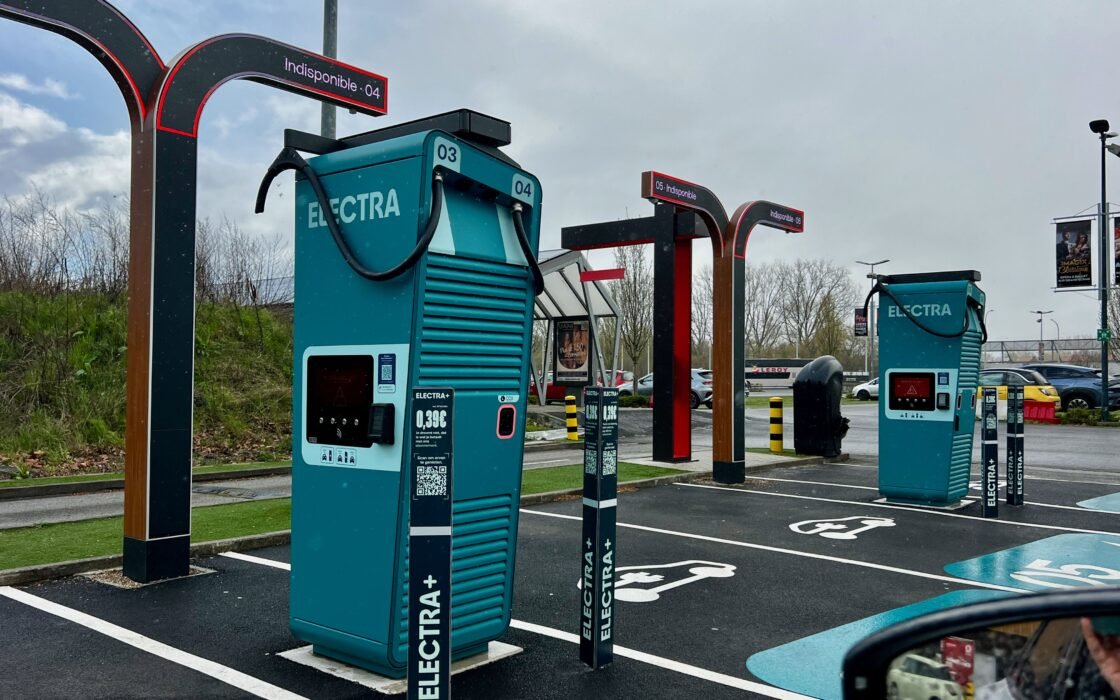
Stations built with federal NEVI funding come with conditions attached that happen to be excellent for drivers. They must display per-kWh pricing upfront before you start, and they must accept any credit or debit card — no app, no account, no membership. Private networks aren’t held to the same requirement.
On price, NEVI sites in lower-cost states have been trending $0.25 to $0.35 per kWh, competitive with or below Electrify America and EVgo guest rates. For anyone who fast-charges too rarely to justify a membership, this is the best-value option on the map, and it’s the one that behaves most like a petrol station.
Worth checking your route for them before defaulting to the network you already have an app for. The Department of Energy’s alternative fuels programme resources track federal and state charging initiatives.
Public Level 2 is a different product
Everything above is DC fast charging. Public Level 2 — the slower stations at shopping centres, hotels, car parks and workplaces — is a separate market with much better economics.
Rates typically run $0.20 to $0.35 per kWh, and a meaningful share of Level 2 stations are free, subsidised by the host to attract you into the shop or the hotel. At those rates public charging stays comfortably cheaper than petrol.
The catch is time: Level 2 adds roughly 25 miles of range per hour, so it only works if the car is parked for something you were doing anyway. That’s exactly why it suits drivers without home charging — the trick is attaching charging to an existing routine rather than making a separate errand of it. We cover how to build that routine in our guide to owning an EV without a driveway.
Fast charging costs your battery too
There’s a second bill, paid slowly. Fleet data across more than 22,700 vehicles found cars using DC fast charging for more than about 12% of sessions degraded at up to 3.0% a year, against roughly 1.5% for cars charged mostly on AC.
Over eight years that’s roughly 78% capacity versus 88% — on the same car, from charging method alone. Occasional road-trip fast charging is what the capability is for and isn’t a problem. Fast charging as your default is expensive in money and in range. The detail is in our guide to EV battery health and degradation.
Six ways to pay less on public charging
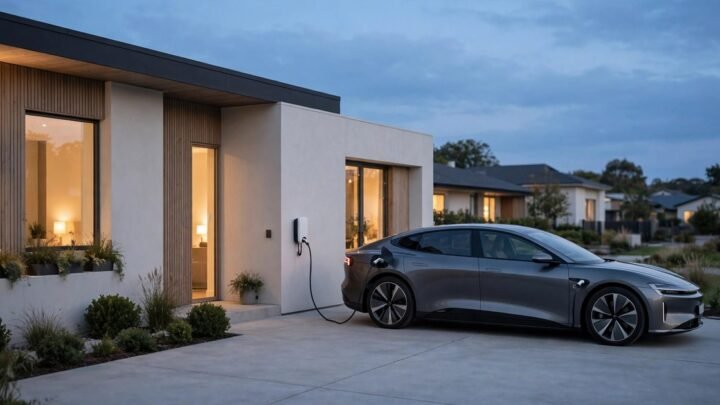
- Charge at home whenever you can. Nothing else on this list comes close — home is roughly a third of guest fast-charging rates. Our home charging cost guide covers the state-by-state picture.
- Stop at 80%. Faster overall, cheaper on per-minute billing, easier on the battery.
- Set an alarm for idle fees. The cheapest saving available, and it costs nothing.
- Check prices in the app before you commit. Rates vary by site and by hour on the same network; a station five minutes further on is sometimes materially cheaper.
- Look for NEVI sites on your route — transparent pricing, no app, often the lowest rate available.
- Use free destination Level 2 at hotels, workplaces and retailers. Slow, but free is hard to beat.
Paying full price at public chargers? Here is how to find genuinely free EV charging instead.
Frequently asked questions
Why is public charging so much more expensive than home? You’re paying for hardware, land, grid connection charges, maintenance and profit — not just electricity. A DC fast charger costs a great deal to install and must earn that back. Home charging has none of those costs layered on top.
Can non-Tesla cars use Superchargers? Increasingly yes, as the NACS connector becomes standard across manufacturers, though availability varies by site and vehicle. Rates for non-Tesla vehicles are typically higher than for Tesla owners. Our Model Y charging cost guide works through the Supercharger comparison in detail.
Is charging ever free? Yes — some workplaces, hotels, retailers and municipal car parks offer free Level 2, and some manufacturers include charging credits with a new car. Free fast charging is rare and usually promotional.
Why did my session cost more than the posted rate? Almost always a session fee, an idle fee, or per-minute billing at a site you assumed was per-kWh. Check the receipt breakdown in the app — the line items are there.
Do I need accounts with every network? Not any more. Most networks accept contactless card payment, and NEVI-funded stations are required to. Accounts are still worth having where you charge regularly, because member rates are meaningfully lower.
The short version
Public DC fast charging runs roughly $0.30 to $0.60 per kWh against about $0.18 at home — two to three times the price, and at guest rates on the major networks it exceeds the fuel cost of a petrol car.
Treat fast charging as a road-trip tool. Do the break-even arithmetic before buying a membership, watch for idle fees, stop at 80%, and look for NEVI-funded stations, which post their prices honestly and take a normal bank card. If you can charge at home for most of your miles, none of this costs you much — and if you can’t, our EV vs gas comparison is worth reading before you buy the car. To turn these per-kWh prices into a full trip budget, use our EV road trip charging cost planner.
Sources
Published 2026 rate schedules for Tesla Supercharger, Electrify America, EVgo and ChargePoint, cross-referenced against third-party network benchmarking for Q1–Q2 2026. US Energy Information Administration — residential electricity price averages. US Department of Energy Alternative Fuels Data Center — NEVI programme requirements on transparent pricing and open payment access. Geotab 2026 battery health study — degradation by charging method across 22,700+ vehicles. Public charging rates change frequently and vary by site, state and time of day; check the network app for current pricing before you plug in.