Every few months a headline promises the “1,000-mile battery” is almost here. It’s worth being precise about what “almost” means, because the honest 2026 answer is: nowhere close to your driveway yet, and the companies working on it have already missed their own earlier deadlines once.
Where Things Actually Stand
- As of mid-2026, zero true all-solid-state cells are installed in any customer’s EV, anywhere in the world.
- Toyota is furthest along: $15B+ invested, more solid-state patents than any other company, formal Japanese production approval in October 2025 — targeting first vehicles in 2027-2028, on premium Lexus models first.
- Toyota’s own timeline has slipped repeatedly: it once promised 2020, then 2023, then 2026. Every date has moved right.
- QuantumScape (backed by Volkswagen) has shipped sample cells hitting 844 Wh/L and 10-80% charging in ~12 minutes, targeting 2027-2028 mass production.
- CATL’s own chief has described their solid-state progress as “level 4 of 9,” with no leap to full solid-state expected until 2030.
- What’s shipping today under similar marketing (NIO’s 150 kWh pack, SAIC’s MG4) is semi-solid — a real but different, less disruptive bridge technology, not the destination.
Quick answer: No production EV sold today has a true solid-state battery, and none will for at least another 1-2 years even in the best case (Toyota, 2027-2028, premium models only). Mainstream, affordably-priced solid-state EVs are realistically a 2030+ story. If you’re buying an EV in 2026 or 2027, you’re buying lithium-ion — and that’s not a consolation prize, it’s simply where the technology actually is.
What Solid-State Actually Changes
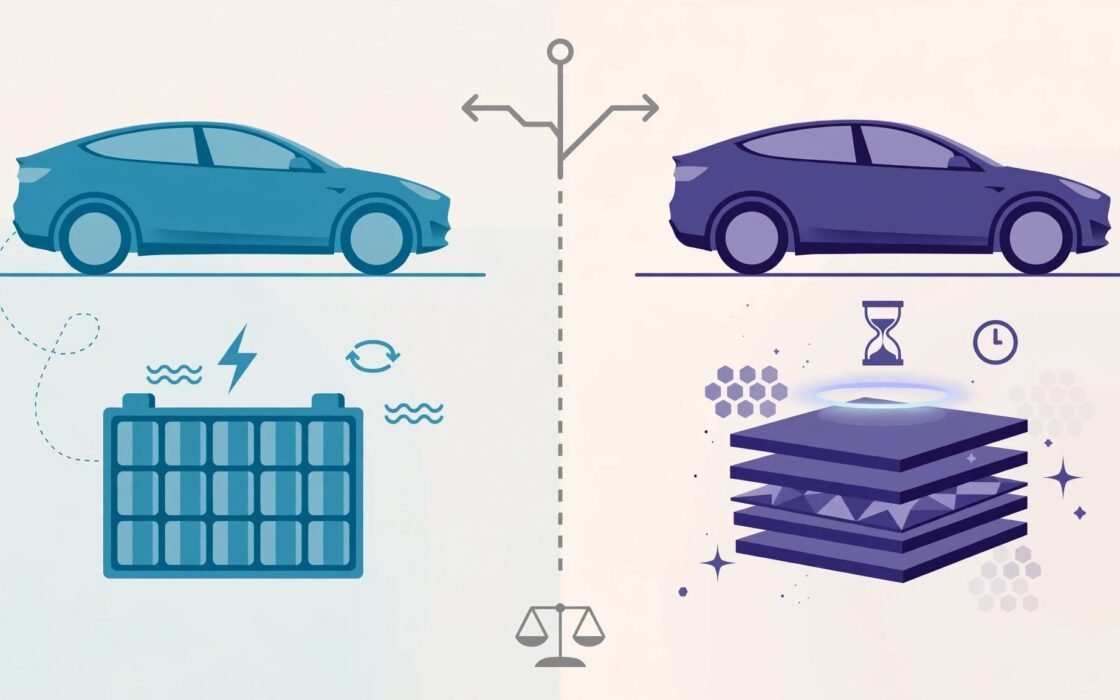
Conventional lithium-ion batteries use a liquid electrolyte, which is flammable and limits how densely energy can be packed in. Solid-state replaces that liquid with a solid material, which in theory allows roughly double the energy density, much faster charging, and meaningfully better safety since there’s no flammable liquid to combust. Toyota’s own program claims 450-500 Wh/kg (more than double today’s typical EV chemistry), 10-80% charging in about 10 minutes, and cycle life exceeding 2,000 charges while retaining over 90% of original capacity. Those are genuinely significant numbers if they hold up in mass production — worth comparing against our real-world lithium-ion degradation research, where today’s packs average about 2.3% capacity loss per year.
The catch, consistently across every company chasing this, isn’t the chemistry — it’s manufacturing. Solid-state cells need tolerances measured in microns, and scaling that precision from a handful of lab cells to gigawatt-hours of annual production is where every serious program has stalled. That’s the honest explanation for why timelines keep sliding from “mid-decade” to “late 2020s,” not any lack of genuine progress.
Who’s Actually Closest
| Company | Target | Status |
|---|---|---|
| Toyota | 2027-2028, premium Lexus first | Formal production approval (Japan, Oct 2025); most credible near-term timeline |
| QuantumScape (VW-backed) | 2027-2028 mass production | Shipping sample cells to partners; strongest published lab results |
| Nissan | 2028 (true solid-state); 2026 semi-solid Ariya | Pilot line under construction, developed with NASA |
| Samsung SDI | 2027 mass production | Already supplying semi-solid cells to BMW/Hyundai |
| Mercedes-Benz | Early 2030s commercial | Prototype EQS drove ~749 miles on one charge in testing |
| CATL | ~2030 full solid-state | Semi-solid cells only near-term; self-rated “level 4 of 9” |
Notice the pattern: every credible timeline points to premium, limited-production vehicles first, with genuine cost parity against lithium-ion — and therefore an affordable solid-state EV — not arriving until around 2030. The technology will trickle down from flagships to mainstream models the same way lithium-ion itself did over the past decade.
Semi-Solid Isn’t the Same Thing
This distinction matters if you’re comparing spec sheets: semi-solid batteries (already shipping in NIO’s 150 kWh pack and SAIC’s MG4, which crossed 100,000 units in eight months) still use some liquid electrolyte, just less of it. They deliver real, incremental improvements, but they’re a bridge technology, not the flammability-free, double-density leap that “solid-state” implies. If a listing says “solid-state” without qualifying it, check whether it actually means semi-solid — the marketing gap between the two terms is a real source of confusion right now.
Should You Wait?
The honest math: waiting for solid-state means waiting for at least 2027-2028 to get a premium-priced, limited-production vehicle, or realistically 2030+ for anything mainstream-priced. Meanwhile, today’s lithium-ion EVs are already good — fast-charging keeps improving, real-world range is solid, and the cost case against gas already works in most ownership scenarios. Every year spent waiting is a year of those savings you don’t collect, on top of whatever incentives currently apply potentially changing or disappearing by the time solid-state actually arrives.
What Would Waiting Actually Cost You?
None of this means solid-state isn’t real or worth being excited about — the underlying chemistry genuinely works in lab and prototype cells. It just means “worth waiting for” and “worth buying today” are separate questions, and for most buyers in 2026-2027, the second one already has a clear answer.
FAQ
Is any EV sold right now “solid-state”?
No. Some marketing uses the term loosely for semi-solid packs (NIO, some Chinese-market vehicles), which are a real but different, less dramatic improvement over standard lithium-ion.
Why does every solid-state timeline keep slipping?
It’s not the underlying chemistry — that’s been proven in lab cells for years. It’s manufacturing at scale: the required tolerances are measured in microns, and that precision is extremely hard to replicate across gigawatt-hours of production.
Will solid-state batteries be cheaper than lithium-ion?
Eventually, according to several manufacturers’ own projections — but not at launch. Every credible roadmap has solid-state debuting on premium vehicles first, with cost parity only arriving as production scales, likely around 2030.
Does buying a lithium-ion EV now mean I’m stuck with worse tech forever?
No — degradation on today’s packs is modest (roughly 2.3%/year on average) and resale timing means most owners aren’t keeping one car for 15+ years anyway. You can always upgrade when solid-state actually reaches a price point that makes sense.
What should I actually look for when buying an EV in 2026-2027?
The fundamentals that matter today: real-world range for your use case, charging network access, and total cost of ownership — covered in our buying checklist. Solid-state isn’t a factor you can shop for yet, so it shouldn’t be a factor you wait for either.
Should You Wait?
For nearly everyone shopping in 2026 or 2027: no. The best solid-state timeline available (Toyota, 2027-2028) still means a limited-run, premium-priced flagship — not something replacing your realistic budget or timeline. Buy the lithium-ion EV that fits your needs now, and let solid-state mature the way every battery generation before it has.
About the author: Written by Shurah, who researches and writes independently on the real cost of EV ownership — charging, maintenance, and total cost of ownership — backed by primary data and original calculations rather than recycled lists.