As of this week, coastal communities are once again being told the same thing they were told after Hurricane Ian in 2022: if your EV has touched saltwater, don’t drive it, don’t charge it, and don’t park it near your house. It’s not a new warning — but it’s worth understanding exactly why it exists, because the mechanism is more specific than “EVs and water don’t mix.”
What We Know
- Hurricane Ian (2022) affected 3,000-5,000 EVs in Florida; about 600 were total losses, and roughly 36 caught fire — some while already loaded on tow trucks.
- Hurricane Helene (2024) ignited around 11 electric vehicles plus dozens of loose lithium-ion batteries from saltwater intrusion.
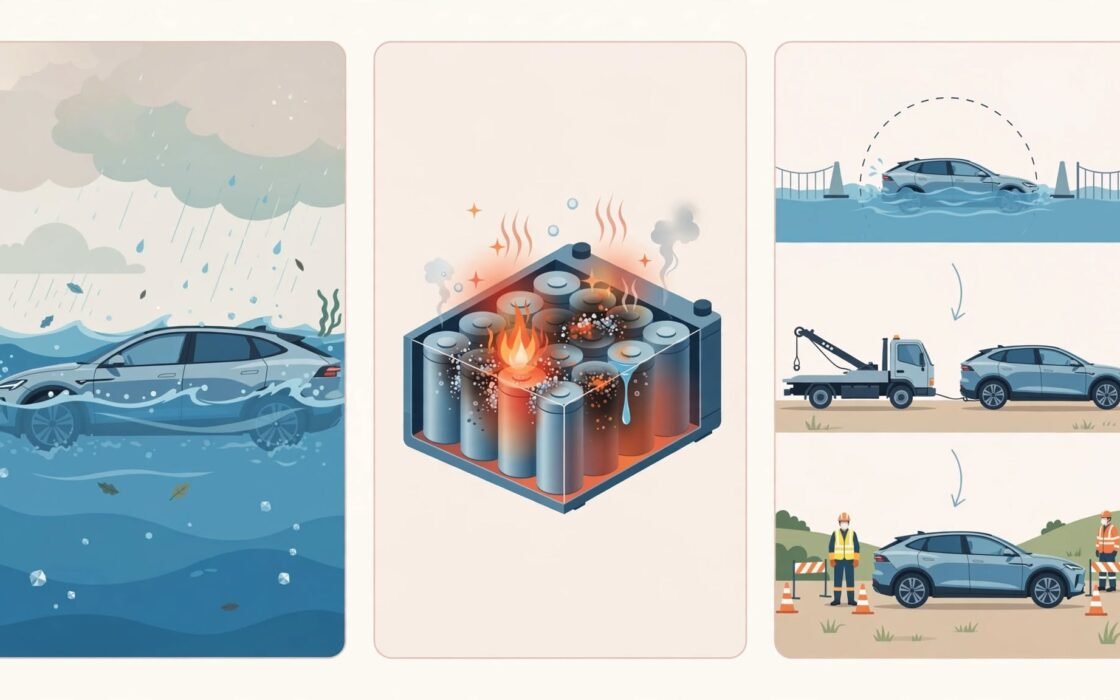
- The risk is specifically tied to saltwater, not flooding generally — salt conducts electricity and can bridge internal battery connections, triggering a short circuit and thermal runaway. Freshwater flooding hasn’t shown the same pattern.
- Fires can ignite days after the water recedes, and NHTSA and automakers both recommend keeping a submerged EV at least 50 feet from any structure or other vehicle.
- Fighting an EV battery fire can take 8,000-12,000 gallons of water — more than 10 times what’s needed for a typical gas car fire — and reignition after “extinguishing” is a documented risk.
Quick answer: EVs don’t catch fire from flooding in general — they catch fire when saltwater specifically gets into the battery pack, corrodes internal connections, and causes a short circuit. It’s rare (dozens of incidents across major hurricanes, out of thousands of exposed vehicles), but the fires it causes are intense, can ignite days later, and are hard to extinguish. If your EV has been in saltwater, the guidance is simple: don’t touch it, don’t charge it, move it away from structures, and get it professionally inspected.
Why Saltwater Specifically
Per the NHTSA-commissioned teardown study of flood-damaged EVs conducted after Hurricane Ian, salt’s electrical conductivity is the key factor. When saltwater penetrates a battery pack, it can create unintended current paths between cells or components that were never meant to be connected — the electrical equivalent of crossing wires. That short circuit generates heat, which can trigger thermal runaway, a self-sustaining chain reaction inside a damaged lithium-ion cell.
Freshwater flooding is a genuinely different situation. As reporting around 2024’s storms noted, similar ignition patterns haven’t shown up after freshwater flooding events, even significant ones. That doesn’t mean freshwater exposure is harmless to an EV — corrosion and electrical faults are still possible — just that the specific fire-triggering mechanism tied to saltwater’s conductivity isn’t the same risk.
What the Real Numbers Look Like
| Event | EVs affected | Fires |
|---|---|---|
| Hurricane Ian (2022) | 3,000-5,000 | ~36 |
| Hurricane Idalia (2023) | Fewer (weaker storm, more owner awareness) | Several, lower count than Ian |
| Hurricane Helene (2024) | Not fully tallied | ~11 vehicles plus dozens of loose batteries |
Worth keeping in perspective: this is a small fraction of exposed vehicles, and it doesn’t change the broader picture from our baseline EV fire-risk research, where EVs remain far less fire-prone per mile than gas or hybrid vehicles overall. This is a specific, avoidable trigger — flood exposure in coastal storm surge — not a sign that EVs are generally more dangerous.
If Your EV Has Been in Water: What Actually to Do
Was Your EV Exposed to Water?
Before a Storm: What Owners in Flood-Prone Areas Should Know
- Move the vehicle to the highest available ground, away from expected storm surge, before flooding starts.
- Never store a flood-exposed or at-risk EV under an elevated home, in an attached garage, or under a carport — a delayed fire there can consume the structure.
- General lithium-battery fire-safety guidance suggests a lower state of charge stores less energy and reduces severity if a fire does start — worth factoring into pre-storm charging decisions if you’re in a high-risk zone.
- If a flooded EV shows warning signs (smoke, popping/hissing, unusual smells), treat it as an active emergency and call 911 rather than trying to handle it yourself.
What This Means If You’re Buying Used
Flood-damaged vehicles, including EVs, sometimes get repaired and resold, occasionally with the flood history not fully disclosed. This is exactly the kind of hidden risk our used-EV buying checklist is meant to catch — a full vehicle history report and, in flood-prone regions, extra scrutiny around storm-season timing are worth the effort. A vehicle that was a genuine total-loss candidate after flood exposure shouldn’t be back on the road without documented, verified repair.
FAQ
Is this only a Tesla problem?
No. The mechanism is about lithium-ion battery packs generally, not any one manufacturer — incidents have been reported across multiple brands, though Tesla’s high market share in affected regions means it shows up often in coverage.
Does my insurance cover flood damage to my EV?
That depends on your policy — comprehensive coverage typically covers flood damage, but check with your insurer directly. Our insurance cost research covers what typically is and isn’t included at a general level.
Can a flooded EV be safely repaired and driven again?
Sometimes, depending on the extent and type of water exposure — but it requires professional inspection and manufacturer-specific procedures, not a simple dry-out. Many flood-affected vehicles end up as total losses instead.
Is a plug-in hybrid at the same risk as a full EV?
The same saltwater-conductivity mechanism applies to any lithium-ion battery pack, so yes, PHEVs carry a similar risk profile in a flood scenario, though pack sizes and locations vary by model.
How long after flooding could a fire still happen?
Documented cases show delayed ignition of days after the water recedes, which is exactly why the 50-feet-from-structures guidance matters even once a vehicle looks dry and stable.
If You’re in a Flood Zone
This remains a rare event relative to the number of EVs on the road, but it’s a real and specific risk with a clear cause: saltwater intrusion into a lithium-ion pack. If you live somewhere that floods, especially coastally, the guidance is straightforward — move the vehicle before the water arrives, never operate or charge it after saltwater exposure, and treat any post-flood warning signs as an emergency, not an inconvenience.
About the author: Written by Shurah, who researches and writes independently on the real cost of EV ownership — charging, maintenance, and total cost of ownership — backed by primary data and original calculations rather than recycled lists.