The Numbers That Matter
- Tires-only winter set: roughly $800–$1,600 for four EV tires (KBB, secondary reporting).
- Tesla Model Y winter package: $2,750, including wheels, tires, sensors, and installation (Tesla Shop, October 2026).
- Stopping distance at 30 mph on packed snow: about 59 feet on winter tires versus about 89 feet on all-season tires (Tire Rack test) — 30 feet shorter.
- Seasonal swap: $60–$80 per visit on their own wheels; $60–$200 per visit to remount onto one set of wheels (secondary guides).
- True yearly cost of a full package: about $492 a year over five winters in our worked example.
The Short Answer
A set of winter tires for an EV costs roughly $800–$1,600 for tires alone, or $1,800–$2,750 for a complete wheel and tire package, plus $120–$400 a year in swaps and storage. Spread over five winters, a full package works out to about $492 a year. If you drive through real winter — snow, ice, or weeks below 45°F — that is cheap for 30 feet of shorter stopping distance.
The First Cold Morning Tells the Truth
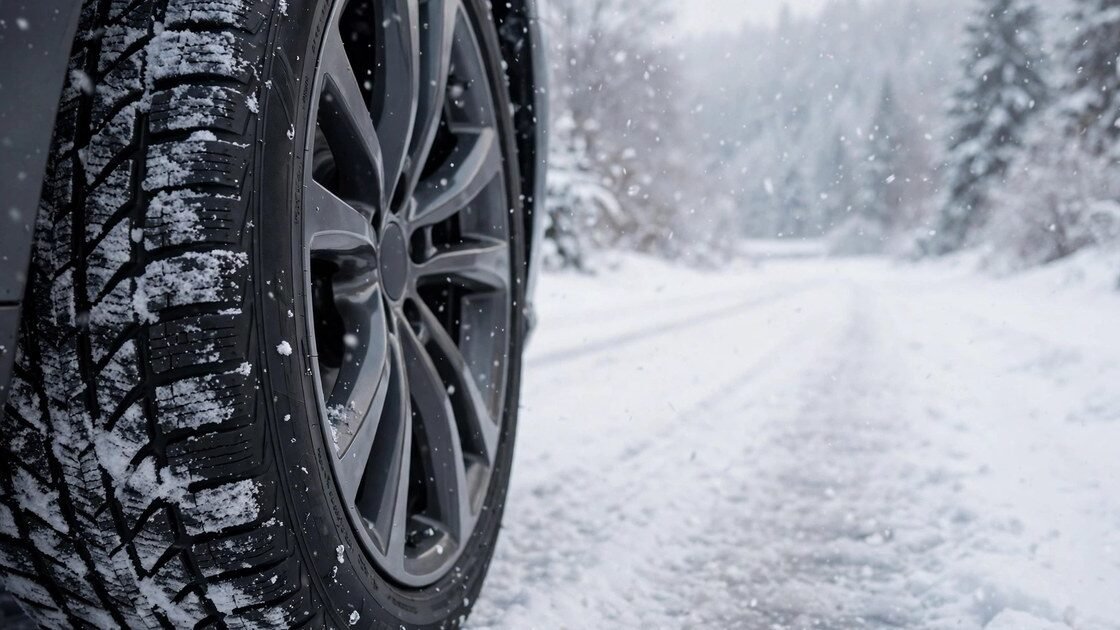
Picture the first genuinely cold morning of the year: 28°F, a thin sheet of overnight ice under a dusting of snow, and a car that weighs close to 4,500 pounds and sends full torque to the wheels the instant you touch the pedal. Below about 45°F (7°C), an all-season tire’s rubber stiffens and loses grip, even on dry pavement. A winter tire’s compound stays flexible, and its tread is cut with thousands of tiny slits, called sipes, that bite into snow and ice.
AAA’s Car Doctor put it bluntly in the organization’s EV winter tire guidance: EVs need winter or all-weather tires for the best cold-weather performance, and the idea that an EV’s weight makes winter tires unnecessary is backwards. Weight means more mass to stop once the car is sliding, and instant torque means the tires break loose more easily. Add regenerative braking, which shifts braking force to the driven wheels in a way gas cars never do, and the tires are doing harder work all winter. That matters because tires are already the biggest recurring cost of running an EV — Geotab’s data puts EV tire wear at roughly 2.7 cents per mile against about 1.0 cent for a gas car.
What 30 Feet Actually Buys You
Most winter tire marketing talks about “confidence” and “control,” which are hard to price. Stopping distance is not. Tire Rack ran both sets of tires on the same cars, on the same snow-packed surface, and published the numbers.
| Test (snow-packed surface) | Winter tires | All-season tires | Difference |
|---|---|---|---|
| Braking from 30 mph | About 59 feet | About 89 feet | 30 feet shorter |
| Accelerating 200 feet from a stop | Just over 8 seconds | About 11 seconds | About 3 seconds quicker |
| 90-degree corner at 25 mph | Completed the corner | Slid off the course | Stability control could not save it |
At 25 mph through a corner, the all-season car slid off even with stability control working: electronics can only use the grip the tires give them. And the braking row is the one to carry into the tire shop: at neighborhood speeds, 30 feet is the difference between stopping at the crosswalk and stopping in it.
Note on the three-peak mountain snowflake symbol (3PMSF): per secondary explanations, it certifies snow acceleration only, not braking or ice grip — a minimum standard, not a ranking.
What Winter Tires for an EV Actually Cost
Two ways to buy in: tires only, or a complete package with a second set of wheels, tires, and sensors.
| Option | Up front | Every year | Who it suits |
|---|---|---|---|
| Tires only (Michelin X-Ice Snow class) | $800–$1,600 for four tires, plus $60–$200 first mount and balance | $120–$400 (two remount visits) | Cheap local fitter; cars sold soon |
| Aftermarket wheel and tire package | $1,800–$2,500 (wheels, tires, sensors, first balance) | $120–$160 (two wheel swaps) | Keeping the car 3+ winters |
| Tesla Model Y factory package (19-inch Crossflow) | $2,750 (four wheels, four Michelin X-Ice Snow+ 255/45R19 XL tires, BLE sensors, installation) | $120–$160 (two swaps) | Model Y owners wanting guaranteed fitment |
The Tesla price comes from Tesla’s own Shop listing in October 2026, which also notes a $100 rebate on four eligible Michelin tires bought between October 1 and December 31, 2026 — a seasonal deal with an expiry date, not a permanent price. The $800–$1,600 band comes from KBB’s EV tire guidance (secondary reporting); Tire Rack lists a Michelin X-Ice Snow at $228 in a 245/45R19 size. Swap prices come from secondary service guides, so get a quote from your own shop.
The Math Most Articles Skip: Two Sets Split the Miles
Winter tires do not add miles to your driving year. They take miles away from your other set. While the winter tires are on the car for four or five months, your all-season or summer tires sit in storage, not wearing. Over the life of the car, you spread the same miles across two sets instead of burning through one set faster.
So the real extra cost of the package route is not the whole $2,750. It is the second set of wheels and sensors, plus the yearly swaps, minus the longer life of your summer set and minus whatever the winter package is worth when you sell the car. The calculator below does the straightforward version: upfront cost, plus swaps and storage, spread over the winters you expect to use the set. It does not credit you for the extended life of your summer tires, so the result is pessimistic — your true cost is lower.
Winter Tire Cost Calculator
The formula is simple on purpose: total cost equals the upfront cost (four tires plus wheels and sensors, if any) plus the number of winters multiplied by two swap visits plus yearly storage. Average yearly cost is that total divided by the number of winters, and cost per winter mile is the yearly cost divided by your winter miles. The defaults are examples only: $240 per tire, $800 for wheels and sensors, $70 per swap visit, no storage charge, five winters, 5,000 winter miles — giving $1,760 up front, $2,460 over five winters, and $492 a year, 9.8 cents per winter mile.
Do You Need EV-Specific Winter Tires, or Will Any Good Ones Do?
This is where EV owners get upsold, so be precise. A winter tire is safe on an EV if three things are right: the size matches your car’s placard, the load index meets or beats what the manufacturer specifies, and the speed rating is appropriate. Everything else — acoustic foam, low-rolling-resistance compounds, EV branding — is optimization, not safety. KBB’s guidance (secondary reporting) is that ordinary tires fit and drive, but wear faster and can hurt range and handling on a heavy, high-torque car.
So the buying rule is: load index first, EV optimization second. Look for XL (extra load) sizes in your car’s size, which most EV fitments already are — the Model Y’s winter size, for instance, is a 104H XL. If an EV-specific winter tire exists in your size, it is worth a modest premium for its lower rolling resistance, which protects winter range. If it does not, a top-rated conventional winter tire like the Michelin X-Ice Snow or Bridgestone Blizzak WS90 is a perfectly good answer. AAA’s position supports this: winter or all-weather tires, not necessarily EV-branded ones, are what matter — and AAA notes winter tires may slightly reduce range, so do not buy them expecting a range gain. Buy them for the 30 feet.
When to Switch, When to Take Them Off, and the Pressure Rule
Switch when average daily temperatures stay below 45°F, not when the first snow falls — usually late October or November across the northern US, because the compound argument applies on dry cold roads too. Waiting for snow means driving your worst weeks on the wrong rubber and joining the queue at the tire shop on the same weekend as everyone else.
Take them off in spring when daytime highs hold above 45°F consistently: winter compound wears fast on warm, dry pavement, and wet braking on warm roads is worse on a soft winter tire. While they are on, check pressures monthly — about 1 psi is lost for every 10°F the temperature drops, so a tire set in a 60°F shop in October can be 3–4 psi low on a 20°F morning in January. Your car’s placard pressure, on the driver’s door jamb, is the target, not the maximum printed on the sidewall.
Who Should Skip Dedicated Winter Tires
Not everyone needs a second set. If your winters rarely drop below 45°F, if snow is a once-or-twice-a-year event that melts by noon, and if you can genuinely leave the car home on those days, a 3PMSF-rated all-weather tire — the Michelin CrossClimate2 is the class leader here — covers you without the swap ritual. Our guide to the best tires for EVs walks through that compromise. All-weather tires give up real ground to dedicated winters on ice and in deep cold, so this is a mild-climate answer only.
Two groups should not take the compromise: anyone who must drive in storms, and anyone running summer tires, which some performance EVs ship with. Summer compound below 45°F can crack, and grip falls off a cliff. If your car wears summer tires, winter rubber or at minimum a 3PMSF all-weather set is the price of winter driving.
Buying Checklist: Five Mistakes That Waste the Money
- Buying only two winter tires. Four matching tires, always — two winters on one axle makes the car unpredictable in a slide.
- Ignoring the load index. Match or beat your placard’s load index. An under-rated tire is the mistake most likely to bite an EV owner.
- Skipping sensors on the second set. If your car came with tire pressure monitoring, the second set of wheels needs sensors too.
- Storing them wrong. Clean, dry, out of sunlight, away from furnaces and electric motors (ozone degrades rubber), preferably bagged.
- Buying used winters without checking age and tread. Check the DOT date code and walk away from anything over six years old or below 6/32-inch of tread.
For the wider winter picture, see our guide to EV range in winter cold weather and our cold-climate EV picks. Tires dominate the long-term bill too: our 100,000-mile EV maintenance breakdown and our EV tire cost and wear guide explain why this decision matters.
Frequently Asked Questions
How much do winter tires for an EV cost in total?
Expect $800–$1,600 for four tires alone, or $1,800–$2,750 for a complete wheel and tire package including sensors, plus $120–$400 a year for swaps and storage. Spread over five winters, a full package costs roughly $492 a year.
Do EVs need special EV-specific winter tires?
No, not as a safety requirement. What an EV needs is the correct size and a load index that meets the manufacturer’s specification, ideally in an XL size. EV-specific winter tires add lower rolling resistance and noise tuning, worth a modest premium if available in your size.
Do winter tires reduce EV range?
They can, slightly. AAA notes that winter tires may slightly reduce range, though EV-optimized compounds minimize the penalty. Most winter range loss comes from cold batteries and cabin heating, not from the tires.
When should I put winter tires on my EV?
When average daily temperatures stay below 45°F (7°C), typically late October or November in the northern US. Do not wait for the first snowfall, because all-season and summer compounds already lose grip in cold dry conditions.
Can I run winter tires all year to save money?
No. Winter compound wears quickly on warm, dry pavement and wet braking gets worse. Swap them off in spring when daytime highs hold above 45°F, and a winter set should last four to six seasons of seasonal use.
Are two winter tires enough if money is tight?
No. Always fit four matching winter tires. With only two, the axle with less grip decides how the car behaves in a slide. If money is tight, buy four mid-range winter tires rather than two premium ones.
The Bottom Line
Winter tires for an EV are a $1,000–$2,750 purchase that looks expensive until you divide it by the winters it serves and set it against the one number that matters: 30 feet of shorter stopping distance at neighborhood speed, measured by Tire Rack. Buy the correct size and load index first, EV branding second. Buy a second set of wheels if you plan to keep the car more than a couple of winters. Switch at 45°F and take them off in spring.
Written by Shurah Beel, who researches and writes independently on the real cost of EV ownership — charging, maintenance, and total cost of ownership — backed by primary data and original calculations rather than recycled lists.
Check your door-jamb placard for the correct size and load index, and have winter tires fitted by a professional; incorrect fitment can affect handling and safety.