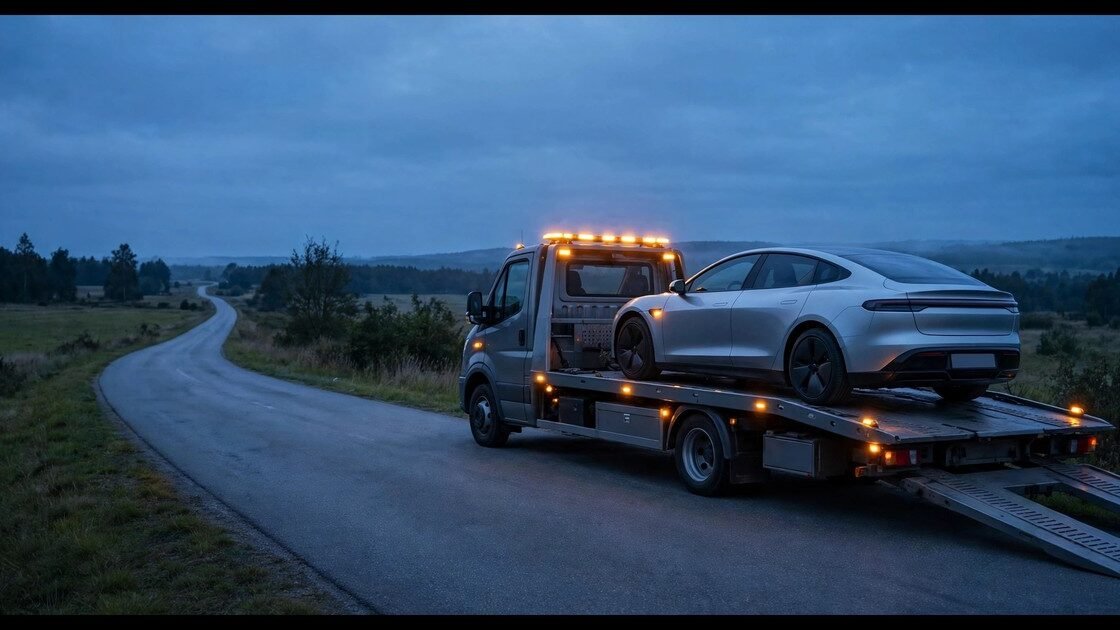
It is 11 pm, raining, and your EV has just gone silent on a road you barely know. The screen is black, the hazard lights are the only thing still working, and the nearest charger is nine miles away. The question that decides your next hour is whether you already paid for help.
The numbers that matter
- $64.99 a year buys AAA Classic: 5 miles of towing per call, four calls a year. Plus is $99.99 for 100-mile tows; Premier is $124.99 with one 200-mile tow. Prices vary by AAA club.
- One flatbed tow with no cover costs roughly $110–$200 for 10 miles (our calculation: $75–$125 hook-up plus $3.50–$7.00 a mile).
- Tesla covers roadside free under its 4-year/50,000-mile warranty: breakdowns tow up to 500 miles, flat tyres 50 miles, and running out of charge is never covered.
- Hyundai gives 5 years of roadside assistance with unlimited miles on every new car in the US, including towing to the nearest dealer even after an accident.
- An insurance add-on costs about $10–$20 a year, the cheapest route in, with the shortest tow limits.
The short answer
EV roadside assistance costs $65–$125 a year through AAA, $10–$20 a year as an insurance add-on, and nothing at all while your carmaker’s free cover is active. Most new EVs include several years of free manufacturer roadside help, so check that first. A membership pays for itself if you need even one flatbed tow a year; if your car is new and covered, a membership mostly duplicates what you already have.
What roadside assistance actually does for an EV
Towing. An EV must travel on a flatbed, all four wheels off the ground: dragging a drive axle can damage the motor. A flatbed costs roughly 20–40% more than a wheel-lift tow. When you call, say “electric vehicle” in the first sentence, so the dispatcher sends a flatbed and not the cheaper truck. See our guide to EV towing costs.
The 12-volt battery. Every EV still has a small 12-volt battery running the computers, the locks, and the contactors that connect the big battery. When it dies, the car will not start even with a full traction battery. A jump start fixes it in minutes, and every plan covers it. It is the most common EV roadside call, and the cheapest to solve yourself with a lithium jump pack. Our guide to the EV 12-volt battery explains why it dies.
Flat tyres and lockouts. Most EVs ship without a spare, so a flat tyre usually means a tow, not a roadside wheel change. Tesla’s own kit costs $110, only handles holes up to 6 mm, and the tyre still has to be replaced soon after. See our guides to EV tyre puncture repair costs and why EVs have no spare tyre. Lockouts are simpler: a dead key fob battery or a phone key that will not connect, fixed by a locksmith call usually capped at $50–$100.
Running out of charge. The EV-only emergency, and the one most plans handle worst. There is no fuel can to deliver: the options are a mobile charging truck, which adds a few miles of range in 15–30 minutes, or a flatbed tow to the nearest charger. AAA runs mobile charging trucks in select cities at no added cost; everywhere else it is a tow.
What your carmaker already gives you free
| Carmaker | Free roadside cover | Towing limit | Out of charge |
|---|---|---|---|
| Tesla | While the Basic Vehicle Limited Warranty (4 years / 50,000 miles) or an Extended Service Agreement is active | 500 miles for a warrantable breakdown; 50 miles for a flat tyre if Tesla does the repair | Help is arranged but it is not a financially covered service — you pay |
| Hyundai / Kia | 5 years, unlimited miles, from the in-service date | To the nearest Hyundai dealer, no mileage cap; covers non-warranty tows including accidents | Tow to the nearest dealer; trip interruption reimbursement over 150 miles from home |
| Ford | 5 years / 60,000 miles for all owners | To the nearest Ford dealer, or within 35 miles of the breakdown | Tow to nearest public charger, home, or Ford EV dealer within 50 miles |
Tesla’s 500-mile breakdown tow is the most generous in the industry. But the 50-mile flat-tyre limit only applies if Tesla itself does the tyre repair. And the out-of-charge exclusion is absolute: Tesla’s own roadside policy says transportation due to battery depletion is the customer’s responsibility, even during warranty. Hyundai’s deal is the opposite shape: no mileage cap on towing, but only to the nearest dealer. Ford is the friendliest when you run out of charge, letting you choose between the nearest public charger, your home, or a Ford EV-certified dealer within 50 miles.
Free manufacturer cover follows the car, not the owner, but it runs from the original in-service date: a four-year-old Hyundai still has a year left, a four-year-old Tesla has none. Check the in-service date, not the model year. See our guide to used EV warranty transfer.
What a membership costs
| Plan | Cost per year | Tow distance | Calls per year | Covers you or the car? |
|---|---|---|---|---|
| AAA Classic | $64.99 | 5 miles | 4 | You, in any car |
| AAA Plus | $99.99 | 100 miles | 4 | You, in any car |
| AAA Premier | $124.99 | One 200-mile tow, rest 100 miles | 4 | You, in any car |
| Insurance add-on | $10–$20 | Nearest shop, or about 15 miles | Varies by insurer | The car on the policy |
| Better World Club Premium Auto | $119.95 (10% EV discount available) | 100 miles | Varies | You, in any car |
AAA’s own membership pages list these prices; they vary by regional club. Classic’s 5-mile tow is nearly useless for an EV owner, because the nearest EV-capable shop is often further away than the nearest petrol-car garage. Plus, at $99.99, is the tier that fits: a 100-mile tow covers almost any realistic stranding.
The insurance add-on is the bargain of the three, with a catch for multi-car households: it attaches to the vehicle on the policy, not to you. Borrow a friend’s car or drive a rental and it does not follow you. A AAA membership follows you as a driver or a passenger in any car.
Better World Club is the niche option worth knowing about: the only major club that discounts EV drivers, 10% off roadside plans, with Premium Auto towing up to 100 miles for $119.95 a year. It is smaller than AAA, so response times outside big cities can be slower.
What one incident costs with no cover at all
Tow companies price in two parts: a hook-up fee for arriving and loading, and a per-mile rate for every loaded mile.
| Tow distance | Hook-up fee | Flatbed per mile | Total (our calculation) |
|---|---|---|---|
| 5 miles | $75–$125 | $3.50–$7.00 | $93–$160 |
| 10 miles | $75–$125 | $3.50–$7.00 | $110–$195 |
| 25 miles | $75–$125 | $3.50–$7.00 | $163–$300 |
| 50 miles | $75–$125 | $3.50–$7.00 | $250–$475 |
The ranges come from 2026 US towing rate guides, which agree closely: hook-up $75–$125, flatbed $3.50–$7.00 a mile. Nights, weekends, and holidays add 20–50%, and a winch-out adds $50–$150. A 50-mile flatbed tow on a Sunday night can pass $500 — four years of AAA Premier in one phone call. A mobile EV charging rescue runs about $120–$199, per the operators’ own price lists. A dead 12-volt battery jump runs $50–$150 a call, against about $90 for a jump pack you own forever.
Is a membership worth it for you?
Roadside membership vs pay-per-incident calculator
How the formula works: one tow costs the hook-up fee plus the tow distance times the flatbed per-mile rate. Multiply by the number of incidents a year for the pay-per-incident total. Divide the membership price by the cost of one tow and you get the break-even number of incidents. Defaults are examples from this article — AAA Plus at $99.99, one incident a year, a 15-mile tow at $100 hook-up and $5.00 a mile — not quotes for your area. After-hours surcharges, 20–50%, push the break-even point lower.
A city driver with a new car under free cover and a short commute will struggle to justify even a $65 membership. A rural driver with a five-year-old EV, 40 miles from the nearest service centre, is the person a $100 membership was made for. One 50-mile flatbed tow pays for five years of it.
The out-of-charge trap
Running out of charge is the one EV emergency where the fine print matters more than the price. Tesla will arrange help but will not pay for it. Ford will tow you up to 50 miles to a charger, your home, or a dealer, per Ford’s EV roadside guidance. AAA will send a mobile charging truck in select cities and tow you everywhere else. Hyundai will tow you to the nearest dealer. Four different answers, and the wrong assumption costs $200 at the side of the road.
The cheapest protection is not a plan at all: never let the battery fall below 10% on an unfamiliar road, and check the next charger’s status in the app before you pass the last one. Next cheapest is a portable jump pack for the 12-volt battery. Third is knowing, before you need it, which number to call: the carmaker’s roadside line while the free cover is active, your membership or insurer after that. Save both numbers in your phone now, not while you are standing in the rain.
Never accept a wheel-lift tow because it is the truck that arrived first. Insist on a flatbed, and if the operator cannot send one, call another company. The saving is not worth a drivetrain repair. Use Tow Mode only as the owner’s manual describes it.
Who should skip a membership, and who should not
Skip it, or at least delay it, if your car is under free manufacturer cover, you drive mostly within 20 miles of home, you have a second car in the household, and you carry a jump pack. Add the $10–$20 insurance add-on instead.
Buy it if your free cover has expired, you road-trip, you live further than 25 miles from the nearest EV service centre, or you have already needed a tow once. One incident a year at 15 miles is the break-even point for AAA Plus. Buy the higher tier if you regularly drive rural highways: Plus to Premier is $25 a year, and it buys a single 200-mile tow. A 200-mile flatbed tow without cover costs $775–$1,525.
Frequently asked questions
Does roadside assistance cost more for an EV than a petrol car?
No. AAA, Better World Club, and insurer add-ons charge the same for EVs as for petrol cars. The difference is per incident: an EV tow needs a flatbed, which runs roughly 20–40% more than a wheel-lift tow.
Is Tesla roadside assistance free?
Yes, while the car is covered by the Basic Vehicle Limited Warranty (4 years or 50,000 miles) or an Extended Service Agreement: breakdown towing up to 500 miles, flat-tyre towing up to 50 miles when Tesla does the repair. Running out of charge is never covered.
How far will AAA tow my EV?
Classic tows up to 5 miles per call, Plus up to 100 miles, and Premier one tow up to 200 miles a year with the rest at 100 miles. All three include four service calls a year, and the membership follows you, not the car.
What happens if my EV runs out of charge on the highway?
Call your carmaker’s roadside line or your membership first and say “electric vehicle, out of charge”. In select cities AAA sends a mobile charging truck; everywhere else it is a flatbed tow to the nearest charger. Ford covers that tow up to 50 miles; Tesla does not cover it at all.
Can a regular tow truck tow my EV?
No, not with wheels on the ground. An EV must travel on a flatbed with all four wheels off the road. If a wheel-lift truck arrives, refuse it and ask for a flatbed. The only exception is the short, controlled movement allowed by Tow Mode while loading.
The short version
EV roadside assistance is cheap insurance against an expensive tow, but only buy it when you actually need it. While the carmaker’s free cover is active, that is your plan: Tesla for four years, Hyundai and Ford for five. When it ends, AAA Plus at $99.99 a year is the right default, because a single 15-mile flatbed tow costs more than the membership. The $10–$20 insurance add-on suits city drivers. Know the number to call, say “electric vehicle” first, and never accept a wheel-lift tow.
Written by Shurah, who researches and writes independently on the real cost of EV ownership — charging, maintenance, and total cost of ownership — backed by primary data and original calculations rather than recycled lists.
Roadside safety: pull fully off the road, switch on hazard lights, and stay inside the car with seatbelts on if it is not safe to stand outside. Confirm tow destination and price before the truck hooks up your car.