EV Bike Rack Cost: Racks, Hitches, and the Range Penalty
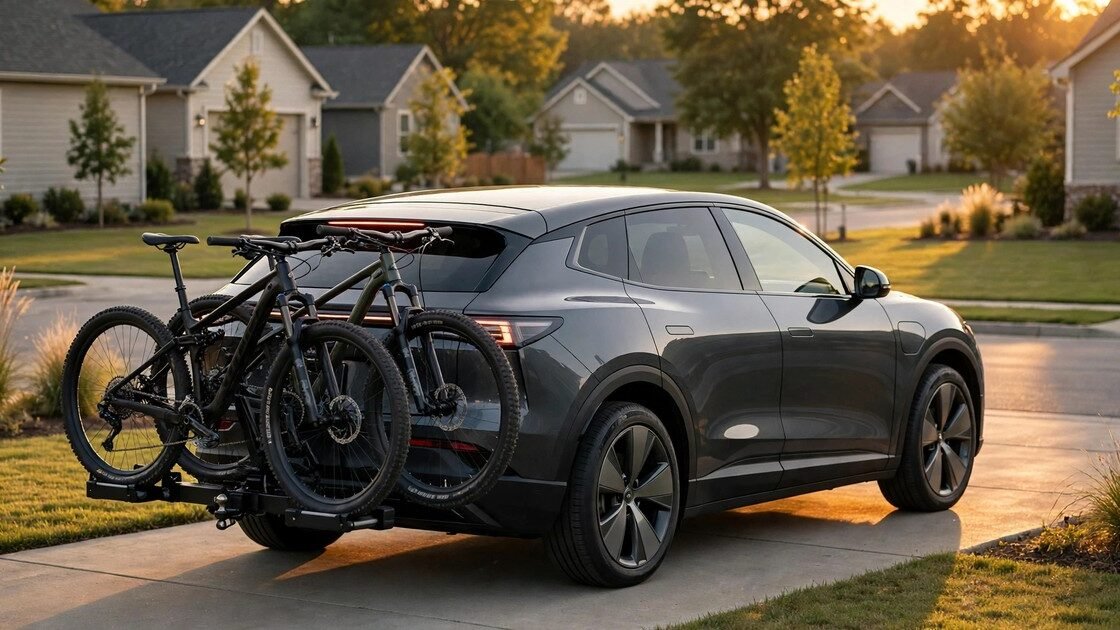
It’s a Saturday morning and you have two e-bikes, a trailhead an hour away, and a Model Y with nothing to mount a rack to. The rack itself is the part everyone prices — $550 to $1,600 for a good hitch rack — but on an EV the rack is only about half the bill. Many EVs ship with no receiver hitch, the receiver has a vertical-load limit two e-bikes can exceed, and the bikes hanging off the back quietly tax your range. Here’s the full cost, measured.
The numbers at a glance
- $1,300: Tesla’s Model Y Tow Package — tow bar, 2″ receiver, 7-pin connector, tow-mode software, and installation, all included (Tesla Shop, $1,300.00 USD confirmed).
- $549.73: an EcoHitch (Torklift) Model Y hitch, hardware-only, on sale from $699 — no wiring, installation extra (Teslarati shop listing).
- $569–$1,589: the 2026 spread for quality tray-style hitch racks, from the Yakima HoldUp to the Kuat Piston Pro X (US retailer listings; table below).
- 160 lb: the accessory vertical-load limit on Tesla’s approved Model Y hitch — a 51-lb rack plus two e-bike-rated bikes can pass it (per third-party quotes of the manual; check your own).
- 5–15% vs 25–39%: the tested highway range loss with a hitch rack versus a roof rack — one controlled study and two independent road tests all point the same way.
The short answer
A full EV bike-rack setup runs $1,300–$2,600: $360–$1,300 for the hitch plus install, $570–$1,600 for a tray-style rack, no wiring cost since a bike rack needs no trailer lights. Hitch racks cost about 5–15% of highway range; roof racks 25–39%. On a 60-mile round trip charged at home, the penalty is under a dollar — the setup price, not the energy, is what you should optimize. Check your owner’s manual for the receiver’s vertical-load limit before loading two e-bikes.
Why a bike rack is a bigger decision on an EV than on a gas SUV
On a gas crossover, a bike rack is a $200 accessory. On an EV it touches four things at once: purchase cost, a factory option you may not have, a weight limit most owners never read, and the efficiency figure the car was engineered around.
Many EVs have no receiver from the factory. The Model Y, Ioniq 5, EV6, and Mach-E all need a hitch added before any hitch rack works — the first half of the bill, and the half most rack roundups never mention.
The weight limit is real and low. A receiver rated to tow 3,500 lb can cap accessory vertical load at a few hundred pounds or less, because a rack hangs far behind the bumper and multiplies its leverage. Third-party towing guides quote the Model Y owner’s manual at 160 lb of vertical load on the approved hitch — a 51-lb rack plus two e-bike-rated bikes can pass it.
The car will notice the rack. The rear camera gets partially blocked, parking sensors beep at your own bikes, and range drops — a little on the hitch, a lot on the roof.
The hitch: the hidden half of the bill
A hitch rack needs a 2″ receiver. If your EV didn’t come with one, here’s what adding it costs in 2026 — Tesla’s numbers confirmed on its shop page, the rest per secondary installation guides and retailer listings:
| Vehicle | Option | Cost | Notes |
|---|---|---|---|
| Tesla Model Y | Tesla Tow Package | $1,300 | Tow bar, 2″ receiver, 7-pin, tow-mode software; install included (Tesla Shop). |
| Tesla Model Y | EcoHitch (Torklift) hardware | $549.73 (list $699) | Bolt-on; 3,500 lb tow / 350 lb tongue; wiring and install extra. |
| Tesla Model Y | Budget aftermarket hardware | $359.99 | Hardware-only retailer listing (secondary); installation extra. |
| Tesla Model Y | Aftermarket, professionally installed | $800–$1,200 | Secondary installation-cost guide estimate, wiring included. |
| Hyundai Ioniq 5 / Kia EV6 | Dealer kit, installed | $1,000–$1,400 | Secondary estimate. |
| Hyundai Ioniq 5 / Kia EV6 | Aftermarket, installed | $750–$1,100 | Secondary estimate. |
| Ford Mustang Mach-E | Accessory-only hitch, installed | $650–$950 | Accessory-only (no trailer wiring). |
Two things worth knowing. First, Tesla’s manual warns that installing a hitch or carrier without the official tow package can cause damage the warranty won’t cover — so on a Tesla the $1,300 official package is also warranty insurance. Second, a bike rack needs no wiring, which is why “with wiring” install quotes overstate what cyclists pay.
What the racks themselves cost
For EVs, the conversation is tray-style hitch racks. Hanging (mast-style) racks are cheaper, but they clash with fenders on e-bikes and make the rear-camera situation worse — fine for one light road bike, wrong for what most EV owners actually buy for. Prices are 2026 US retailer list prices (secondary), and they move with sales:
| Rack (2-bike tray) | Price | Weight | Per-bike limit | EV note |
|---|---|---|---|---|
| RockyMounts MonoRail | $549.99 | ~40 lb | 60 lb | Budget tray pick; fine for acoustic bikes. |
| Yakima HoldUp | $569 | ~50 lb | 60 lb | The long-running value standard. |
| Saris SuperClamp EX | $579.99 | ~35 lb | 60 lb | Lightest of the value tier — weight matters for the 160-lb limit. |
| Thule T2 Pro XTR | $900 | 51 lb | 60 lb, e-bike rated | The default recommendation. |
| Thule Epos 2 | $1,299.95 | ~41 lb | E-bike rated | Premium; lighter than the T2. |
| Kuat Piston Pro X | $1,589 | ~52 lb | E-bike rated | Premium metal build. |
A note on pricing honesty: one EV rack roundup lists the Kuat Sherpa 2.0 at $629 while retailers show $759 — manufacturer pricing we couldn’t verify directly, so we left it out of the table rather than pick a number. Treat any rack article that quotes a price without a retailer link the same way.
The e-bike weight trap
“Rated for e-bikes” describes the rack — not your hitch. The receiver’s accessory vertical-load limit is the binding constraint, and on some EVs it’s uncomfortably close to a normal two-e-bike load. Work it out from published specs — our calculation:
- Thule T2 Pro XTR rack: 51 lb + two bikes at its 60-lb per-bike limit: 120 lb = 171 lb hanging off the receiver
- Model Y approved-hitch vertical-load limit (owner’s manual, per third-party quotes): 160 lb
Over by 11 lb — with the bikes at the rack’s own rated limit. Lighter racks help: a 35-lb rack with two 55-lb e-bikes totals 145 lb and clears it. Confirm the limit in your own owner’s manual or with your dealer — it varies by model year and market, and exceeding it risks damage the warranty won’t cover. If you tow a trailer with the same hitch, the tongue-weight math is a cousin of this problem — our EV towing range-loss guide walks through how hitch limits compound.
The range penalty, honestly measured
Every rack costs range; the honest question is how much, and the answer splits cleanly by mounting position. Three independent tests — one controlled study, one journalist road test, one careful owner experiment — plus one secondary owner report all land in the same two bands:
| Test | Setup | Measured result |
|---|---|---|
| AVILOO study (Apr 2025) | ID.4, 3 bikes, 75 mph, controlled | Roof −34% (−92 mi); rear −9% |
| Model 3 owner test | Hitch + 2 e-bikes, mixed roads | +19% consumption (≈ −16% range); author estimates 5% city / 15% mixed / 25% highway |
| Singletracks road test (2022) | ID.4 roof vs hitch, 31-mi mixed route | Roof −6%; hitch 0–3%. Conclusion: hitch ≤5–10% max |
| Owner report via TorqueNews (Aug 2026, secondary) | Model Y, 2 bikes on roof, 70–80 mph | −39% range (secondary, unverified) |
The pattern is physics, not brand: air resistance rises with the square of speed, and a roof rack puts the bikes where the air is fastest and the car is most carefully shaped. The AVILOO engineers found a driver at 130 km/h (81 mph) had to slow to 97 km/h (60 mph) to match unloaded consumption with a roof load — but only drop 7 km/h with a rear rack.
An honesty beat on the scariest number: Singletracks’ dashboard estimated a 39% range drop on its roof run, but measured efficiency fell only 6%. EV range estimators pad heavily when they detect new drag — trust the mi/kWh figure, not the guess-o-meter. Roof-rack losses at highway speed are a harsher math we’ve measured separately in our roof-rack range-loss guide.
Bottom line for planning: hitch rack + 2 bikes ≈ 5–15% highway range loss; roof rack ≈ 25–39%. At 75 mph the bands widen; in town they nearly vanish.
What does the rack actually cost you per trip?
Plug in your own numbers. The defaults are examples: 3.5 mi/kWh is roughly the AVILOO ID.4 baseline, 18.3¢/kWh is the July 2026 US residential average, and 10% is a mid-range highway penalty for a hitch rack with two bikes. Set the loss to 30% to see what a roof rack does.
Efficiency with rack: — mi/kWh
Extra electricity per trip: — kWh
Extra cost per trip: —
Extra cost per year: —
Range eaten per trip: — miles
How the math works. Efficiency with the rack equals your normal efficiency × (1 − loss%). Extra electricity per trip is miles × (1 ÷ efficiency_with_rack − 1 ÷ efficiency_without); multiply by your electricity price for the per-trip cost, then by trips per month × 12 for the yearly figure. “Range eaten” is the extra kWh converted back into normal miles — how many miles of your battery the penalty costs each drive. All defaults are labeled examples; your EV’s real efficiency is on its window sticker.
When the honest answer is “don’t”
If you ride twice a year, a $2,200 setup is $1,100 per ride in year one — borrow a friend’s rack, rent bikes at the trailhead, or put one bike inside the car with the seats down. If your trips are 200-mile highway runs at 80 mph with roof-mounted bikes, you’re buying charging stops, not just a rack: check current public charging prices when planning them.
And if your EV is a lease, check the lease terms before bolting anything on — no-cut wiring harnesses exist for leased cars, and the official tow package keeps everything inside the warranty.
Frequently asked questions
Do I need a special bike rack for an EV?
No — any quality 2″ hitch rack works. What’s special is everything around it: your EV may need a hitch installed first, the receiver’s vertical-load limit may be lower than the rack’s rating, and the range penalty is worth measuring on an EV in a way gas owners never bother with.
How much range will I actually lose with bikes on the back?
With a hitch rack and two bikes, plan on 5–15% less highway range — 10% is a reasonable planning figure. With a roof rack, 25–39% at highway speed. In town both cost far less; one mixed-speed test found a hitch rack within 3% of no rack at all.
Can my EV carry two e-bikes on a hitch rack?
Sometimes — and this is the trap. The rack may be rated for it while the car’s receiver isn’t: a 51-lb rack plus two 60-lb bikes is 171 lb against the Model Y’s 160-lb accessory limit. The only authoritative number is in your owner’s manual; third-party quotes are a starting point, not permission.
Will an aftermarket hitch void my warranty?
No blanket answer exists. Tesla’s manual warns that damage from a hitch or carrier installed without the official tow package isn’t covered, and the official package is required for Trailer Mode. For other brands, ask the dealer in writing before the install.
Do I need trailer wiring for a bike rack?
No. Wiring powers trailer lights; a bike rack has no lights. Accessory-only hitches skip wiring entirely — one legitimate way to cut the install bill.
Why do my parking sensors go crazy with the rack on?
The rear sensors see the rack and bikes as an obstacle two feet behind the bumper. Most EVs let you mute the beeping per drive; some disable rear automatic braking with a carrier detected. The rear camera narrows too — one owner tester kept it as a way to confirm the bikes hadn’t fallen off.
The short of it
A bike rack on an EV is a $1,300–$2,600 project, not a $600 purchase — the hitch is half the bill, and on a Tesla the official $1,300 package doubles as warranty protection. Buy a tray-style hitch rack, never a roof setup, if range matters: the measured penalty is 5–15% versus 25–39%. Do the 171-vs-160-lb arithmetic before loading two e-bikes, and let the per-trip calculator above — not the dashboard’s guess-o-meter — price the penalty. For what home charging costs against, see our guide to what it really costs to charge an EV at home.
Check your owner’s manual for your receiver’s vertical-load and tongue-weight limits before mounting any carrier, and never exceed them. If you’re unsure about a hitch install, have a qualified shop or dealer do it.
Written by Shurah, who researches and writes independently on the real cost of EV ownership — charging, maintenance, and total cost of ownership — backed by primary data and original calculations rather than recycled lists.