EV Towing Range: How Much Range You Lose Pulling a Trailer
The Towing Math in 30 Seconds
- ~50% — the typical highway range loss pulling a large travel trailer with an electric truck.
- ~30% — the typical loss with a small, low, or aerodynamic trailer.
- Drag, not weight — wind resistance does most of the damage; doubling trailer weight costs far less range than adding a tall, boxy trailer.
- ~$52–$60 — energy cost per 100 miles of towing at public fast-charger rates (~55¢/kWh, our calculation).
- Under $20 — the same 100 miles of towing on home electricity (~18.3¢/kWh, our calculation).
Short Answer
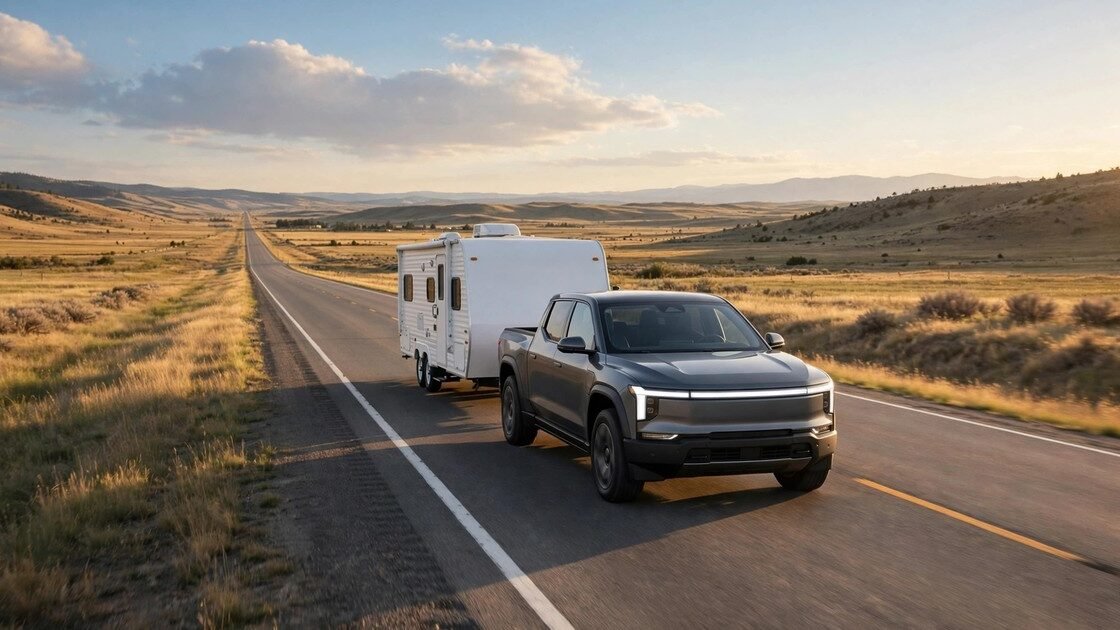
Towing a trailer cuts an EV’s highway range by roughly 30 to 50 percent. Big, boxy travel trailers land near the 50 percent mark; small or aerodynamic trailers cost closer to 30. The main culprit is wind drag, not trailer weight — which is why slowing to 60 mph recovers more range than leaving cargo behind. Expect to charge about twice as often, and if you pay public fast-charger prices, expect energy costs near 50 cents a mile.
Hook a trailer to an electric truck and the dashboard range number stops being yours — it belonged to a sleek, unloaded truck on a calm day. Below: independent tow tests, why trailer shape matters more than weight, the real per-mile cost at home and public rates, and a calculator for your own trip. The arithmetic is ours; the test data is sourced.
Why Drag Hurts More Than Weight
Most towing advice starts with weight. For EVs, that is the wrong place to start. Automotive journalist Mercedes Streeter at The Autopian compared two real tests on a Chevrolet Silverado EV: The Fast Lane Truck hitched a 6,000-pound enclosed cargo trailer and got 230 miles; JerryRigEverything hooked up 11,000 pounds and still got 177. Nearly doubling the weight cost about 23 percent of towing range. Attaching a trailer at all had already cost around half.
The pattern repeats everywhere. In a 2022 Car and Driver comparison, a Ford F-150 Lightning towing a 6,100-pound camper managed just 100 miles against 230 miles of unladen highway range, while a GMC Hummer EV did 140 against 290. Weight mattered, but the frontal area — the wall of air the trailer shoves aside — mattered more.
The physics is unforgiving. Drag force grows with the square of speed, and the power to overcome it with the cube. A tall travel trailer can double or triple the wind resistance at highway speed. Weight mostly costs energy when accelerating and climbing; at a steady 65 mph on flat ground, drag is the tax collector. Regen cannot save you either: with a trailer pushing from behind, friction brakes do much of the slowing, and the energy regen would have recaptured becomes brake heat.
The cheapest range upgrade in towing is free: slow down. Dropping from 70 to 60 mph cuts the drag power demand by roughly a third — no accessory does more.
What the Tests Actually Show
No single test covers every truck and trailer, but results cluster tightly. The table uses model-by-model estimates from the towing tracker at evmath.net (a secondary source; treat figures as estimates, not lab results):
| Truck | Empty range (claimed) | Towing range at/near max rating | Range kept |
|---|---|---|---|
| Rivian R1T | 410 mi | ~194 mi | ~47% |
| Tesla Cybertruck (Long Range RWD) | 350 mi | ~165 mi | ~47% |
| Chevrolet Silverado EV RST | 440 mi | ~211 mi | ~48% |
| Ford F-150 Lightning (Extended Range) | 320 mi | ~154 mi | ~48% |
| GMC Sierra EV Elevation | 390 mi | ~189 mi | ~48% |
| Cadillac Escalade IQ | 460 mi | ~228 mi | ~50% |
The pattern is the signature of a physics problem, not a brand problem: the spread is tiny, and the absolute numbers differ only because the starting batteries differ. A Silverado EV towing at 211 miles still out-ranges a Lightning at 154 — the big 205 kWh pack buys a bigger cushion at the same percentage loss. Which EV tows best? Usually the one with the biggest battery.
Smaller trailers change the picture: a 5,693 km test by The Driven with a 730 kg pop-top camper lost 37 percent (24.5 vs 15.5 kWh/100 km), and an Arval/University of Cambridge dynamometer study found 23–31 percent with a 500 kg trailer (Trans.info’s write-up). Real highway speeds push well past the lab numbers.
The Money Side: What Towing Costs Per Mile
Range is the headline; cost is the bill. Towing roughly doubles energy use per mile, so the price per kWh decides everything. Using October 2026 benchmarks — 18.3¢/kWh home electricity (EIA, July 2026) and ~55¢/kWh public DC fast charging (our 15 October tracker reading) — plus a 12% charging loss, here is what 100 miles of towing costs (our calculation):
| Scenario | Energy per 100 mi (incl. charging loss) | Cost per 100 mi at home rates | Cost per 100 mi at public rates |
|---|---|---|---|
| Silverado EV RST, towing (211 mi towing range, ~205 kWh pack) | ~109 kWh | ~$19.90 | ~$59.90 |
| F-150 Lightning ER, towing (154 mi towing range, ~131 kWh pack) | ~95 kWh | ~$17.40 | ~$52.40 |
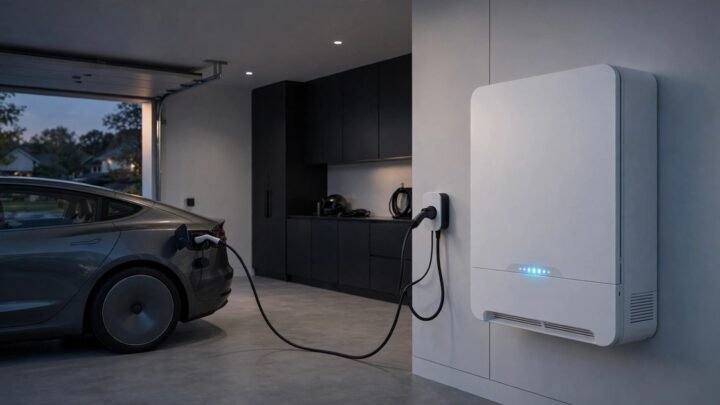
The gap between the columns is the whole story. Tow from your driveway: under 20 cents a mile even dragging a trailer. Tow a long trip on public chargers: 50 to 60 cents a mile in energy alone, with 30-to-45-minute fuel stops. Same math as our road-trip charging cost breakdown — home charging is the EV’s superpower, and towing makes it matter twice as much.
These are energy-only figures. They exclude extra tire wear and the charging memberships frequent towers should price in — our charging membership analysis shows the monthly fees pay for themselves quickly with weekly fast charging. And they exclude time: a 500-mile towing trip with four or five charging stops eats most of a day.
Charging With a Trailer Attached
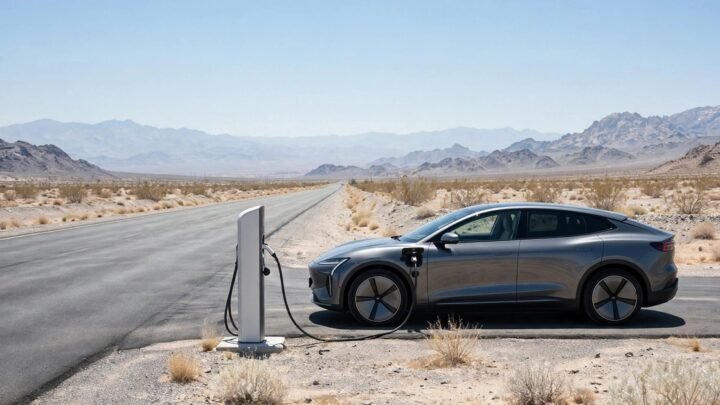
Most fast-charging stations were designed for cars, not 40-foot rigs. A trailer sticking out behind you can block the lane or the next stall. In The Driven’s 5,693 km towing tour, the driver had to unhitch at 6 of 41 charging stops — on a route planned around it. Budget real time for this, not just charging time.
A few things that make it bearable:
- Look for pull-through stations. Newer sites increasingly include drive-through stalls for trucks and trailers — check your route planner before committing to a stop.
- Plan stops at 10 to 80 percent. Towing shrinks your range, but the charging curve does not change: the battery crawls past 80, so charging to full at every stop wastes your scarcest resource — time. Our guide to the slowdown past 80 percent explains why.
- Precondition the battery. Navigating to the charger in the truck’s own system warms the pack so it accepts full power on arrival — worth real minutes when you stop twice as often.
- Mind idle fees. Tesla charges up to $1.00 per minute at busy Superchargers once charging finishes — easy to overstay when you are unhitching and rehitching.
- Slow down to stretch legs. Speed kills range faster than almost anything else, and with a trailer the penalty compounds. Sixty mph is the towing sweet spot.
What Each Truck Is Actually Rated to Tow
Headline ratings by best configuration — confirm your exact trim in the owner’s manual:
| Truck | Max tow rating (best configuration) |
|---|---|
| Rivian R1T | 11,000 lb |
| Tesla Cybertruck | 11,000 lb |
| Chevrolet Silverado EV | 10,000 lb (RST; Work Truck trims rate higher) |
| Ford F-150 Lightning | 10,000 lb (Extended Range) |
| GMC Sierra EV | 9,500 lb |
| Cadillac Escalade IQ | 8,000 lb |
Two details matter as much as the headline number. First, tongue weight — the downward force on the hitch — should sit at roughly 10 to 15 percent of the loaded trailer weight; too little invites sway, too much overloads the rear axle. Second, many smaller EVs are rated for light towing only, and some are not rated to tow at all in the US. Never exceed the owner’s manual rating, and have the hitch and brake-controller setup confirmed by the dealer or a qualified trailer shop before the first trip — this is the one part of EV towing where a mistake is a safety issue, not just an efficiency one.
Which Trailers Are Kindest to Your Range
If range is the currency, trailer choice is the budget:
- Kindest (~30% loss): low utility trailers, teardrops, pop-up campers — narrow and low.
- Middle (40–50%): Airstream-style rounded campers, mid-size boats.
- Harshest (50%+): tall travel trailers, enclosed cargo trailers, toy haulers.
Also: keep tires at placard pressure, use tow/haul mode, load heavy items low and forward without breaking the 10 to 15 percent tongue-weight rule. And winter compounds everything — winter already costs EVs 20 to 40 percent of range, and a trailer stacks on top of that.
EV Towing Trip Calculator
Enter your truck and trip: the calculator applies a range-loss band for your trailer type, then works out towing range, charging stops, and energy cost at your rates.
How the calculator works. Towing range is your unladen range reduced by the trailer’s loss band. Energy per mile is the battery size divided by that towing range, scaled up 12% for charging loss. Costs multiply wall energy by your two rates, blended by your home-charging share. Stops assume you start full, then charge in the fast 10–80% window. Loss bands are our synthesis of the tests above — your trailer, speed, and weather will move the real number.
Frequently Asked Questions
Can you tow with an electric truck?
Yes — every major electric truck is rated to tow, from 8,000 lb (Cadillac Escalade IQ) to 11,000 lb (Rivian R1T, Tesla Cybertruck). Expect roughly half the unladen range with a large trailer at highway speed, double the charging stops, and energy costs near 50 cents a mile on public fast chargers.
How much range does an EV lose when towing?
Typically 30 to 50 percent at highway speeds: around 30 for small or aerodynamic trailers, around half for tall, boxy travel trailers. Independent tests cluster tightly — a Ford F-150 Lightning towing a 6,100-lb camper managed 100 miles against 230 unladen; a Silverado EV towing 11,000 lb managed 177 miles.
Is it cheaper to tow with an EV or a gas truck?
It depends on where you charge. On home electricity at ~18¢/kWh, 100 miles of towing costs under $20 in energy — far cheaper than any gas truck. On public fast chargers at ~55¢/kWh, the same 100 miles costs $50–$60, which erases the EV’s fuel advantage.
Do you have to unhitch the trailer to charge?
Often, yes. Most charging stalls are pull-in bays designed for solo cars, and a trailer can block neighboring stalls. Newer pull-through stations built for trucks and trailers are appearing — check your route planner for them before committing to a stop.
Does towing damage an EV battery?
Towing does not damage the battery, but it cycles the pack faster per mile driven, which feeds long-term degradation. Average degradation across the fleet is about 2.3% per year (Geotab 2026), and every EV battery warranty covers excessive capacity loss — typically to 70% over 8 years or 100,000 miles. The bigger wear item while towing is tires, not the battery.
What is the best speed for towing with an EV?
Around 60 mph: drag power grows with the cube of speed, so dropping from 70 to 60 mph cuts the drag load by roughly a third.
The Honest Bottom Line
Towing with an electric truck is not a compromise in pulling power. The compromise is entirely in range and refueling logistics. Around town it barely registers: a boat to the ramp or a utility trailer to the job site fits inside a 150-mile towing range, and home charging keeps it cheap. Cross-country with a travel trailer means charging twice as often, unhitching at some stops, and either paying public-charger prices or building the trip around overnight charging.
If towing is occasional, any of these trucks does it well and the biggest battery buys the most margin. If long-distance towing is the job — a camper living behind the truck all summer — decide honestly whether the charging rhythm fits your patience before the range number sells you.
Towing changes braking distances and vehicle stability. Stay within the ratings in your owner’s manual, and have your hitch and brake-controller setup checked by the dealer or a qualified trailer shop before your first trip.
Written by Shurah, who researches and writes independently on the real cost of EV ownership — charging, maintenance, and total cost of ownership — backed by primary data and original calculations rather than recycled lists.