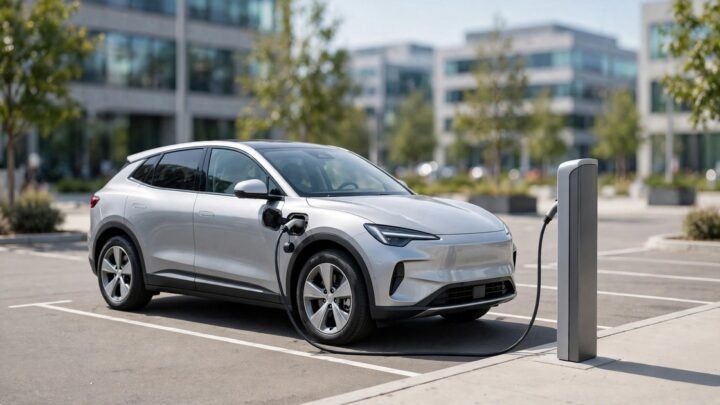
You pull into a DC fast charger at 18 percent. The screen jumps to 180 kW and you feel smart about the stop. Twenty minutes later you are at 80 percent, the car is down to 40 kW, and the last 20 percent looks like it will take nearly as long as the first 60. Nothing is broken. That cliff is designed in, and it is the single most useful thing to understand about public fast charging.
The Numbers at a Glance
- A Hyundai Ioniq 5 on a 350 kW charger goes from 10 to 80 percent in about 18 minutes — then the final 20 percent tapers hard (Hyundai official specs).
- Across most EVs, 80 to 100 percent on a DC fast charger can take nearly as long as 10 to 80 percent.
- The 2025 Porsche Taycan holds up to 320 kW and still quotes just 10 to 80 percent in 18 minutes — even Porsche does not promise the curve stays flat.
- Below 80 percent a typical curve delivers most of its energy at 60 percent of the peak rate or better; above 80 percent, expect roughly a quarter to a third of peak.
- Our session-time estimator below models this two-zone taper with your own car’s numbers.
The Short Answer
Your EV slows down after roughly 80 percent because its battery management system switches from constant current to constant voltage as cells approach their safe voltage ceiling. Near-full cells risk lithium plating and heat damage if current stays high, so the car tells the charger to taper power — often to a quarter of the peak rate or less. Plan road-trip stops from 10 to 80 percent, not to 100.
Why the Curve Exists: Constant Current, Then Constant Voltage
Every lithium-ion battery charges in two phases, whether it is in a phone or an 800-volt EV pack. The first phase is constant current (CC): the charger pushes a steady, high current and the cell voltage climbs gradually. This is the fast part, and it covers most of the 10 to 80 percent window. The second phase is constant voltage (CV): once cells approach their maximum safe voltage — around 4.2 volts per cell for the common NMC chemistry — the system holds the voltage fixed and lets the current taper down on its own.
The switch happens around 80 percent because that is where the safety margin gets thin. Three things force the slowdown. First, voltage headroom: overshooting a nearly full cell’s ceiling accelerates permanent damage. Second, chemistry: above 80 percent the graphite anode is nearly full of lithium ions, and forcing more in at high current causes metallic lithium to plate onto the anode instead of sliding into it — microscopic dendrites that rob capacity and, rarely, threaten the separator. Third, balance: a pack holds thousands of cells that fill at slightly different rates, and the system slows down so laggards can catch up near the top.
One common misunderstanding: the charger is not giving up. It could deliver full power the whole session — it is your car’s battery management system that instructs it to taper. The same curve on a different stall means the car is the limiter, not the station.
What Real Curves Look Like: Two Models, Side by Side
Manufacturers publish 10-to-80 percent times because that is the honest window — the part of the curve where the car is actually fast.
| Model | Peak DC rate | 10–80% claim | Source |
|---|---|---|---|
| Hyundai Ioniq 5 (2026, long range) | 350 kW | ~18 min | Hyundai official charging page; Hyundai’s own spec table quotes the same 18 minutes at 350 kW and ~73 minutes on a 50 kW charger |
| Porsche Taycan (2025, Performance Battery Plus) | 320 kW | 18 min | Porsche figures via InsideEVs (secondary source) — the previous generation quoted 5–80% in 22.5 min at 270 kW |
| Tesla Model Y | 250 kW (V3 Supercharger) | ~25–30 min (owner-measured, not an official Tesla figure) | Tesla publishes miles-per-15-minutes claims rather than 10–80 times; treat these as secondary estimates |
| Chevrolet Equinox EV | 150 kW | Close to 40 min | Road Ethos comparison (secondary source) |
The table is the whole argument in one glance: peak power and real speed are different numbers. The Ioniq 5’s headline is 350 kW, but 54.2 kWh (70 percent of its 77.4 kWh pack) delivered in 18 minutes is an average of about 181 kW — barely half the peak. That gap is the curve. When you compare cars, the 10-to-80 time is the only number that means anything; peak kilowatts are marketing. Our charging-time guide walks through what to expect on slower chargers too.
The Real Cost of the Last 20 Percent
Time is the obvious cost. A slower, less obvious one is money. In US states where per-kWh billing is restricted, some networks bill DC fast charging by the minute. When you pay per minute, the taper is not just slow — it is expensive, because you keep paying the same per-minute rate while the kilowatt-hours trickle in. Going from 90 to 100 percent at 25 kW on a per-minute plan can cost you several times more per kWh than the fast portion of the same session. Even on per-kWh pricing, idle fees that start when charging finishes mean lingering past 80 percent risks fees for energy that arrived at a crawl.
There is also a battery-health angle, and it cuts in one direction. Occasional 100 percent charges are fine — the car is designed for it — but habitual DC fast charging to 100 percent keeps cells at high voltage, which accelerates the degradation our battery-health guide documents. That is why most EVs let you set a daily charge limit — our charging-habits guide explains the 80-percent everyday ceiling. The taper is the battery protecting itself; the daily limit is you helping it.
Estimate Your Own Session Time
Drop in your battery size, where you arrive, where you want to leave, and the power numbers. The tool splits the session into a fast zone (below 80 percent) and a taper zone (above 80 percent) and estimates each.
How the formula works (our calculation): the model is a two-zone simplification of a real charging curve. In the fast zone (below 80 percent) it assumes your car averages 60 percent of the lower of the car’s peak and the charger’s maximum — because peak power is only held briefly. In the taper zone (above 80 percent) it assumes 28 percent of that peak, which matches the sharp drop most curves show. Time equals energy divided by average power. Check it against the anchors: a 77.4 kWh Ioniq 5 from 10 to 80 percent at a 350 kW charger comes out at about 15 minutes (Hyundai claims ~18, so the model runs slightly optimistic), and an 85 kWh Equinox EV from 10 to 80 at a 150 kW charger comes out at roughly 40 minutes — right on the reported figure. The cost line uses 55¢/kWh, the live US average tracked on our public-charging-cost page, purely as an example; swap in your charger’s real rate.
Five Levers That Change Your Curve (Besides the Battery)
The battery is not the only thing shaping the session. EVgo’s driver guide lists five factors that affect real charging speed: how full the battery is, its temperature, other loads running while you charge, battery age, and the current/voltage limits of both car and charger (EVgo’s 5 Things That Affect Your Charging Speed, primary source). Two of these deserve emphasis because they are free to fix.
Battery temperature is the silent killer of fast sessions. A cold pack will not accept peak power until it warms up — most modern EVs pre-heat the battery automatically when you route to the charger in the car’s navigation. In summer heat the same logic applies in reverse; the car spends energy cooling the pack, and cabin A/C running during the session steals a few more kilowatts.
Shared stalls halve your peak before the curve even starts. Many DC stations split one power cabinet between two stalls. If someone plugs in next to you mid-session, your ceiling drops and the whole curve compresses. When a site looks busy, picking a stall whose paired neighbor is empty — or just waiting two minutes for the other car to finish — can matter more than the car’s curve itself. Network reliability varies enough that checking recent reviews of the specific station is worth two minutes before a long trip.
The remaining two factors are physics you cannot negotiate. A 400-volt car on a charger whose cable is current-limited to 200 amps tops out around 80 kW no matter what the screen promises — power equals current times voltage, and the lower limit wins. And an older battery with real degradation simply holds less and accepts less; it is not a fault.
When Charging Past 80 Percent Actually Makes Sense
The 80-percent rule is guidance, not law. Three situations justify the taper: the next charger is far enough that you need the buffer, you are towing or facing a long climb and want margin, or the next site is known to be full or broken and you would rather wait once than gamble twice. Cold nights count too — a warm, full battery gives you heating headroom if you get stuck. Outside those cases, the math is brutal: arriving low and leaving at 80 usually beats arriving at 50 and sitting through the taper to 100. Tesla’s own trip planner and most automakers’ route planners already optimize for exactly this, which is why Supercharger pricing is worth understanding before a trip — see our Tesla Supercharger pricing breakdown and the membership math if you fast-charge often.
AC Charging Does Not Have This Problem
One common confusion: your home Level 2 charger does not show a dramatic 80-percent cliff. That is because a 7–11 kW home charger is already gentle enough that the battery’s limits rarely bind — the taper exists in principle, but at single-digit kilowatts it is invisible in practice. The cliff is a DC fast-charging phenomenon, where the current is high enough for the protection logic to matter. If you want the full picture on home versus public costs, home charging at single-digit kilowatts is almost always the cheapest way to fill up.
Frequently Asked Questions
Is it bad to fast-charge past 80 percent?
Occasionally, no — the taper exists precisely to protect the pack. Habitually, it is a poor trade: slow, sometimes more expensive per kWh on per-minute billing, and it holds cells at high voltage longer than they like.
Why does my EV show 150 kW on a 350 kW charger?
Because the car is the bottleneck. Your vehicle negotiates with the charger and accepts only what its battery, voltage, temperature, and state of charge allow. EVgo puts it plainly: power is limited by whichever side — car or charger — is lower.
Does the curve flatten on very powerful cars?
No. The flattest curve in the business belongs to the 800-volt cars — Ioniq 5, Taycan — and they still quote only 10-to-80 times. More peak power shortens the fast zone; it does not remove the taper.
Can preconditioning fix the 80-percent slowdown?
No. Preconditioning fixes a cold battery, which is a different problem. The post-80 taper is voltage and chemistry, not temperature — a warm battery tapers exactly the same way.
Should I unplug at 80 percent even if the next charger is 200 miles away?
Do the arithmetic with the estimator above. If 80 percent does not cover the gap plus a buffer, charge past it — a slow session beats a tow. If it does cover the gap, leave. Arriving low at the next fast charger is faster than nursing this one to 100.
Why do manufacturers only advertise 10-to-80 times?
Because that window is where the car is genuinely fast, and because the taper above 80 percent varies with temperature, age, and pack. It is the one comparable, repeatable number — treat it as the real spec and the peak kilowatt figure as context.
The Takeaway
The charging curve is not a flaw and it is not negotiable: below 80 percent your EV drinks, above it, it sips. Once you internalize that, the strategy writes itself — arrive with a low battery, precondition on the way, leave at 80 unless the road demands more. The cars with the best 10-to-80 times, not the biggest peak-kilowatt headlines, are the fastest road-trip cars in practice. Use the estimator above with your own numbers before your next long drive, and the slowdown will stop being a surprise and start being a plan.
Written by Shurah, who researches and writes independently on the real cost of EV ownership — charging, maintenance, and total cost of ownership — backed by primary data and original calculations rather than recycled lists.