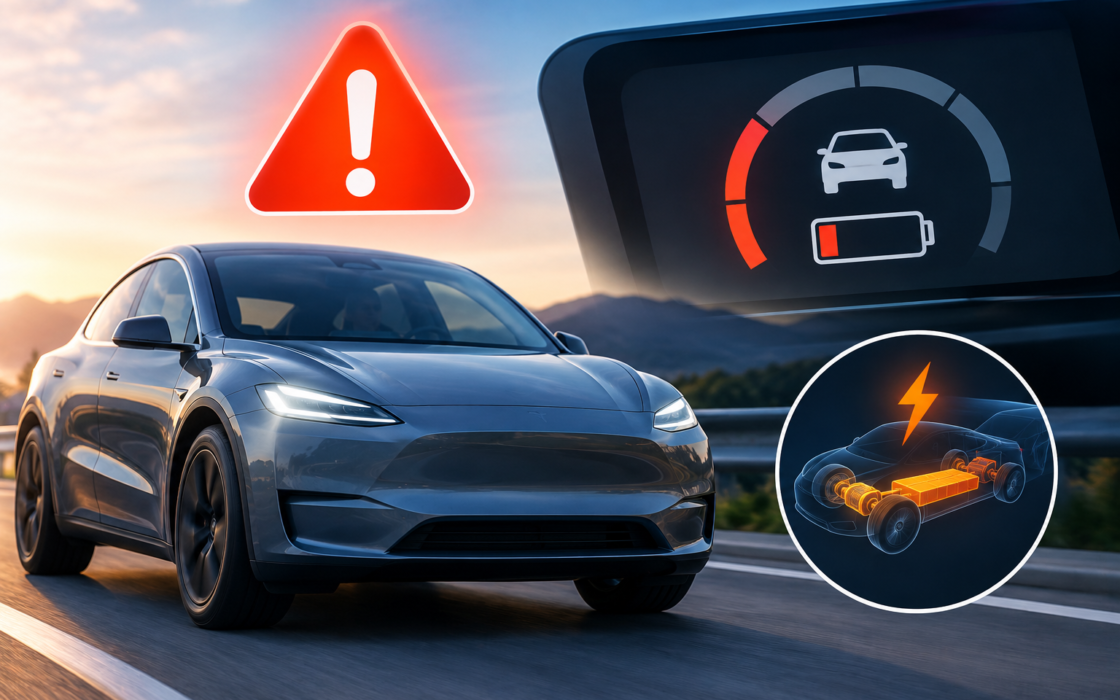
A warning light appears, acceleration suddenly feels sluggish, and a message says something like “Reduced Power Available” or “Drive System Limited.” This is limp mode — and the important thing to understand first is that it isn’t the failure itself. It’s your car’s software deliberately protecting something, and figuring out what it’s protecting tells you what’s actually wrong.
Key Numbers
- Limp mode can be triggered by at least six distinct root causes — thermal protection, a 12V battery fault, a charging control unit (ICCU) failure, cell imbalance, a position sensor fault, or deliberate low-charge power limiting — each needing a different response.
- Thermal protection is widely cited as the most common trigger, and it’s also the one most likely to resolve itself once the battery returns to a normal operating temperature.
- A single 2024 Hyundai/Genesis ICCU recall (NHTSA 24V-868) documented 145,235 vehicles where a charging control unit fault could progressively cut drive power, up to and including a full loss of propulsion — a real, manufacturer-acknowledged example of this exact symptom.
- Even EVs use a conventional 12V battery to power control systems, and a failing one is a frequently cited cause of unexpected power restriction, independent of the main high-voltage pack’s health.
- Position/rotor sensors (Hall sensors or resolvers) feeding the motor controller bad data are described as a “frequent culprit” behind stuttering, jerking, or intermittent power cuts that can look like a motor problem but aren’t.
Short Answer
Limp mode is a deliberate protective response, not a malfunction on its own — your car’s software has detected a real or potential fault somewhere (thermal, electrical, or mechanical) and is restricting power to prevent further damage while you get to safety. The most common cause, extreme battery temperature, often clears on its own once the pack cools or warms back into its normal range. Persistent limp mode after a restart and a temperature-normalization period generally means an actual fault — a 12V battery, a charging control unit, a sensor, or the battery management system itself — and needs professional diagnosis rather than repeated attempts to drive through it.
What Limp Mode Actually Is
Every EV’s battery management system (BMS) and motor controller continuously monitor dozens of parameters — cell voltages, pack temperature, insulation resistance, sensor signals. When one of those readings crosses a safety threshold, the software’s job is to protect the expensive, dangerous-if-mishandled components (the battery pack and the high-voltage electronics) rather than let you keep driving normally. Limiting power output — reducing torque, capping top speed, sometimes disabling regenerative braking — is that protective response. It’s the same logic as a gas engine’s limp-home mode, just triggered by a different set of sensors watching a fundamentally different system.
Six Real Causes, and What Each One Means
- Thermal protection (most common). If the battery gets too hot or too cold, the BMS restricts power to prevent damage or unsafe operation. This is frequently self-resolving — the car often returns to normal once the pack is back in its target temperature range, with no lasting issue.
- A 12V auxiliary battery fault. Nearly every EV still relies on a conventional 12V battery to power control systems, wake the car up, and manage low-voltage electronics — a fault here can trigger limp mode independent of the main pack’s health, exactly the mechanism we cover in detail in our 12V battery guide.
- Charging control unit (ICCU) failure. On E-GMP platform vehicles specifically, a failing ICCU — the component that steps high-voltage power down to charge the 12V battery — has been documented to progressively reduce drive power, in some cases to a full loss of propulsion, which is exactly the mechanism behind the real recall we covered in our EV recall-rate research.
- Cell imbalance or BMS-detected cell fault. If individual cells within the pack drift out of balance or trip an internal protection threshold, the BMS can restrict overall pack output to protect the weakest cells from further stress.
- A position/rotor sensor fault. Hall sensors or resolvers tell the motor controller exactly where the rotor is at any instant. Heat, humidity, vibration, or a loose connector can corrupt that signal, and the controller responds to bad positional data with stuttering, jerking, or a deliberate power cut rather than risk driving the motor incorrectly.
- Deliberate low-state-of-charge limiting. This one isn’t a fault at all — some EVs intentionally restrict acceleration and top speed as the battery approaches empty, both to protect the remaining cells and to stretch the last few miles of range. It looks identical to a fault-triggered limp mode from the driver’s seat but is simply the car doing exactly what it’s designed to do.
What Symptom Points to Which Cause?
What to Actually Do
- Don’t try to override or push through it. The restriction exists to prevent a bigger problem — forcing more power isn’t possible on modern EVs anyway, and trying complicates diagnosis later.
- If it’s plausibly heat- or cold-related, give it time. Pull over safely, let the vehicle sit (running the climate system if needed) so the pack can return to its normal temperature range before continuing.
- It’s generally considered safe to drive a short distance cautiously to reach a safe location or charging point, but avoid continuing to use the vehicle normally until the underlying cause is identified.
- A restart can clear a temporary software glitch — but if the same fault reappears immediately or after a short drive, that points to a real underlying issue, not a one-off.
- If limp mode persists after a temperature-normalization period and a restart, get a diagnostic scan rather than continuing to drive on reduced power repeatedly — a professional scan can read the actual fault code rather than guessing from symptoms alone.
What NOT to Do
- Don’t ignore a repeat occurrence and keep driving as normal — a fault that keeps returning is telling you something specific isn’t resolving on its own.
- Don’t assume a 12V battery swap fixes everything by default. It’s a common and often correct first check, but replacing a healthy 12V battery repeatedly without confirming the actual fault code wastes money if the real cause is elsewhere in the system.
- Don’t treat a persistent hardware fault as something a reset will permanently clear — clearing a code without fixing the underlying issue typically means the same warning returns within a day or two.
FAQ
Is it dangerous to drive in limp mode?
Reduced power itself is a protective, controlled state rather than a dangerous one, but you should treat it as a signal to get to safety and stop normal use rather than continuing to drive as usual, especially on higher-speed roads where sudden reduced acceleration could be hazardous.
Will limp mode damage my battery further if I keep driving?
The restriction exists specifically to prevent further damage, so driving cautiously within the limited power the car allows is generally the safer choice — the real risk is ignoring the warning and attempting to force normal performance, which the car’s software won’t allow anyway on most models.
Does limp mode always mean an expensive repair?
No — a thermal-protection trigger or a deliberate low-charge limitation often costs nothing to resolve. Only a genuine hardware fault (12V battery, ICCU, sensor, or pack-level issue) leads to a repair, and the cost varies enormously depending on which component is actually at fault.
Can cold weather alone put my EV into limp mode?
Yes, extreme cold can trigger thermal protection just as extreme heat can — this ties into the broader winter performance picture we cover in our cold-weather range guide, though limp mode from cold is a separate, less common event than ordinary winter range reduction.
Should I keep driving on a long trip if limp mode clears after a restart?
Treat a cleared warning with some caution rather than complete reassurance — if it returns within the same trip, plan to get the vehicle scanned rather than continuing to reset and drive repeatedly.
The Short Version
Limp mode is your EV’s protective response to something it has detected, not a malfunction in itself — the real question is always which of several distinct causes triggered it. Thermal protection is the most common and often resolves on its own; a 12V battery fault, a charging control unit failure, cell imbalance, or a sensor glitch are less common but require actual diagnosis; and sometimes it’s simply the car deliberately limiting power near an empty battery, which isn’t a fault at all. Give a temperature-related trigger time to clear, treat a repeat occurrence as a real signal rather than an inconvenience, and get a proper diagnostic scan rather than guessing at the cause from symptoms alone.
About the author: Written by Shurah, who researches and writes independently on the real cost of EV ownership — charging, maintenance, and total cost of ownership — backed by primary data and original calculations rather than recycled lists.