You step outside on a freezing morning, hit the button to open the charge port, and nothing happens. Or worse — you’re ready to leave and the charging cable simply won’t release. This isn’t a sign anything’s broken; it’s one of the most common cold-weather complaints EV owners report, and it has a real, well-understood mechanical cause along with a few genuinely bad pieces of advice still circulating in owner forums.
Key Numbers
- The Department of Energy’s own winterizing guidance confirms charging connectors are designed to be waterproof, but heavy snow or sleet accumulation can still cause them to freeze.
- Tesla’s official owner’s manual documents a dedicated “Defrost Car” setting specifically built to thaw a frozen charge port latch — this is manufacturer-acknowledged, not a forum workaround.
- There are at least 5 distinct mechanical causes of a stuck charge cable — frozen latch, a hung software session, debris/misalignment, a wedged third-party adapter, and an actual failed latch motor — and each needs a different fix.
- Repeatedly triggering a motorized charge-port door while it’s frozen shut risks burning out the actuator motor or blowing a fuse — the fix for “it won’t open” is never “try harder.”
- Tesla shipped at least one documented over-the-air software update specifically adjusting charge port locking behavior for cold climates, confirming this is an engineering problem manufacturers actively work on, not just user error.
Short Answer
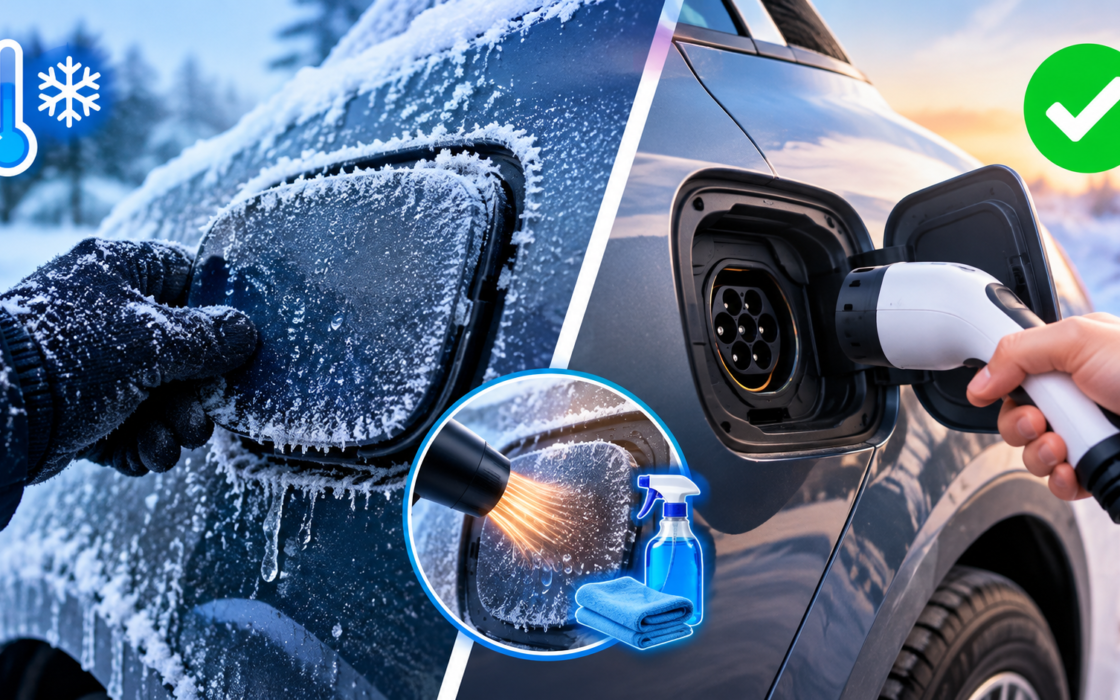
Water that seeps into the seam around the charge port or the cable latch freezes in cold weather and mechanically locks the door or connector in place — the port itself is weatherproof by design, but ice accumulation defeats that. The fix is heat, not force: use your car’s built-in defrost/preconditioning feature, or a hairdryer on low heat aimed at the latch, and never pry the door open or pour hot water on it. If nothing works, most EVs have a manual emergency release documented in the owner’s manual.
What’s Actually Freezing
Charge ports and cable connectors are built to IP-rated waterproof standards — the same engineering that makes charging safely in rain a non-issue (see our breakdown of exactly how that works). The problem isn’t water getting where it shouldn’t; it’s water sitting in the seam around the port door or latch mechanism, then freezing solid when temperatures drop, mechanically locking a hinge or a spring-loaded latch pin in place. It’s the same physics as a car door lock freezing shut — the seal did its job, but ice doesn’t care about seals once it’s already in the gap.
Five Different Causes, Five Different Fixes
Not every “won’t release” situation is actually ice. Distinguishing the cause matters because the wrong fix can make some of these worse:
- Frozen latch (the classic case) — water in the seam has frozen and locked the mechanism. Responds to heat.
- Hung software/handshake glitch — the car’s software thinks it’s still mid-charging-session even though it isn’t, so the latch logic never releases. Responds to a soft reset or power-cycle, not heat.
- Debris or a misaligned plug — grit, a bent pin, or a connector seated at an angle binds the latch mechanically. Needs a visual inspection, not force.
- A wedged third-party adapter — a NACS-to-CCS or CCS-to-NACS adapter can jam between the car and the cable so the cable itself releases but the adapter stays stuck (this ties directly to the adapter-compatibility confusion we cover in our EV adapter guide).
- An actually failed latch actuator — the small motor or solenoid that drives the locking pin has genuinely failed. This is the one cause on this list that’s a real hardware fault, not weather or software, and it needs a technician.
What NOT to Do
- Don’t pour hot water on it. It melts the immediate ice, but the water runs into the same seam and refreezes within minutes, often worse than before — several owners in forum threads report exactly this cycle happening to them.
- Don’t pry the door open with a screwdriver or similar tool. Plastic housings are more brittle in freezing temperatures and are easy to crack or snap this way, turning a temporary ice problem into a permanent broken-latch problem.
- Don’t repeatedly mash the open/close button on a motorized port door. If the door is genuinely frozen shut, repeated actuation attempts put real strain on the small motor driving it and can burn it out or blow a fuse — at which point you have a hardware repair instead of a weather problem.
What Actually Works
- Use your car’s built-in defrost or preconditioning feature — Tesla’s owner’s manual specifically documents a “Defrost Car” setting for exactly this scenario, noting it can help thaw the latch in cases where the cable can’t be inserted or removed due to a frozen latch, though it can take up to an hour with significant ice buildup.
- A hairdryer on low heat, aimed at the latch/hinge area, is a widely reported working fix that avoids the refreezing problem of hot water.
- Preheat before you need to charge, not after — Tesla’s own cold-weather guidance notes that using scheduled preconditioning and charging can help prevent the latch from freezing in the first place, rather than only fixing it after the fact.
- Check your owner’s manual for the manual emergency release — most EVs have one, and the location varies significantly by manufacturer. If nothing else works, this bypasses the motorized/latched mechanism entirely.
- If it’s a software hang, not ice — a soft reset or power-cycle of the vehicle’s infotainment/charging system (check your specific manufacturer’s instructions) resolves it without needing heat at all.
Preventing It Next Time
The Department of Energy’s official winterizing guidance recommends a few concrete habits specifically aimed at this problem:
- Covered or garage parking when possible reduces direct snow/sleet accumulation on the port area.
- A magnetic EV charging inlet cover or bag, sold as an aftermarket accessory, adds a physical barrier over the port seam between charging sessions.
- Hang the charging cable/connector according to the manufacturer’s recommendation when not in use, rather than letting it sit on the ground where it can collect moisture and ice.
- Use scheduled preconditioning so the port area gets a warm-up cycle regularly rather than only when you’re already stuck.
Which Fix Should You Try First?
FAQ
Is a frozen charge port a sign something is wrong with my EV?
No — it’s a known cold-weather characteristic across essentially every EV brand, not a defect specific to your vehicle. Manufacturers actively engineer and update software around it, which is itself evidence it’s an expected condition, not a fault.
Can I use a de-icer spray on the charge port?
A de-icer product specifically formulated as vehicle-safe is generally reported as workable, but check that it’s not a windshield-only formula that could affect plastics or electrical contacts, and avoid spraying directly into the electrical pin area.
Will this damage my charging equipment long-term?
A one-time frozen latch resolved with gentle heat typically causes no lasting damage. Repeated forcing, prying, or motor over-cycling is what actually causes lasting damage — the ice itself usually isn’t the destructive part.
Does parking outside overnight make this worse than a garage?
Yes, generally — direct exposure to snow, sleet, and temperature swings increases the chance of moisture collecting and freezing in the port seam, which is why DOE’s own guidance specifically recommends covered parking as a preventive step.
Is this the same issue as reduced winter range?
No — a frozen charge port is a separate, purely mechanical issue from the cabin-heating-driven range loss covered in our winter range guide. You can have one without the other.
The Short Version
A frozen charge port isn’t a malfunction — it’s moisture in a seam that was never meant to stay dry forever, freezing solid in cold weather. The fix is consistently heat, whether from your car’s built-in defrost feature, a hairdryer, or simply preheating on a schedule so it doesn’t happen in the first place — never force, never hot water, and never repeated button-mashing on a motorized door. Distinguishing a genuinely frozen latch from a software hang, a misaligned plug, or an actual hardware failure matters, because the wrong fix on the wrong cause can turn a five-minute annoyance into a real repair.
About the author: Written by Shurah, who researches and writes independently on the real cost of EV ownership — charging, maintenance, and total cost of ownership — backed by primary data and original calculations rather than recycled lists.