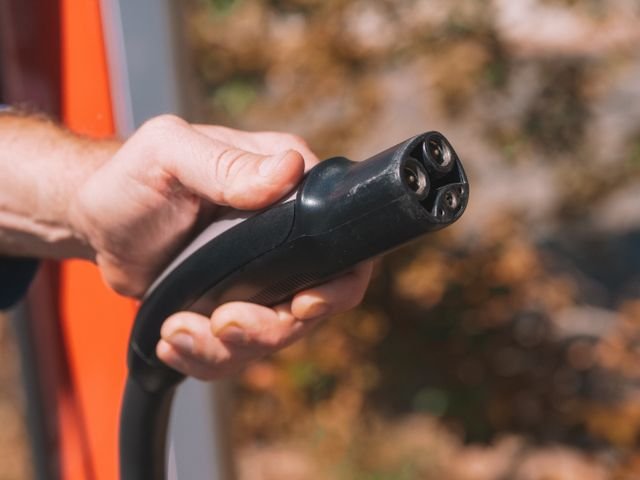
A thief cuts the cable off a DC fast charger, strips the insulation, and sells the copper for somewhere between five and twenty dollars. Replacing that cable costs the operator up to four thousand.
That ratio — roughly 35 to 100 times more damage than gain — is the whole story of EV charging cable theft, and it is why the problem has been so hard to solve. This is not rational crime responding to rational deterrents. It is opportunistic vandalism with a small payout attached, and it disables a piece of public infrastructure that somebody was relying on that afternoon.
It is also, increasingly, a problem for the cable in your own boot. Portable charging cables run $300 to over $1,000, and home chargers are not immune either.
The key numbers
- $5–$20 — what the copper in a cut charging cable is actually worth
- $650–$4,000 — what replacing one costs, Level 2 through DC fast
- 18 of 19 — cables stolen from a single Houston Tesla site in one incident
- 200+ — recorded UK charger theft and vandalism incidents, 2022 to mid-2025
- 23% — share of curbside Level 2 repairs caused by cable damage, much of it not theft at all
- $300–$1,000+ — what your own portable cable costs to replace
What the theft data shows
The trend is real and it accelerated fast. Electrify America reported that until recently a cable might be cut roughly once every six months across its whole network of 968 stations and 4,400 plugs. In one subsequent year the count reached 129 by the end of May alone — already more than the entire preceding year. That works out to nearly 3% of the network’s plugs being hit inside five months.
Individual incidents are worse than the averages suggest, because thieves work a site rather than a plug. At one Houston-area Tesla station, 18 of 19 cables were taken, disabling 95% of the location in a single visit. Seattle police recorded seven cable thefts from charging stations in a year, matching the total for the whole year before.
The UK picture matches. Freedom of information requests to more than 30 police forces turned up over 200 recorded incidents between 2022 and mid-2025, with industry sources describing that as the tip of the iceberg because many go unreported or are not logged separately. West Mercia Police recorded five cable thefts in a single month of 2025 against one in all of 2023. One operator, Instavolt, reported 33 incidents across just 13 sites in a year.
ChargePoint’s chief executive has described spending time in the company’s San Jose laboratory attacking its own chargers with saws and shears to understand what happens to the 65,000 cords in its care. That is where the industry is.
The economics that make it so stubborn
Cutting a charging cable is not much harder than stealing a bicycle. Stations sit in quiet corners of shopping centres and municipal car parks, almost all of them unmanned, and severing a cord can be a hacksaw job.
What the thief gets is trivial. Charging companies put the recoverable copper at perhaps $15 to $20 per cable, and after stripping insulation the realistic figure has been put as low as five to seven dollars. FLO calculated that the two cables on a DC fast charger hold about 40 pounds of copper for roughly a $40 payout un-stripped.
| What the thief earns | What the repair costs | Ratio |
|---|---|---|
| ~$20 (Level 2 cable) | $650–$700 connector plus labour | 32–35x |
| ~$20 | $1,000 — one city-owned cable, Minneapolis | 50x |
| ~$40 (DC fast, two cables) | $1,500–$4,000 | 38–100x |
The costs land somewhere, and eventually that somewhere is charging prices. Operators absorbing thousands per incident across thousands of sites is a cost line that shows up in what you pay at the plug — something worth remembering when reading our breakdowns of Electrify America’s rates and EVgo’s, both of which sit above 60 cents per kWh.
An honest correction to the headlines
The coverage of this problem runs hotter than the data in one respect, and it is worth saying plainly.
FLO, one of North America’s larger networks, reported that it was not seeing a marked rise in service calls for cable theft specifically, and made a point that deserves repeating: in one recent quarter, 23% of all its curbside Level 2 repairs involved cable damage — but much of that was misuse rather than theft. Drivers dropping the connector on the ground. Drivers pulling the cable too hard. Cars driving off still plugged in.
So a broken cable at your local charger is more likely to be wear and clumsiness than crime. The network also warned that heavy media coverage risks encouraging copycat thefts for a payout that never made economic sense in the first place.
Both things are true: theft is rising sharply from a low base, and it is still not the main reason a cable is out of service. Our guide to why EV charging fails covers the far more common causes, of which payment and authentication problems top the list.
Your own cable is a target too
This is the part that affects you directly, and it gets almost no coverage because the public-charger story is more dramatic.
A portable Level 2 cable costs $300 to over $1,000 to replace. It lives in your boot, it is often left plugged in overnight on a driveway, and at a public Level 2 charger it sits unattended for hours. Home charging setups have been targeted too.
Unlike a network operator, you have real options here — and most of them cost less than $30.
1. Use the car’s own cable lock
Nearly every EV can lock the connector into the charge port while a session is running, and most will keep it locked until the car is unlocked. It is a setting, it is free, and a large share of owners have never checked whether theirs is on. Look for “charge port latch”, “cable lock” or “lock connector while charging” in the charging menu.
The limitation: this secures the car end. The station end is still loose, so at a public charger it stops someone walking off with your cable but not someone cutting it.
2. A physical cable lock for the far end
Simple padlock-style clamps that fit over the connector body or the cable itself, typically $15–$40. They will not stop a determined person with bolt cutters — nothing at this price will — but almost all of this is opportunistic. A lock moves you past the easiest target on the row, which is the entire job it needs to do.
3. Mount the cable, do not coil it on the floor
A wall hook or holster at home costs about $15 and does three jobs at once: it keeps the connector off wet ground, it removes the strain that causes most cable failures, and it makes the cable harder to grab and pull. If you use a portable charger as your permanent setup, you should be mounting the control box anyway — our guide to portable EV chargers explains why the weight hanging on the socket is a problem in its own right.
4. Bring the cable inside when you are away
Obvious, and almost nobody does it. If the car is parked for a week, the cable does not need to be outside.
5. Light and cameras
A motion-activated light over a driveway charger costs under $40 and is the single most effective deterrent per dollar spent on any property. Most EVs also have built-in camera modes that record around the car — useful, though as our guide to the 12-volt battery explains, leaving them on continuously is one of the fastest ways to flatten it.
6. Check what your insurance actually covers
A charging cable may be covered under your car policy, your home contents policy, both or neither, and the answer depends on whether it was attached to the car at the time. Find out before you need to know. Some home policies also exclude a fixed wallbox unless it has been declared.
Choosing between public chargers with this in mind
The location advice from the reliability data applies here too, for the same underlying reason. Chargers attached to a business that wants you there — hotels, petrol forecourts, restaurants — are lit, overlooked and maintained. Stand-alone car parks and quiet municipal lots are where both vandalism and neglect concentrate — the satisfaction data in our guide to why charging fails shows a 122-point gap between the two.
Practically: prefer sites with more stalls, better lighting and visible cameras, and check recent user comments before committing to a stop with low battery. A site reported as having three of six cables cut is a site to route around; PlugShare check-ins are the fastest way to see it.
Where this is heading
Operators are not standing still. FLO’s chargers carry around 200 sensors, including one that detects a cut cord. Electrify America has been installing more cameras. Proposals under discussion include dye packs that mark a vandal with ink, in the same spirit as bank security, alongside tougher cable construction and stiffer penalties.
The most interesting fix is a side effect of something else entirely. 800-volt vehicle architecture needs thinner cables, because higher voltage means lower current for the same power and less cooling. Less copper per cable means less to steal and cheaper replacement. The same engineering that gives an 800-volt car an 18-minute charge also makes the cable a worse target — see our guide to how long charging takes for what that architecture does on the driver’s side.
Frequently asked questions
Why do people steal EV charging cables?
For the copper inside. The recoverable value is small — roughly $5 to $20 per cable after stripping — but the cables are accessible, stations are unmanned, and cutting one takes little skill.
How much does a stolen cable cost to replace?
Around $650–$700 for a Level 2 connector including labour, and up to $1,500–$4,000 for a DC fast charging conduit. One US city paid $1,000 to replace a single cable.
Is my home charging cable at risk?
Less than a public one, but yes — home setups have been targeted, and a portable cable costs $300 to over $1,000 to replace. Enable the car’s connector lock, mount rather than coil the cable, add a motion light, and bring it inside when you are away for a while.
Do cable locks actually work?
Against opportunists, which is most of this. A $15–$40 lock will not defeat bolt cutters, but it makes your cable a harder target than the unlocked one next to it, and that is usually enough.
Can I lock the cable to my car?
Almost certainly. Nearly every EV has a charge port latch setting that locks the connector during charging and until the car is unlocked. It is off by default on some models.
Is every broken charger cable a theft?
No, and this is worth knowing. One network reported that 23% of its curbside Level 2 repairs involved cable damage, much of it from misuse — dropped connectors, over-pulled cables, drivers pulling away still plugged in — rather than crime.
Does insurance cover a stolen charging cable?
Sometimes, under a car policy or home contents policy, and it can depend on whether the cable was connected to the vehicle at the time. Check the wording before you need it, and check whether a fixed wallbox needs to be declared separately.
The short version
Charging cable theft is rising sharply and makes no economic sense: a thief recovers $5 to $20 of copper while the repair costs $650 to $4,000, a ratio of up to a hundred to one. Public networks are responding with sensors, cameras and tougher cables, and 800-volt architecture will quietly help by requiring less copper in the first place. What you can control is your own cable, which costs $300 to $1,000 to replace. Turn on your car’s connector lock, add a $15–$40 physical lock at the station end, mount the cable on a wall hook instead of coiling it on the ground, put a motion light over a driveway charger, bring it indoors when you travel, and check which of your policies actually covers it. And remember that most broken cables at public chargers are wear and misuse, not crime.