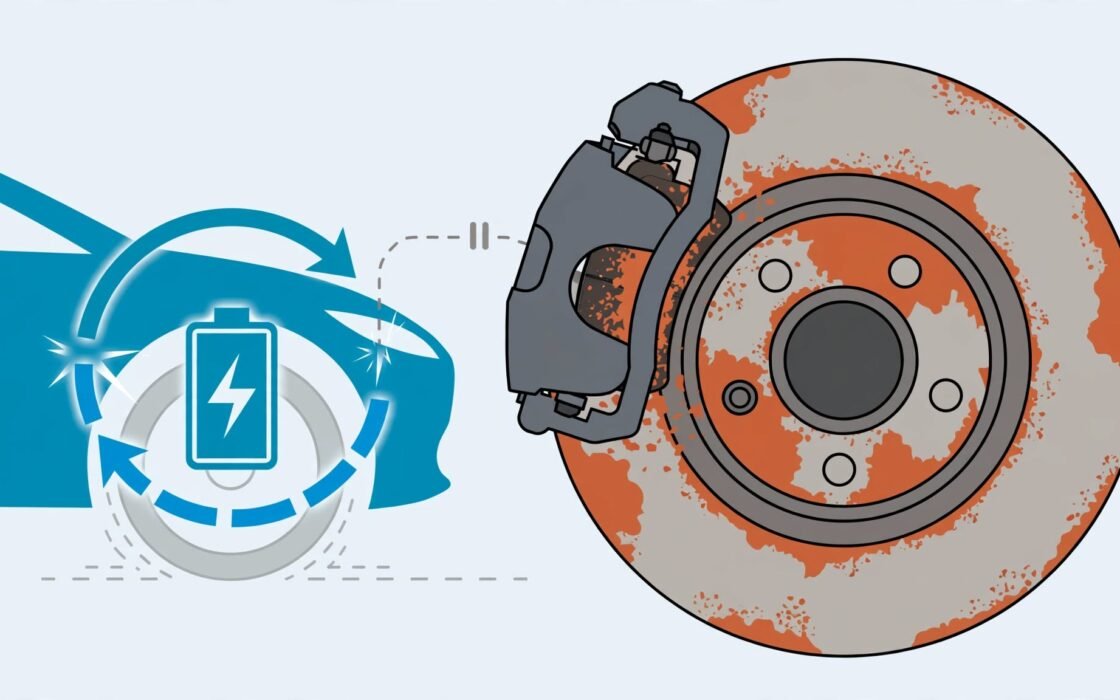
It sounds backwards: a car with barely any miles develops a grinding noise on cold mornings, or a shop finds a completely seized rear caliper on a low-mileage vehicle. The cause isn’t neglect in the usual sense — it’s the direct side effect of the exact feature that makes an EV efficient. Regenerative braking is genuinely good for pad life and range. It’s genuinely bad for keeping rotors and calipers clean.
Key Numbers
- Regenerative braking generates little to no heat at the wheels during most stops, removing the thermal self-cleaning cycle that normally burns moisture off rotors and pads in a conventionally-braked car.
- One documented repair-shop case (a 2016 Chevy Volt, reported by Tire Review) found a fully seized rear caliper and heavily corroded rotor, with the brake pad’s friction material physically separated and rolling loose inside the assembly.
- Because most platforms bias regen more heavily to certain wheels, rear brakes commonly corrode faster than fronts — though the exact pattern varies by how each manufacturer distributes regenerative torque.
- Brake fluid absorbs moisture regardless of how often the friction brakes are actually used — the same underlying issue behind the brake-fluid paradox covered in our EV maintenance research, just showing up externally on the rotor instead of internally in the fluid.
- Manufacturers and brake specialists distinguish light overnight surface rust that clears after a few stops (normal) from persistent grinding, pulsation, or heavy pitting that doesn’t clear (a real problem worth inspecting).
Short Answer
Yes — an EV’s friction brakes can genuinely rust, corrode, or seize from simply not being used enough, because regenerative braking handles most everyday slowing and generates none of the heat that normally scrubs rotors clean and dries out moisture. This isn’t a defect; it’s the direct tradeoff of the same feature that extends pad life and boosts range. A little surface rust after sitting overnight is completely normal and usually clears itself within a few stops — persistent grinding, a pulsating pedal, or uneven wear that doesn’t resolve is the point where it becomes a real maintenance issue.
The Mechanism: Why Less Use Means More Corrosion
In a conventionally-braked car, friction between the pad and rotor does two things at once: it slows the car, and it generates enough heat to burn off surface moisture and physically scrub the rotor face clean on nearly every stop. Regenerative braking replaces most of that friction work with the electric motor acting as a generator, which slows the car while sending energy back to the battery — but produces essentially none of that cleaning heat at the wheel. The friction brakes only fully engage during hard stops, low-speed final stops, or when the battery is too full to accept more regenerative energy. Between those moments, moisture and road salt simply sit on the rotor and caliper hardware for hours or days at a time, exactly the conditions that accelerate rust.
A Real Documented Case
This isn’t theoretical. Tire Review reported a repair shop’s inspection of a 2016 Chevy Volt brought in for a noise on the driver’s side rear — pulling the wheel revealed the brake pad’s friction material had separated from its backing plate and was rolling loose between the rotor and dust shield, and the rotor itself showed heavy corrosion consistent with not having functioned properly in a long time. Further inspection found the rear caliper completely seized. The Volt’s regen system biases braking heavily to the front wheels, leaving the rears engaging only for hard or low-speed stops — precisely the underuse pattern that let corrosion take hold unnoticed.
The Same Root Cause, a Different Symptom
This connects directly to something we’ve already covered: our EV maintenance research found that brake fluid absorbs moisture over time regardless of how often the brakes are actually used, meaning fluid degrades on a calendar timeline rather than a mileage-and-heat-cycle timeline the way it does in a gas car. Rotor and caliper corrosion is the external, visible version of the exact same underlying issue — reduced friction-brake use removes the natural moisture-clearing mechanism, whether that moisture is sitting in the fluid internally or on the rotor face externally.
What Symptom Points to What?
What Actually Helps
- Periodic firm braking. Occasionally — many owners find once a week reasonable — disable regen if your vehicle allows it, or simply brake firmly on a safe, dry stretch of road. This generates the heat needed to burn off moisture and lightly scrub the rotor surface, the same self-cleaning a gas car gets automatically on every stop.
- Wash the undercarriage in road-salt climates. Since regen already means your rotors are more exposed to accumulated moisture and salt than a gas car’s, rinsing wheel wells after winter driving matters more, not less.
- Don’t skip brake fluid service based on reduced heat exposure. As covered in our maintenance research, fluid absorbs moisture regardless of use — stick to the manufacturer’s interval (typically 2 to 4 years) rather than assuming lower thermal stress means it can wait longer.
- Consider EV-specific brake pad and rotor products if you’re replacing components — some manufacturers now build pads and coated rotors specifically designed for the reduced-use duty cycle regen-heavy braking creates, rather than standard parts designed around a gas car’s more frequent friction-brake use.
- Have brakes physically inspected periodically, not just visually through the wheel — corrosion and sticking components often hide behind the rotor or inside the caliper housing where a quick glance won’t catch them.
FAQ
Is brake rust a sign my EV’s brakes are failing?
Not automatically — light surface rust after sitting overnight is normal and expected on any EV that relies heavily on regen. It only becomes concerning when it’s heavy, doesn’t clear after normal driving, or comes with a pulsating pedal or one-sided pull.
Does this mean EV brakes cost more to maintain than gas car brakes?
Not necessarily overall — pads typically last much longer on an EV due to reduced friction use, but the corrosion risk means the failure mode shifts from “worn down” to “rusted or seized,” which can still require replacement even with plenty of remaining pad material.
Can I just leave regenerative braking on maximum and never worry about this?
Maximum regen is fine for daily driving and range, but occasional deliberate friction braking is the practical counterbalance that keeps the self-cleaning cycle from disappearing entirely.
Is this issue worse in certain climates?
Yes — road salt and consistent moisture (winter climates, coastal or humid regions) accelerate the corrosion process significantly compared to a dry climate, making the periodic hard-braking habit more valuable in those conditions.
Will my dealer catch this during a normal service visit?
Not always — corrosion and sticking components can hide behind the rotor or inside the caliper housing, so a purely visual check through the wheel may miss it. Ask specifically about caliper function and rotor corrosion if you’re concerned.
The Short Version
Regenerative braking is one of an EV’s clearest efficiency wins — it extends pad life dramatically and recovers energy that would otherwise be wasted as heat. The tradeoff is that friction brakes see so little use that the self-cleaning, moisture-clearing cycle a gas car gets automatically on every stop simply doesn’t happen the same way, leaving rotors and calipers exposed to rust and, in documented cases, full seizure. Light overnight surface rust is normal and self-resolving; persistent grinding, pulsation, or one-sided pulling isn’t. A little deliberate friction braking now and then, along with sticking to the fluid-change interval regardless of reduced thermal stress, is the practical counterbalance to a feature that’s otherwise a genuine advantage.
For the full picture on why this happens and how to prevent it, see our guide to EV brake rust and corrosion.
About the author: Written by Shurah, who researches and writes independently on the real cost of EV ownership — charging, maintenance, and total cost of ownership — backed by primary data and original calculations rather than recycled lists.