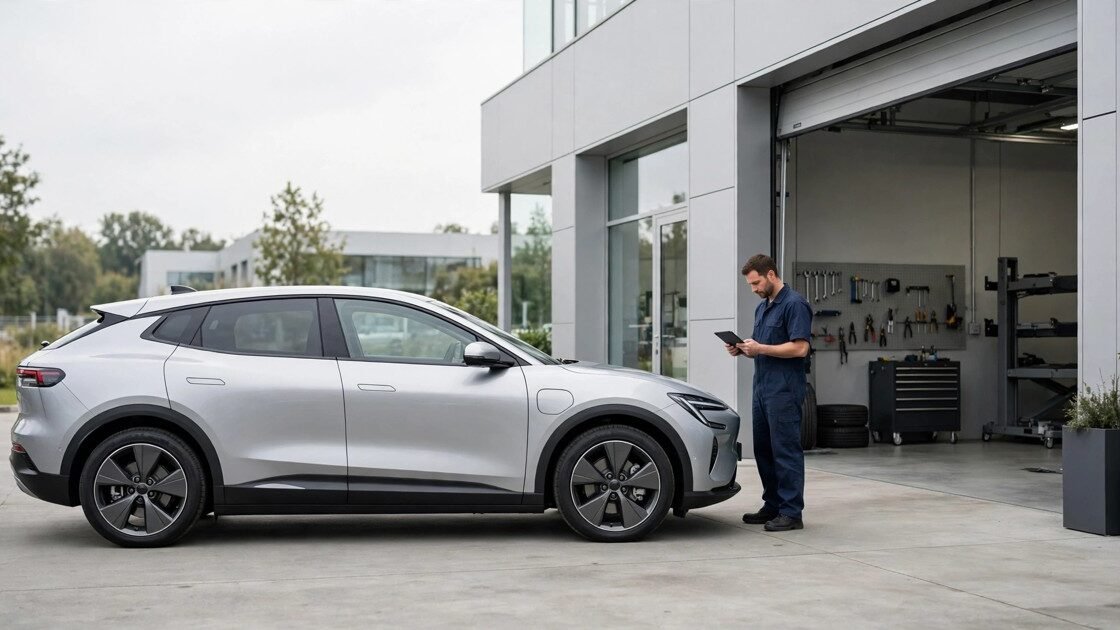
A used EV listing will shout about range, price, and one careful owner. It will almost never tell you what decides whether a five-figure battery failure lands on the manufacturer or on you: how much factory warranty is still attached to that exact car. That coverage follows the car, not the seller, but not unchanged. Some transfers in full, some shrinks on resale, and some stops at the seller’s account. The difference is worth real money, and it is easy to check before you pay.
Where the Numbers Stand
8 years / 100,000 miles: typical US battery term; Rivian to 175,000 miles, Tesla 100,000 to 150,000 by model.
70%: the usual capacity threshold for a battery claim; normal loss above it is not a claim.
5 years / 60,000 miles: second-owner Hyundai/Kia powertrain coverage, down from 10 years / 100,000 miles.
$0: the Tesla factory warranty transfer fee, stated as transferable at no cost to a lawful subsequent owner.
0: the warranty left on a salvage- or rebuilt-title EV, whatever the odometer says.
The Short Answer
On most mainstream used EVs, the high-voltage battery warranty transfers to the next owner for whatever time and mileage remain from the car’s original in-service date. The basic warranty usually transfers too, but it is often already expired. The trap is elsewhere: Hyundai and Kia cut powertrain coverage for a second owner, seller-account perks generally do not transfer, and a salvage title ends factory coverage entirely. Confirm the balance by VIN before you buy.
The One Date That Controls Everything
Every warranty clock starts on the in-service date: the day the car was first delivered to its first retail buyer or put into service, not the model year and not the day you buy it used. A 2023 model first sold in late 2024 can carry more coverage than a 2024 model first sold in early 2024.
The clock runs on whichever limit comes first, time or mileage. Work out both for the specific car, and plan around the one that ends first; the calculator below does exactly that. Ask the seller for the in-service date in writing, then check it against the manufacturer’s own record for the VIN. A listing screenshot is not proof; a written statement tied to the VIN is.
What Transfers, What Shrinks, and What Stops
| Coverage | Transfers? | The catch |
|---|---|---|
| High-voltage battery and drive unit | Yes, remainder | Ends at term or cap; loss above threshold not covered |
| Basic (bumper-to-bumper) warranty | Yes, remainder | Often expired by age 3 to 4; wear items never covered |
| Powertrain (Hyundai / Kia) | Only reduced | Drops 10yr/100k to 5yr/60k, unless certified pre-owned |
| Service contract / extended warranty | Sometimes | Often needs a form, fee, and action within 30 to 60 days |
| Subscriptions, credits, seller perks | Usually no | These belong to the seller’s account, not the car |
| Goodwill repairs | No | A one-off repair for the prior owner need not be repeated |
Two things kill coverage outright, whatever the brand. The first is a salvage or rebuilt title: every manufacturer treats that as the end of factory coverage, even if the damage was cosmetic and the repair excellent. The second is use outside the warranty’s terms, such as opening the battery pack or ignoring a recall repair. Neither shows up in a listing photo, so a title check and VIN check belong before the deposit.
The Hyundai and Kia Trap, in Plain Numbers
Hyundai and Kia advertise one of the longest warranties in the business: 10 years or 100,000 miles of powertrain coverage for the original owner, plus a 5-year / 60,000-mile new-vehicle limited warranty and a 10-year / 100,000-mile EV battery warranty. For a used buyer, only part survives. The battery warranty transfers in full, 10 years or 100,000 miles from the in-service date. The powertrain warranty does not: a second or later owner gets powertrain coverage only through the 5-year / 60,000-mile new-vehicle limited warranty, from the same date. Hyundai’s wording states the 10-year term applies to the original owner only, with a narrow exception for a spouse transfer.
Take a 4-year-old Ioniq 5 bought privately with 55,000 miles on it. The battery warranty still has roughly 6 years or 45,000 miles left. Powertrain coverage has only 1 year or 5,000 miles left, because the 5-year / 60,000-mile clock started at first delivery. A buyer who budgeted for “10-year coverage” has about a tenth of it where it shrank. That gap is our calculation from Hyundai’s published terms, and the most common warranty surprise in the used EV market. The workaround is certified pre-owned purchase, which restores the full term, as covered in CarBuzz’s report on Hyundai and Kia used warranties.
Tesla: Full Transfer, but Read the Fine Print
Tesla is the straightforward case. Its New Vehicle Limited Warranty states it is transferable at no cost to any person who subsequently and lawfully assumes ownership after the first retail purchaser. The basic warranty (4 years or 50,000 miles) and the battery and drive unit warranty (8 years; 100,000 miles for standard-range Model 3 and Model Y, 120,000 for long-range and performance versions, 150,000 for Model S and Model X) both follow the car for their remaining term.
What does not follow the car is almost everything digital that belonged to the seller. Tesla’s guidance says Supercharging credits, upgrades, subscriptions, and some other features may not be transferable. A Full Self-Driving subscription stops with the seller’s account, while a package bought outright generally stays with the car unless the previous owner moved it. Check what the car itself shows, rather than trusting the listing. Tesla’s Pre-Owned Vehicle Limited Warranty, effective June 2025, adds 1 year or 10,000 miles after basic expiry, but only for vehicles sold directly by Tesla, passing on only through a purchase directly from a previous private retail purchaser. Do not assume an independent dealer’s car carries that extra year; see Tesla’s Pre-Owned Vehicle Limited Warranty.
Ford, GM, Rivian, and the Rest of the Field
For Ford, General Motors, Nissan, BMW, and Volkswagen, the pattern matches Tesla’s on the battery: typically 8 years or 100,000 miles with a 70% threshold, transferring for the remaining time and mileage. Rivian goes further, at 8 years or 175,000 miles on some models, again with a 70% threshold, and that term transfers too. For a high-mileage buyer, Rivian’s longer cap is worth real money, because mileage, not years, is usually the binding limit on a well-used EV.
Two details deserve care. A Bolt with a recall battery replacement may carry its own fresh term from installation, but verify that against the service record, not a promise. Kia’s battery threshold is reported by secondary guides as 65% rather than the usual 70%; treat that as unverified until the booklet for its model year says so, because the threshold decides whether a degraded battery is a claim or just an old battery. One honest flag: several secondary guides call the 8-year / 100,000-mile battery term a federal floor that always transfers. That framing is too strong; the booklet for that VIN is what pays a claim. A general explainer of how car warranties transfer to a new owner draws the same line between factory warranties, which usually follow the VIN, and service contracts, which follow their own paperwork.
Service Contracts Are Not Warranties, and Their Clock Is Shorter
A factory warranty follows the VIN with no form and no fee. A service contract, sold as an “extended warranty,” is separate, and usually requires paperwork to move: a transfer form signed by buyer and seller, proof of sale, an odometer statement, and sometimes a fee, all inside a deadline commonly 30 to 60 days after the sale. Miss that window and the contract can lapse even though the car is fine. Some cannot transfer at all, and some exclude the high-voltage battery entirely, making them nearly useless on an EV. Before paying extra for a car “with an extended warranty,” read it and answer three questions: does it transfer, by when, and does it cover the battery and drive unit? If the seller cannot produce it, value the car as if it has none. Our research on extended EV warranties found the same pattern: the headline term means little until the exclusions and transfer clause are read.
Certified Pre-Owned: What the Premium Actually Buys
Certified pre-owned is a bundle that differs by brand. On a Hyundai or Kia, it restores the full powertrain term, the single biggest certified benefit in the used EV market. On other brands, the benefit is usually a fresh inspection, a short extra term, and roadside assistance, while the battery term is unchanged because it already transferred. Price it piece by piece: subtract the private price from the certified price, and ask what the difference buys. If it exceeds a service contract plus an independent inspection, the private car plus those two may be better. Read the certified terms first, because programs cap eligibility by age and mileage. Our comparison of certified pre-owned EV programs walks through those caps brand by brand.
Remaining-Warranty Calculator
Enter the car’s warranty terms, age, and mileage. The calculator shows what is left on each limit and which ends first at your annual mileage. Defaults are examples only; use the car’s own booklet figures.
The formula is simple. Remaining years equal the term minus age since the in-service date; remaining miles equal the cap minus the odometer; years until the mileage cap runs out equal remaining miles divided by annual mileage. The smaller year-figure ends your coverage. Example: an 8-year / 100,000-mile warranty on a 3-year-old car with 40,000 miles leaves 5 years and 60,000 miles; at 12,000 miles a year, time and mileage end together, at 15,000, mileage binds at 4 years. The calculator is our calculation; the booklet for the VIN is the authority.
Check Before You Pay
Do not pay a deposit until every line has an answer tied to the VIN.
- Get the in-service date and the current odometer in writing from the seller.
- Ask the manufacturer or a dealer for the remaining balance on each coverage: battery, basic, powertrain, and any service contract.
- Check the title status. A salvage or rebuilt title ends factory coverage; a clean title does not prove the warranty is intact.
- Ask for the battery health report and service history, including any battery replacement and open recall.
- Read any claimed service contract for transferability, deadline, fee, and battery exclusion before valuing it at anything.
- For a Hyundai or Kia, decide certified versus private on the powertrain gap, not on the headline 10-year figure.
If the seller cannot produce the in-service date or the VIN check contradicts the listing, walk away or reprice the car as one with no warranty. A used EV without battery coverage is not automatically a bad buy; it is a different purchase, priced for a risk the buyer now carries alone. Our used EV buying checklist covers the mechanical checks, our guide to checking EV battery health shows how to read the health report, and our guide to EV battery replacement cost puts numbers on the repair reserve. A further used EV battery warranty transfer guide (secondary source) repeats the same advice: verify by VIN.
Frequently Asked Questions
Does a used EV warranty transfer to the second owner?
Yes, in most cases the factory battery and basic warranties transfer for whatever time and mileage remain from the original in-service date, with Hyundai and Kia powertrain coverage as the major exception, dropping to 5 years or 60,000 miles. Service contracts are separate and may need paperwork and a fee within a deadline.
Does the warranty clock restart when I buy a used EV?
No. The clock never restarts on resale; it runs from the car’s first delivery date, so you inherit the remainder, not a fresh term. The exception to check is a replacement pack fitted under warranty or recall, which may carry its own term from installation.
How do I check the remaining warranty on a specific car?
Take the VIN, in-service date, and odometer to a franchised dealer or the manufacturer’s customer service line and ask for the remaining balance on each coverage, before paying a deposit. Treat any listing claim contradicting the VIN record as a reason to walk away.
The Takeaway
A used EV’s warranty is not one promise but a set of clocks, and they do not all survive a sale equally. The battery term is the good news: it follows the car on nearly every mainstream brand. The traps are the Hyundai and Kia powertrain cut, the service contract needing paperwork in a short window, the digital perks belonging to the seller, and the salvage title ending everything. Get the in-service date, run the VIN, read the booklet, and price the car on the coverage actually left. That check is the cheapest insurance a used EV buyer will ever buy.
Written by Shurah, who researches and writes independently on the real cost of EV ownership — charging, maintenance, and total cost of ownership — backed by primary data and original calculations rather than recycled lists.