First winter tells you the truth about your paint
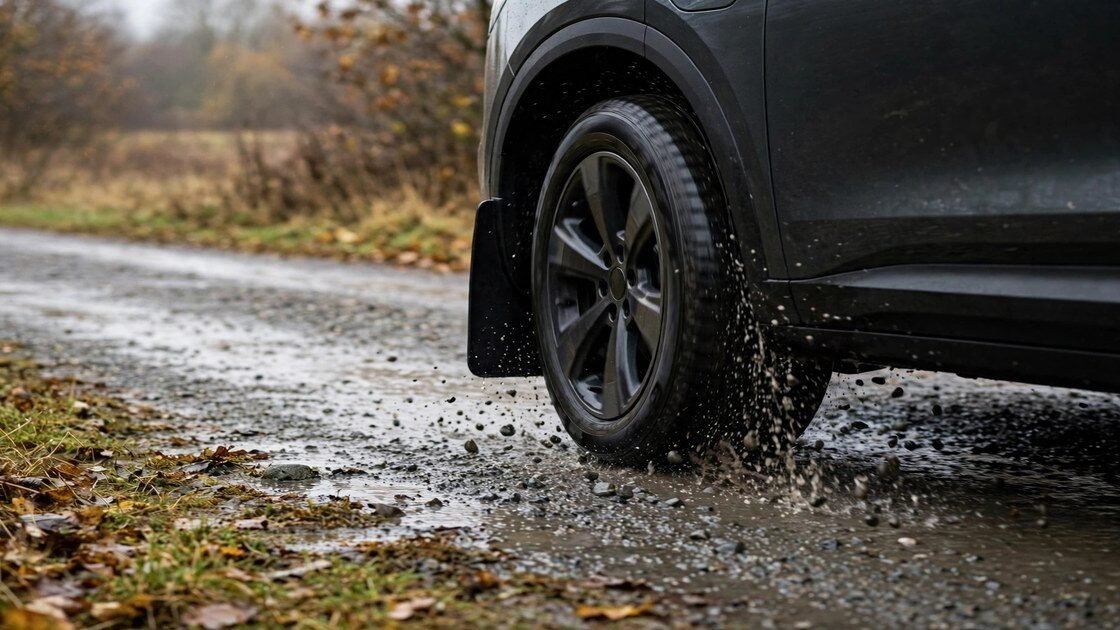
It usually happens on a wet November road. You wash the car after the first salty weeks of winter and find the lower rear doors look sandblasted: tiny chips along the rocker panels, a dull strip where grit has been hitting the paint again and again. The front tyres did that. Every rotation throws water, salt, sand and small stones backwards and slightly outwards, and the rear doors sit right in the firing line. Mud flaps are a small plastic panel hung behind each wheel to catch that spray before it reaches the bodywork. They will not change how the car drives.
This article answers that with prices you can check and a calculator that runs your own numbers. Where a figure comes from a shop listing or a vendor claim, it says so. Where nobody has published an independent test, it says that too.
At a Glance
- Typical kit price: $35 to $145 for most EV owners, before any shop labour. Tesla’s own Model Y front pair is $40.
- What they protect best: rocker panels, lower rear doors and the rear bumper edge, the panels your front tyres spray.
- What they do not do: stop every chip. Stones can still arrive from other cars.
- Range cost: no independent EV test was found. Vendor and secondary estimates cluster around 0.5% to 1% extra energy use.
- Best moment to fit them: before the first salty winter, or before a gravel-road trip, when the paint is still undamaged.
In Short
EV mud flaps cost roughly $35 to $145 for the kit, most no-drill sets fit in under half an hour, and they are worth it if you drive on wet, salted or gravel roads, because one avoided bumper or rocker-panel repaint, typically $500 to $900 for a bumper in secondary repair guides, pays for the kit many times over. For a garage-kept city car on clean tarmac, they are a cosmetic choice rather than a saving.
What your tyres actually throw at the car
Picture the front wheel turning. The contact patch picks up grit and water and flings it backwards along the side of the car. The lower rear door and the sill sit directly behind that spray path, which is why those panels chip first. Rear flaps, by contrast, mostly protect the car behind you and your own rear bumper edge from your rear tyres’ spray. That is still useful, especially in rain, but if you can only fit one pair, fit the fronts.
EVs add two wrinkles: instant torque spins the tyres harder from a standstill on loose surfaces, and many EVs run wide tyres with the tread close to the fender edge, so spray escapes sideways more easily. Neither fact makes flaps mandatory.
What mud flaps cost
Prices below are US listings checked in October 2026. Tesla changes its shop prices often, and retailer prices move with sales, so treat these as the price band at writing time, not a standing quote. Installation is usually free in money terms because most EV-specific kits are no-drill; the cost is your time, roughly 15 to 30 minutes for a set.
| Kit | What you get | Price checked | Best for |
|---|---|---|---|
| Tesla Model Y mud flaps (official shop) | Front pair only, with hardware | $40 | Factory part, fronts only |
| BASENOR TPE set, Model Y Juniper 2025–2026 | Four flaps, no drilling, TPE all-weather material | $34.99 | Four-corner cover, lowest price |
| Rally Armor Universal UR set | Four urethane flaps, no hardware included | About $114 to $143 at US retailers | Gravel drivers, flexible rally style |
| Universal basic blanks | Flaps only, cut and hardware to be sourced by the buyer | About $19 to $44 at US retailers | DIY owners, unusual fitments |
Read the Tesla row carefully: $40 buys two front flaps, not four. Owners who want rear cover from Tesla’s own shop need a separate solution, and that is one reason third-party four-piece sets outsell the official kit. The BASENOR set, by contrast, is four pieces for $34.99, but it fits only the 2025–2026 Juniper refresh and explicitly does not fit the 2020–2024 Model Y. Fitment by model year is the single most common buying mistake in this category.
For comparison with the other paint-protection options on this site, a professional ceramic coating runs roughly $500 to $3,000 depending on durability, and full-body paint protection film runs far higher, as covered in our guides to ceramic coating costs and paint protection film costs. Mud flaps are not a substitute for either. They are the cheap first layer: they reduce how much grit reaches the paint, while film and coatings deal with what still gets through.
Which material suits which driver
Three materials dominate, and the choice matters more than the brand name on the box.
Rigid ABS plastic looks the most factory-fitted and holds its shape at speed. It also scrapes on steep driveways and tall speed bumps, because a low EV leaves little room for a stiff panel to flex. Scraping usually damages nothing but the flap edge.
TPE (thermoplastic elastomer) is the middle ground most EV-specific kits use: flexible enough to bend over a bump, stiff enough to hold its shape. BASENOR rates its TPE set from minus 40°F to 176°F, a vendor claim, but the material class handles winter cold better than hard ABS. For a daily driver in a four-season climate, TPE is the default pick.
Polyurethane rally flaps, the Rally Armor style, are thicker, longer and far more flexible. They survive gravel, ice chunks and ruts that would crack a rigid flap, and they are the right answer for unpaved roads. They cost more, stick out more visually, and on a universal set you source the hardware yourself. Buy them for the roads you actually drive, not for the look.
The range question, answered honestly
Every flap adds a small obstacle to the airflow around the wheel, so some extra drag is physically unavoidable. How much is where the honesty gets thin. BASENOR claims its slim Juniper profile cuts the loss to about 1%, against up to 5% for what it calls conventional bulky flaps. That is a vendor claim for its own product, not an independent measurement. A secondary owner guide puts the figure at 0.5% to 1.0% for four flaps. An old forum thread among hypermilers claims about 10% after removing flaps, but that is an anecdote from a different era of car, with no test method attached, and it should not be quoted as data.
No published independent test of mud-flap drag on a modern EV was found while researching this article. The practical reading is this: on a 300-mile car, a 1% penalty is about 3 miles, worth roughly 20 to 55 cents of electricity per full charge at home and public rates. Even the vendor’s own 5% worst case is 15 miles. If range is your top priority and you drive only clean city tarmac, skip the flaps, or fit only the fronts.
Installation traps that cost more than the kit
Fitment by model year, not just model name. The Model Y changed shape with the Juniper refresh, and a 2020–2024 set does not fit a 2025–2026 car. The same trap applies to any EV with a mid-life facelift. Check the listing’s year range against your car’s build date.
No-drill beats drill-in for most owners. No-drill kits reuse factory screws and clips, so removal leaves no holes. Drill-in sets need new holes in liners or sills, and every hole is a future rust start if it is not sealed. If you lease the car, no-drill is the only sensible option.
Trapped salt is the hidden cost. A flap that sits tight against the body can trap salty slush behind it all winter. Wash behind the flaps when you wash the car in winter, and pull them off once a year to inspect the paint underneath. A thin strip of film under the flap’s contact edge prevents rubbing marks.
Clearance and width. A flap should be at least as wide as the tyre tread it sits behind, or spray escapes around its edges. It should hang low enough to catch low-angle spray but not drag on every driveway. If your car already scrapes its chin, choose a shorter flexible flap.
Winter preparation pairs naturally with flaps: the same salty months that chip paint also punish tyres, so check your pressures as temperatures fall, as explained in our guide to EV tyre pressure in cold weather, and budget for cold-weather rubber using our winter tyre cost breakdown.
Do the maths on your own car
The formula is simple on purpose, and every input is yours. Avoided repair value equals repairs avoided multiplied by the average repair cost. Net saving equals that avoided value minus the kit cost. Break-even repairs equals kit cost divided by average repair cost, so a $40 kit against a $700 repair breaks even at 0.06 repairs. The drag side is separate: extra kilowatt-hours per year equal annual miles divided by miles per kWh, multiplied by the drag percentage, and extra cost equals those kilowatt-hours multiplied by your electricity price. Defaults are examples only: $40 is Tesla’s front-pair price, $700 sits inside the $500 to $900 secondary bumper-repaint band, and 1% is the planning assumption discussed above, not a measured result.
When flaps are not worth it
Flaps are cheap, but cheap is not the same as always right. Skip them, or fit fronts only, if your car lives in a garage, drives clean city tarmac, and rarely sees rain, salt or gravel. Skip long rally flaps if your driveway already scrapes, and skip any kit that needs drilling on a leased car. If your rocker panels already carry full paint protection film, flaps add a second layer of protection but with a smaller payoff. And if the paint is already chipped down to bare metal, fit the flaps after the repair, not instead of it: a flap over an open chip traps moisture against exposed metal and can make rust worse.
One more honest limit: flaps do not protect against the car next to you. Motorway grit thrown up by a truck ahead lands on your bonnet and bumper, where no flap can reach. That is why flaps belong in a protection plan alongside film or coating on the front end, not as a replacement for them. Over a full ownership period, tyres and brakes dominate running costs far more than paint accessories, as our 100,000-mile maintenance breakdown shows.
Frequently asked questions
Do I need rear mud flaps, or are fronts enough?
Fronts matter most for your own paint, because front tyres spray the rear doors and sills. Rear flaps mainly protect following traffic and your rear bumper edge.
Will mud flaps reduce my EV’s range?
By a small amount that nobody has independently measured on a modern EV. Vendor and secondary estimates sit around 0.5% to 1%, so a 300-mile car loses about 3 miles per charge at 1%.
Can mud flaps cause rust?
Yes, if they trap salty slush against the body or if a drilled mounting hole is left unsealed. Wash behind the flaps in winter, inspect the paint underneath once a year, and prefer no-drill kits.
Do mud flaps fit every EV?
No. Fitment depends on model and model year, not just the badge. A set made for a 2020–2024 Model Y does not fit the 2025–2026 Juniper refresh, so match the listing’s year range to your car’s build date.
Do mud flaps void the warranty?
No manufacturer blanket rule was found that voids a warranty for fitting mud flaps. Damage caused by a badly fitted part, such as a drilled hole that rusts, is normally the owner’s responsibility, so keep the fitting clean and reversible.
The bottom line
For most EV owners the maths is lopsided in a good way. A $35 to $145 kit, fitted in under half an hour with no drilling, guards the exact panels that salt and gravel attack first, and a single avoided repaint pays for it many times over. The range cost is real but small, the rust risk is manageable with basic cleaning, and the main mistake is ordering the wrong model year. Fit them before winter if your roads are wet, salted or unpaved.
If a kit needs drilling, confirm the mounting point in your owner’s manual first. A misplaced hole in a sill or liner is a rust start, not a saving.
Written by Shurah Beel, who researches and writes independently on the real cost of EV ownership — charging, maintenance, and total cost of ownership — backed by primary data and original calculations rather than recycled lists.