Headline Numbers
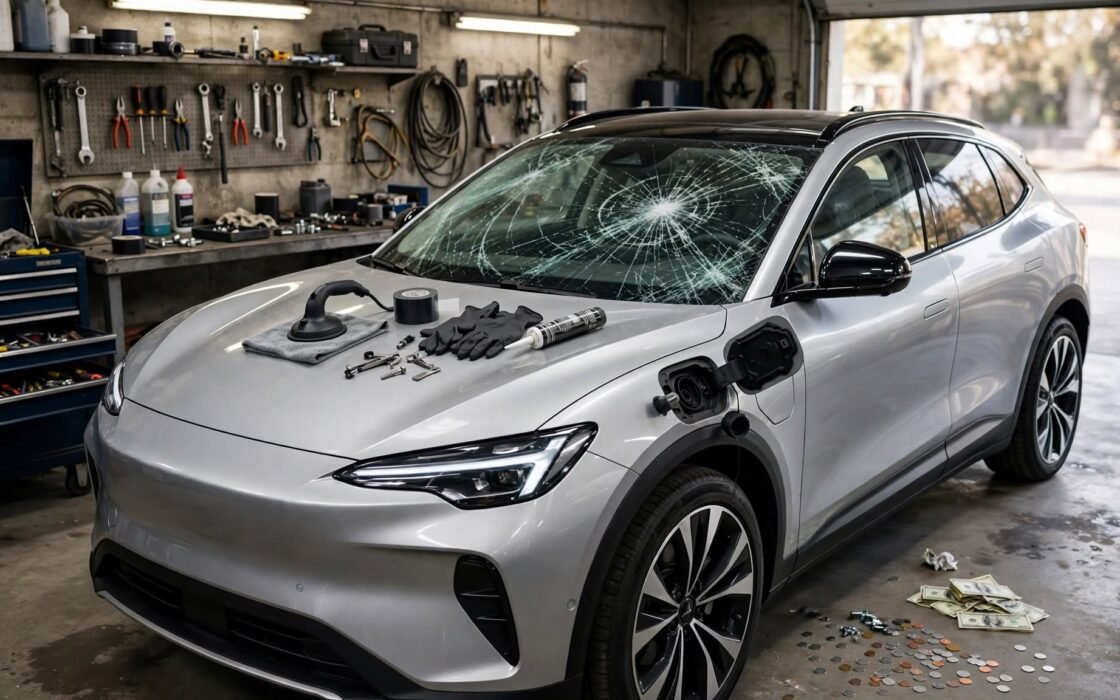
- AAA puts a standard windshield replacement at $250–$1,500+, and says a windshield with a camera behind it runs about $1,500 — up to three times a no-camera car.
- Tesla Model 3 or Model Y: $600–$1,500 all-in at an independent shop; Tesla Service Centers usually quote $1,200–$1,800+.
- ADAS camera recalibration alone: $150–$500 — and it is the line item most cheap quotes leave out.
- Glass.net live quotes (Oct 2026) show ~$516–$664 for a Model 3 windshield fitted — glass only, before calibration.
- Tesla’s Windshield Protection Plan: $16/mo (Model 3/Y), $20 (S), $23 (X), $25 (Cybertruck) — one free replacement every 12 months, unlimited chip repairs.
- Chip repair while it is still small: $60–$100, per AAA.
In 30 Seconds
Expect $600–$1,500 for a Model 3 or Model Y windshield replaced and recalibrated, and $1,200–$2,300+ for a Model S, Model X, or Ford Mustang Mach-E with ADAS glass. The premium over a gas car comes from acoustic laminated OEM glass and camera recalibration ($150–$500), not the glass alone. Comprehensive insurance covers it minus your deductible in most states, and chip repairs at $60–$100 stop small damage from becoming a full replacement.
Why EV Glass Costs More Than Gas-Car Glass
The price gap is not a markup trick. Three things about an EV windshield are genuinely different from the $400 windshield on a 2012 Civic.
First, the camera. Most late-model EVs mount their driver-assistance camera to the windshield behind the mirror — move the glass, move the camera — so every replacement ends with a recalibration step. AAA found that a windshield on a car with a camera behind the glass costs about $1,500 to replace — up to three times the bill for a car without the technology, and every real-world EV quote below confirms that multiplier has held up.
Second, the glass itself is fussier. Tesla glass is acoustically laminated, and the camera bracket tolerance is tight enough that slightly off mounting geometry can leave calibration unable to complete. On a camera-dependent car, OEM or OE-equivalent glass is the lower-risk choice — at 30–50% more than generic aftermarket.
Third, parts control. Panoramic and specialty shapes (the Model X’s giant windshield, the Cybertruck’s slab) have thin aftermarket pools, so the factory sets the price. One 2024 quote tracker logged US Auto Glass OEM jobs from $1,773 for a 2018 Model S to $3,419 for a 2020 Model X — before labor and calibration. Outliers, but they show the ceiling when OEM glass is the only option.
Real Prices, Model by Model
Independent shops sit at the low end of each range, Tesla Service Centers at the top.
| Vehicle | Typical all-in range | What drives the number |
|---|---|---|
| Tesla Model 3 | $600–$1,500 | Independent shop with calibration at the low end; Tesla Service Center $1,200–$1,800+ at the top |
| Tesla Model Y | $650–$1,600 | Slightly larger acoustic glass; same camera-calibration step as the 3 |
| Tesla Model S | $1,200–$2,000 | Luxury trim, embedded electronics, pricier OEM glass |
| Tesla Model X | $1,400–$2,500+ | Panoramic windshield; 2024 OEM-only quotes ran past $3,400 |
| Ford Mustang Mach-E | $850–$2,300 | $850–$1,200 standard; $1,700–$2,300 with full OEM glass and BlueCruise calibration (shop estimates, 2025) |
| Generic late-model EV with camera glass | $900–$1,800 | Camera recalibration adds $200–$500 to the glass-and-labor bill |
| Older or simple EV, no glass-mounted camera | $600–$1,000 | Closest to a conventional car; still confirm whether calibration is needed |
A note on conflicts: shops quote wide ranges because the same car can mean different glass. One tracker’s $536 live quote for a 2021 Model 3 (September 2026) covered glass fitted only; add the roughly $310 camera re-aim the car needs, and the real number was $846. Live boards like Glass.net’s Tesla page confirm the pattern: the headline number is glass only; the calibrated price is what you pay.
The Calibration Line Item: Where Cheap Quotes Hide
Recalibration is what turns a $550 glass quote into a $1,100 invoice. Here is what it actually is.
There are two methods. Static calibration happens in a bay: targets are set at measured distances and the camera is aimed at them. Dynamic calibration happens on the road: the technician drives a prescribed route and the camera learns from lane lines and signage. Some vehicles need both. The equipment is expensive and technicians train for it — that is why the line item runs $150–$500 for common models and higher at dealerships.
Tesla adds its own twist. After a windshield swap, Tesla’s service documentation says the camera calibration data must be cleared through Controls > Service > Camera Calibration > Clear Calibration on the touchscreen. The cameras then self-calibrate over roughly 20 to 25 miles of driving — and Autopilot stays offline until they finish. Tesla advises contacting them if calibration has not completed after 100 miles. Tesla’s internal Model 3 procedure also includes a driver-assistance reset, a forward-camera aim check against a tripod target, and entering the new glass’s part number, per independent Tesla glass specialists.
Owner-reported cautionary tale: one Model Y owner was quoted $650 by a national chain, then called the day before the appointment and told the price was now $1,450 after a $750 camera-calibration fee. The lesson is procedural: always ask, in writing, whether calibration is included and whether you get a post-calibration pass/fail printout.
Repair or Replace? The Decision Rules
Not every chip needs a full replacement. The standard thresholds:
- Repairable: chip smaller than a quarter, or crack shorter than about three inches — not in the driver’s line of sight, not reaching the glass edge, not through both layers.
- Replace: damage longer than a dollar bill, anything in the driver’s field of view, cracks reaching the edge, or damage near the camera area.
Repair runs $60–$100 for a small chip and $100–$150 for a crack repair, per AAA — and many insurers waive the deductible for chip repairs. The expensive mistake is waiting: cracks spread fast in temperature swings, and a $100 repair becomes a $1,200 replacement by the next cold snap. See our breakdown of the cheapest EV to own for more hidden-cost math.
Insurance and the Deductible Trap
Windshield replacement falls under comprehensive coverage, not collision: rock chips and road debris, minus your comprehensive deductible — the same deductible on your EV insurance policy. The decision tree:
- Bill under your deductible? Pay cash — the claim buys you nothing.
- Bill over your deductible? Filing usually makes sense, but call your insurer first: comprehensive claims can now raise rates at some companies, and repeated claims can count against you at renewal.
- Chip repair? Often free or deductible-waived under glass coverage. Always ask.
Three states — Florida, Kentucky, and South Carolina — commonly require insurers to waive the glass deductible entirely under comprehensive coverage (widely reported; confirm your state’s current rule). If you commute behind gravel trucks in one of those states, your effective windshield cost is close to zero regardless of the car.
One more insurance angle: a glass claim is still a claim on the car’s record. Our total-loss threshold calculator shows how insurers decide when a car is worth more as salvage — and EV depreciation and resale value explains why EV values are unusually sensitive to reported damage.
Is Tesla’s Windshield Protection Plan Worth $16 a Month?
Tesla sells its own answer: a US-only Windshield Protection Plan bought in the Tesla app. Current pricing (per Tesla’s support page, checked October 2026): $16/month for Model 3 and Model Y, $20 for Model S, $23 for Model X, and $25 for the Cybertruck — that last one cut from $35 on October 1, 2026. Coverage: unlimited chip and minor crack repairs, one free full windshield replacement every 12 months, and a $100 deductible for any additional replacements in the same year. Collision, vandalism, and weather damage are excluded, and pre-existing cracks are not covered.
The math is straightforward — our calculation. A Model 3/Y owner pays $192/year. One replacement at Tesla-service prices ($1,200–$1,800) covers the plan six times over; even at independent-shop prices ($600–$1,500) a single replacement covers three to eight years of premiums. The plan only loses money if you go several years without needing a replacement.
Who should subscribe: highway commuters, anyone driving daily through construction zones or desert states, and owners who would otherwise carry a high comprehensive deductible. Who should skip: garage-kept, low-mileage cars in mild climates — and non-Tesla owners, since the plan only covers Teslas. Tesla raised the 3/Y price from $12 to $16 in January 2026 and cut the Cybertruck price nine months later, so recheck the app’s current figure before deciding.
EV Windshield Cost Estimator
Run your own numbers: the tool below compares paying out of pocket against Tesla’s Windshield Protection Plan over the years you keep the car. Defaults are examples only.
How the tool works (our calculation). Out of pocket = (replacements per year × years × your calibrated quote) + (chip repairs per year × cost per repair × years). Plan cost = (monthly premium × 12 × years) + $100 × replacements beyond the one free replacement per 12 months. Chip repairs are unlimited under the plan, so they drop out of the plan total. The replacement rate matters most: one every five years (0.2/year) favors cash; one every two years usually favors the plan.
Who Should Worry Most
- Highway commuters who spend an hour a day behind trucks — chip frequency scales with miles, not with the car's price.
- Desert and gravel-belt drivers (Arizona, Texas, the Mountain West) where chips are a seasonal certainty.
- Cybertruck owners: the biggest single pane in the lineup and the priciest OEM-only replacements.
- Leased EVs: turn-in inspections penalize cracked glass, so repair chips before lease end — the lessor's price will be worse than a shop's.
- High-deductible owners: with a $1,000+ comprehensive deductible, a replacement is mostly your money — chip repairs and Tesla's plan matter more for you.
Frequently Asked Questions
Does car insurance cover EV windshield replacement?
Yes, under comprehensive coverage, minus your deductible. Chip repairs are often covered with no deductible. Florida, Kentucky, and South Carolina commonly require a zero glass deductible — confirm your state's current rule with your insurer.
Can I use aftermarket glass on a Tesla?
You can, and it is cheaper. But the aftermarket pool for Tesla is thinner than for a Camry, the glass is acoustically laminated, and the camera bracket tolerance is tight enough that slightly off geometry can leave calibration unable to complete. OEM or OE-equivalent is the lower-risk choice on a camera-dependent car.
How long does Tesla camera calibration take after new glass?
After clearing the old calibration on the touchscreen, the cameras self-calibrate over roughly 20 to 25 miles — fastest on a straight multi-lane highway with clear lane markings. Autopilot stays unavailable until it finishes; Tesla advises contacting them if it has not completed after 100 miles.
Can a mobile service do the calibration?
Dynamic (road) calibration, yes. Static calibration needs targets at measured distances in a bay, so some shops schedule a facility visit. Ask which type your car needs before booking.
What happens if I skip the calibration?
Don't. A misaligned camera can throw Autopilot errors, disable lane assist, or silently misjudge distances for emergency braking. Get a pass/fail printout and keep it with your records.
Is a cracked windshield an inspection failure?
In many states, yes — a crack in the driver's field of view or near the camera area can fail a safety inspection.
The Takeaway
An EV windshield is not just glass — it is a structural part with a camera bolted to it, and the bill reflects that. Budget $600–$1,500 for a mainstream Tesla and more for panoramic or specialty glass. Get the calibration question answered in writing before anyone touches the car, repair chips the week they happen, and run the insurance-vs-plan math with your real deductible. The owners who overpay are the ones who discover the calibration line item after the glass is already in.
Written by Shurah, who researches and writes independently on the real cost of EV ownership — charging, maintenance, and total cost of ownership — backed by primary data and original calculations rather than recycled lists.
Safety note: windshield camera calibration affects active safety systems — have it done by a shop equipped for your make and model, and confirm coverage details with your insurer before authorizing work.