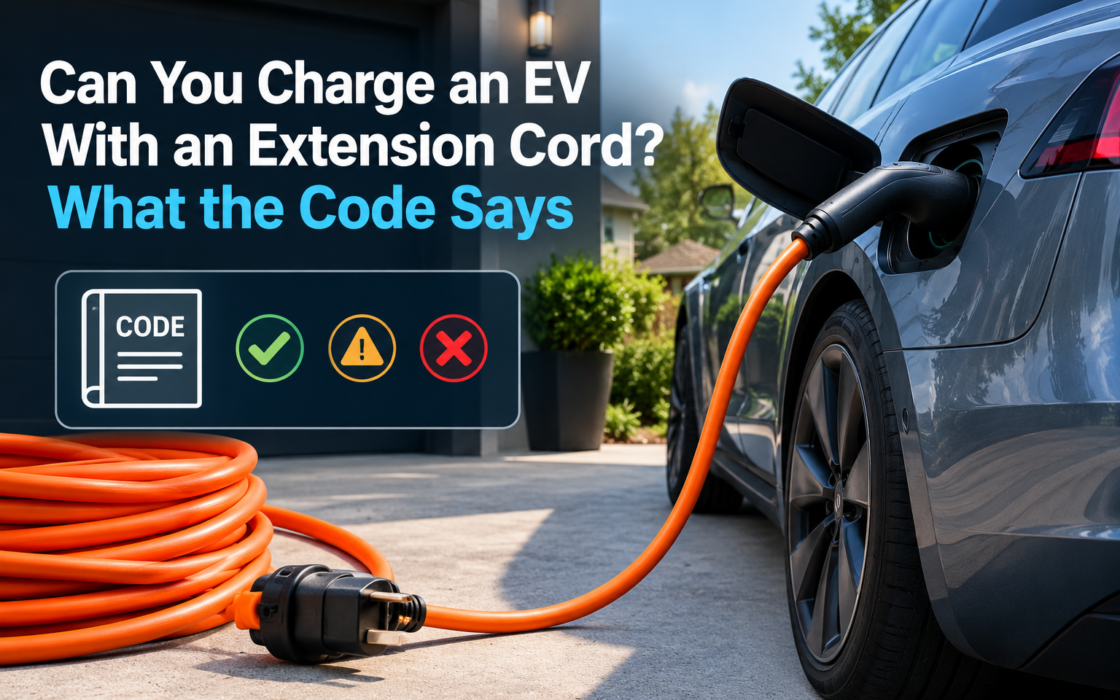
You’ve pulled into the driveway and the only outlet close enough is on the wrong side of the garage. The extension cord is right there. It’s rated 15 amps, it’s heavy-duty, and it’s fine for the table saw — so why not the car? Every major automaker’s manual and the National Electrical Code both answer the same way: don’t. Not “avoid if possible” — a flat no, with a specific code section behind it. This article works through the actual electrical reasoning, not just the warning label, including a calculator so you can see the numbers for your own setup.
Key Numbers
- NEC Article 625.50 requires a direct connection between EV charging equipment and the vehicle — no intermediary extension cord is permitted, regardless of amperage.
- CPSC estimates roughly 3,300 U.S. home fires a year originate in extension cords (all uses combined — this is a general household figure, not EV-specific).
- A 50-ft, 16-gauge cord carrying a 12A Level 1 charging load already loses about 4% of its voltage — right at the point where the NEC’s own voltage-drop guidance calls a branch circuit inefficient.
- The same 12A load over 100 ft on that same 16-gauge cord loses closer to 8% — well past the 3% branch / 5% total guideline.
- A Tesla engineer has documented “multiple instances” of extension-cord junctions overheating and shorting Supercharger DC cables.
- Chevrolet’s Bolt owner’s manual names extension cords specifically, alongside power strips, splitters, and surge protectors, as accessories not to use with the charge cord.
- EV charging is a sustained, hours-long continuous load — the exact duty cycle ordinary household extension cords were never rated for.
Short Answer
No. NEC Article 625.50 requires a direct connection between the vehicle and its charging equipment, with no intermediary extension cord, and this is repeated in most manufacturers’ owner’s manuals. The danger isn’t charging speed — it’s heat. An extension cord adds resistance and a second connection point, and both generate heat over the many-hour continuous draw EV charging demands, inside a cord that was never tested for that duty cycle.
Why the Code Says No — Even When the Math Looks Fine
NEC Article 625 treats EV charging as a continuous load, defined as running at a steady current for three hours or more. That single classification is why the rules are stricter than for a power tool: continuous loads must be sized at 125% of their rating specifically because sustained current generates sustained heat, and a component only needs to run a little hot for a few hours before insulation starts to degrade. Section 625.50 responds to that by requiring the vehicle to connect using only its listed, factory-supplied charging cable — an extension cord counts as unlisted intermediary wiring, full stop, whether it’s rated 15A or 50A.
That’s a different question from “will this cord technically carry the current.” A cord can carry 12A for an hour without complaint and still be the wrong choice for a 10-hour overnight charge, because the two connection points it adds — one plug-to-cord, one cord-to-charger — are additional places for resistance (and therefore heat) to build up that a direct connection doesn’t have. Every plug-and-socket joint has some contact resistance; a slightly loose, slightly worn, or slightly undersized connection turns that resistance into heat under sustained current, and unlike a listed EVSE, a household extension cord has no thermal monitoring to shut things down if it gets too hot.
What’s Actually Happening Electrically: Voltage Drop
Every wire has resistance, and resistance turns some of the electricity moving through it into heat instead of useful current — that’s Ohm’s law (V = I × R) doing exactly what it always does. The longer and thinner the wire, the more resistance, so a long, thin extension cord loses more voltage — and generates more heat — than a short, thick one carrying the same current.
Standard AWG copper resistance values (the same conductor-sizing math used across electrical engineering, at roughly 68°F) look like this per 1,000 feet of wire:
| Wire gauge | Resistance (Ω per 1,000 ft) |
|---|---|
| 16 AWG | ~4.02 Ω |
| 14 AWG | ~2.53 Ω |
| 12 AWG | ~1.59 Ω |
| 10 AWG | ~1.00 Ω |
| 8 AWG | ~0.63 Ω |
The formula for voltage drop on a cord (current has to travel out and back, so the length counts twice) is:
Voltage drop (V) = 2 × [length in feet ÷ 1,000] × resistance (Ω/1,000 ft) × current (A)
Our Own Worked Calculations
| Scenario | Voltage drop | % of supply | Verdict |
|---|---|---|---|
| 120V, 12A, 16 AWG, 50 ft | 4.8V | ~4.0% | Above the NEC’s 3% branch-circuit guideline |
| 120V, 12A, 12 AWG, 50 ft | 1.9V | ~1.6% | Within guideline, but still code-prohibited |
| 120V, 12A, 16 AWG, 100 ft | 9.6V | ~8.0% | Well past 5% total guideline — real heat risk |
| 120V, 12A, 12 AWG, 100 ft | 3.8V | ~3.2% | Borderline even on heavier-gauge cord |
| 240V, 32A, 10 AWG, 50 ft | 3.2V | ~1.3% | Looks fine on paper — still not code-legal |
Notice the last row. Even a well-built, correctly sized cord that passes the voltage-drop math cleanly is still not a legal or listed way to connect a vehicle under NEC 625.50. The voltage-drop number tells you about efficiency and heat under ideal conditions; it says nothing about the connector’s contact quality after 200 plug-in cycles, the cord’s continuous-duty rating, or whether it’s the specific listed cable your charging equipment was tested with.
Try It: Voltage Drop Calculator
When It’s Most Dangerous
The worst combination is the one people reach for most often: a long, thin, already-coiled cord carrying a sustained high current overnight. A few conditions stack the risk higher:
- Coiled cords — a cord left coiled while in use traps heat that would otherwise dissipate, because the loops insulate each other.
- Daisy-chaining two cords — each added junction is another resistance point and another place for a loose connection to develop.
- Indoor-rated cords used outdoors — moisture ingress at an unsealed joint adds a shock-hazard dimension on top of the heat issue.
- Anything above roughly 15A on a light-duty cord — Level 1 charging typically draws 12A continuously; Level 2 portable units draw 16–40A, well outside what a typical garage extension cord is built for.
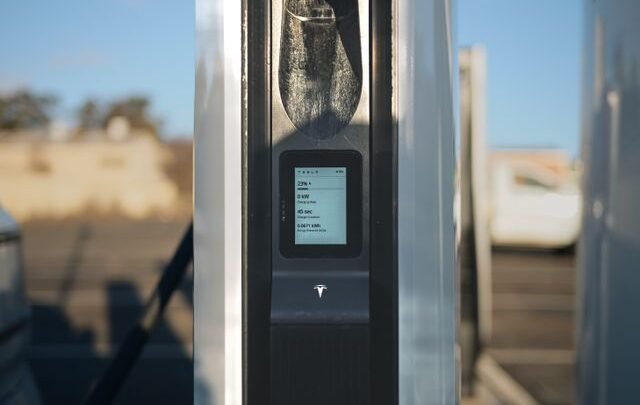
Tesla’s own engineering team has flagged a related version of this problem at DC fast chargers specifically: Wes Morrill, the Cybertruck lead engineer, has documented “multiple instances” of third-party extension cords overheating and shorting the DC lines on Superchargers, and noted that the Supercharger’s built-in handle-temperature monitoring — which normally tells the charger to slow down if it’s getting hot — stops protecting you once an unmonitored extension cord is added to the chain. That’s a DC fast-charging scenario, not a home Level 1/2 one, so the specifics differ — but the underlying mechanism (extra junction, extra heat, lost monitoring) is the same physics behind the home-charging warning, just at much higher power.
What to Do Instead
The honest fix is almost never “a bigger extension cord” — it’s closing the gap between the outlet and the car:
- Have an electrician run a dedicated outlet closer to where you park. This is a one-time cost that solves the problem permanently instead of every night — see our breakdown of what a proper installation actually costs.
- If the charger itself is overheating a fine, correctly rated receptacle (not an extension cord issue but a related one), the fix is usually the receptacle, not the cord — our look at portable EV chargers found the $12 household receptacle, not the charger, is usually the real weak point.
- Renting or living somewhere without a dedicated space? Our guide to charging without home access covers the realistic options for that situation, including when the honest answer is “not yet.”
- One-off situations (a relative’s house, a hotel) — Level 1 charging directly into a standard outlet, with no extension cord, at a lower amperage setting if your car allows it, is far safer than any extension-cord workaround, even if it’s slower.
FAQ
Can I use a heavy-duty 10-gauge extension cord instead of a regular one?
A heavier gauge reduces voltage drop and heat, which is why the math above looks better for 10 AWG. It doesn’t change the code position: NEC 625.50 prohibits any extension cord between the EVSE and the vehicle regardless of gauge, because the requirement is about using the equipment’s listed cable, not about whether a given cord can technically carry the current.
Does this rule apply to Level 2 home chargers too, or just the Level 1 cord that comes with the car?
It applies to both. Level 2 units draw more current for longer, which makes an unlisted intermediary connection a bigger heat risk, not a smaller one. Hardwired Level 2 chargers avoid the question entirely since there’s no cord-and-plug connection to extend in the first place.
What if the extension cord is rated for more amps than my charger draws?
A cord’s amp rating (ideal, brief-use conditions) and its safe rating under a multi-hour continuous load are different numbers — most consumer cords aren’t tested or listed for continuous duty at all. The rating on the cord’s own tag isn’t the same as the “continuous load” standard EV charging equipment is held to.
Is it different for public DC fast charging?
The stations themselves use permanently attached, liquid-cooled cables with no plug for the driver to extend — the extension-cord scenario documented by Tesla involves third-party adapters/extensions some drivers have improvised, not anything the network itself provides or permits.
What if I only need it once — say, at a relative’s house with no nearby outlet?
A single short-duration use carries less cumulative heat exposure than nightly charging, but it’s still outside the code requirement and still removes the thermal-monitoring safety margin. If it’s a recurring situation, it’s worth having an outlet added rather than repeating the workaround.
The Short Version
An extension cord can often carry an EV’s charging current without immediately failing — that’s exactly why the temptation exists. But NEC 625.50 doesn’t leave room for a case-by-case judgment call: it requires a direct connection using the equipment’s own listed cable, because continuous multi-hour loads turn ordinary connection resistance into real heat, and a household extension cord carries no thermal monitoring to catch that before it becomes a problem. The voltage-drop numbers above explain why a longer, thinner cord is worse and a shorter, thicker one is better — but even a cord that scores well on that math isn’t a code-compliant substitute for a proper outlet. If the real issue is that the outlet is in the wrong place, that’s a one-time electrician visit away from being solved for good, rather than a nightly risk.
About the author: Written by Shurah, who researches and writes independently on the real cost of EV ownership — charging, maintenance, and total cost of ownership — backed by primary data and original calculations rather than recycled lists.