The Short Version
Yes, you can charge an EV at many campgrounds, but it is not as simple as plugging in. About 4 in 10 parks ban pedestal charging outright, and most others prefer you use a dedicated charger. Where pedestal charging is allowed, expect a $20 to $30 nightly surcharge, and a 50-amp hookup adds roughly 200 to 300 miles overnight. Always ask first, and never plug in unannounced.
The Numbers That Matter
- 504 parks surveyed (June 2026): 15% allow charging at the campsite, 46% offer a dedicated charger, 39% ban campsite charging entirely (Camp and Charge directory).
- Typical EV surcharge: $20 to $30 per night at parks that allow pedestal charging (owner-reported via RV LIFE).
- Median RV site rate: $62 per night nationally (Insider Perks 2026 pricing report, 370,000 RV-site price points).
- 50-amp hookup speed: about 7.7 kW with a typical portable charger, 25 to 30 miles of range per hour.
- 30-amp hookup speed: about 2.9 kW continuous, roughly 8 to 10 miles per hour.
- Ordinary 120-volt outlet: about 1.4 kW, roughly 3 to 5 miles per hour.
- 10-hour night on a 50-amp site: about 77 kWh before charging losses, roughly 250 miles at 3.3 miles per kWh (our calculation).
Why Campgrounds Suddenly Matter to EV Drivers
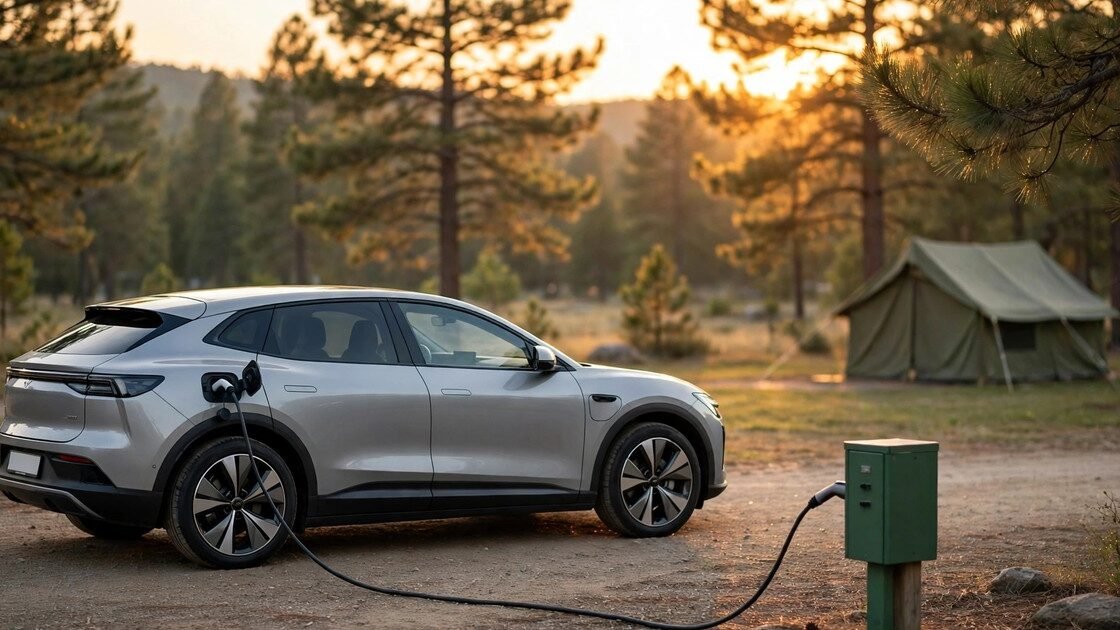
Picture the last 40 miles to a state park on a Friday evening. The nearest fast charger is 30 miles behind you, your battery is at 12%, and the park has no charger at all. What it does have is a row of RV sites, each with a gray metal pedestal carrying the same 240-volt, 50-amp outlet your home charger plugs into. That pedestal is why campground charging has become a real, if awkward, part of American road tripping.
It is awkward for a reason worth understanding. A campground pedestal was designed for an RV, not a car. An RV’s air conditioner cycles on and off, so its average draw over a night is modest. An EV charger pulls a high, steady current for hours, the kind of load that finds the weakest breaker in a park built decades ago. That is why park policies are all over the map.
What Plugs You Will Actually Find
North American campgrounds offer three outlets, and which one your site has decides whether you wake up full.
| Outlet | What it is | Continuous power | Rough range per hour | 10-hour overnight gain |
|---|---|---|---|---|
| NEMA 14-50 | 50-amp RV service, 240 volts | 7.7 kW (32-amp portable charger) | 25 to 30 miles | About 250 to 300 miles |
| TT-30 | 30-amp RV service, 120 volts | 2.9 kW (24 amps) | 8 to 10 miles | About 80 to 100 miles |
| NEMA 5-15 | Ordinary household outlet, 120 volts | 1.4 kW (12 amps) | 3 to 5 miles | About 30 to 50 miles |
The 80% rule explains the gap between the outlet’s rating and the power you actually get. Electrical code treats EV charging as a continuous load, so you may only draw 80% of a circuit’s rating for hours at a time. A 50-amp circuit therefore tops out at 40 amps, and most portable chargers cap themselves at 32 amps anyway. On a TT-30, the same rule means 24 amps, not 30, and if your charger defaults to 32 amps through an adapter, turn it down before you plug in or you will trip the breaker, or heat up a receptacle never meant to carry that load all night. This is our calculation from the published outlet ratings, and it matches what every campground-charging guide warns about.
What Parks Actually Allow in 2026
The best snapshot available is the June 2026 Camp and Charge survey of 504 campgrounds in the US and Canada. Only 76 parks, 15%, explicitly allow charging at the campsite pedestal. Another 230, 46%, have a dedicated charging station on the property and want you to use that instead. The remaining 198, 39%, prohibit campsite charging in writing, and among private campgrounds roughly 45% ban it. The trend is toward dedicated chargers, not open pedestals.
The bans are not just about the electricity bill. A phrase repeated verbatim across 21 parks in the survey is that “our current electrical pedestals were originally designed for non-continuous loads typical of today’s RV usage.” That is a fair engineering point and a liability point: one Door County park backs its no-charging rule with a $20-per-day fee and a $1,500 bill for a damaged pedestal.
None of this means campgrounds are hostile territory. The same survey found parks advertising EV charging as a feature, including one Missouri resort offering free charging to guests and a California park with a separate metered 50-amp plug for the EV at every site. You cannot assume. Filter for NEMA 14-50 sites on PlugShare and call the front desk before you book.
What It Really Costs
Campground charging has two cost layers, and confusing them is the most common budgeting mistake. The first is the site itself. The Insider Perks 2026 pricing report, built from more than 370,000 RV-site price points, puts the national median RV site at $62 per night, while public campgrounds average about $34 per night on the September 2026 Outdoor Hospitality Pricing Index. If you were camping anyway, the site fee is not a charging cost. If you booked the site only to charge, it is the whole cost, and it dwarfs the electricity.
The second layer is the EV surcharge, commonly a flat $20 to $30 per night according to owner reporting collected by RV LIFE. A few parks charge $10, and some meter the pedestal. The electricity itself is cheap: 77 kWh at the July 2026 average residential rate of 18.3 cents per kWh (US Energy Information Administration) is about $14. So a $25 surcharge is roughly double the park’s power cost, pricing in wear on its infrastructure. Compare it with the alternative: the same 77 kWh at a public fast charger at about 55 cents per kWh runs about $42.
| Scenario | Energy delivered | What you pay | Cost per 100 miles* |
|---|---|---|---|
| Campsite included in a stay you planned anyway | 77 kWh | $25 EV surcharge | About $10 |
| Campsite booked only to charge | 77 kWh | $62 site + $25 surcharge | About $35 |
| Public DC fast charger | 77 kWh | About $42 at 55 cents per kWh | About $17 |
| Home charging | 77 kWh | About $14 at 18.3 cents per kWh | About $6 |
*Our calculation at 3.3 miles per kWh, before charging losses of roughly 10 to 12%. The lesson is plain: campground charging is a bargain when you are camping and a bad deal when you are not. If the only reason you are stopping is electrons, drive to the fast charger.
One more cost deserves a line: the gear. Tesla’s Mobile Connector, which ships with both the household and the 14-50 adapter, sells for $300 on the Tesla Shop and was listed out of stock in October 2026, so do not assume a new Tesla includes one; cars ordered since late April 2022 do not. Spare Tesla adapters run $35 to $45 each, and Tesla sells no TT-30 adapter, so that one is third-party only, about $30 for an EV-rated version. For the broader road-trip picture, see our guide to road-trip charging costs and our rundown of portable EV chargers worth carrying.
Campground Charging Cost Calculator
Enter your own numbers to compare a campground session against the same energy at a public fast charger.
The formula is simple. Energy needed equals miles divided by your miles-per-kWh efficiency. Energy delivered equals the smaller of that need and your hookup’s kilowatts multiplied by hours plugged in. The campground cost here is only the EV surcharge, because the site fee belongs to the camping trip, not the charge; if you booked the site solely to charge, add the full nightly site rate to the campground side. Charging losses of roughly 10 to 12% mean the battery gains slightly less than the metered energy.
The Rules That Keep You Welcome
First, ask before you plug in, not after. A park that allows charging will usually say so at booking or check-in; a park that bans it may fine you or ask you to leave. Second, use only one receptacle on the pedestal. Pedestals are wired so you pick the 50-amp, the 30-amp, or the 20-amp outlet, not several at once, and running an RV air conditioner plus a car charger off the same pedestal is how breakers and receptacles get damaged. Third, dial your amps down on older pedestals. Dropping from 32 to 24 amps still fills most cars overnight and is far kinder to tired infrastructure.
Fourth, bring the right adapters and a cable long enough to reach without strain. Fifth, never use a household extension cord for an EV, and never adapt a TT-30 plug with a cheap hardware-store adapter not rated for EV charging. If the receptacle looks scorched, loose, or rain-damaged, do not use it. A melted pedestal can cost a park $1,500 to repair, and it can cost you far more. For the related question of whether a cord belongs in the setup at all, see our guide on charging an EV with an extension cord.
Finally, set your charge limit before bed, and if you leave before checkout, coil the cable and leave the pedestal as you found it.
When Campground Charging Beats the Alternatives
Campground charging wins in three situations. The first is the genuine camping trip: you are sleeping there anyway, the surcharge is small, and you wake up full. The second is the charging desert, where the next fast charger is beyond your remaining range and a campground is the only 240-volt power for miles. The third is the long stay: a week at one park turns the nightly surcharge into a routine top-up replacing every public charging stop for the whole trip.
It loses in two situations. If you are passing through and need a quick charge, a 10-hour Level 2 session is the wrong tool; a fast charger, even at 55 cents per kWh, is cheaper than a $62 site plus a $25 surcharge for one night. And if the park bans pedestal charging but has its own charger, use the park’s charger rather than testing the policy. For drivers weighing paid plans more broadly, our comparison of charging memberships covers when a monthly plan pays off, and campers heading off-grid should read our guide to charging an EV with a generator before relying on one.
Frequently Asked Questions
Can I charge my EV at any campground?
No. In the June 2026 Camp and Charge survey of 504 parks, only 15% explicitly allowed charging at the campsite pedestal, 46% offered a dedicated charger instead, and 39% banned campsite charging outright. Check the specific park’s policy before booking.
How much does a campground charge for EV charging?
Parks that allow pedestal charging typically add a flat $20 to $30 per night on top of the site fee, which itself averages $62 per night for an RV site nationally. A few parks meter the pedestal or charge $10.
How fast is charging on a 50-amp campground hookup?
A 50-amp NEMA 14-50 outlet delivers about 7.7 kW through a typical portable charger, adding roughly 25 to 30 miles of range per hour, so a 10-hour overnight session adds roughly 250 to 300 miles before charging losses.
Do I need a special adapter for campground charging?
You need the adapter that matches the pedestal: a 14-50 adapter for 50-amp sites, which Tesla includes with its Mobile Connector, and a third-party EV-rated TT-30 adapter for 30-amp sites, since Tesla sells none. Never use a household extension cord or an adapter not rated for continuous EV charging.
Can I charge my EV and run my RV from the same pedestal?
No. A campground pedestal is designed for one receptacle at a time, and running an RV’s loads plus a car charger together risks tripping breakers and damaging the pedestal.
The Takeaway
Campground charging is a genuinely useful tool that too many EV drivers treat as either a free lunch or a forbidden trick, when it is neither. It is a paid, permission-based service on infrastructure built for RVs, and it works best when you treat it that way: confirm the policy, bring the right adapters, dial your amps down on old pedestals, and compare the real cost, surcharge plus site fee, against the fast charger down the road. Used that way, a $25 surcharge and a quiet night under the trees is one of the cheapest full charges you will ever buy.
About the Author
Written by Shurah Beel, who researches and writes independently on the real cost of EV ownership — charging, maintenance, and total cost of ownership — backed by primary data and original calculations rather than recycled lists.
Charging equipment runs at high voltage and high current for hours; if a pedestal, plug, or cable looks damaged or overheats, stop charging and have a licensed electrician check it.