EVgo has a good reputation. It is one of the oldest fast-charging networks in America, it sits in supermarket and mall car parks rather than motorway services, and it powers its stalls with renewable energy certificates. What it is not is cheap.
Across 893 tracked stations in June 2026, EVgo averaged 64.1 cents per kWh — the most expensive of the three big fast-charging networks, and about 18% above the national average across all networks. It also has a pricing habit that none of its rivals share, which we will come to.
Here is what EVgo actually charges, how it stacks up against Tesla and Electrify America, and the per-minute billing quirk that can double what you pay for the same electricity.
The key numbers
- 64.1¢/kWh — network average, June 2026, across 893 sites
- 52¢ to 69.4¢ — cheapest state (Wisconsin) to dearest (New York)
- 267 up, 5 down — sites that raised versus cut prices in a single month
- $32.05 — a 50 kWh session at the network average
- 18.3¢ a mile — more than a 30 mpg petrol car in 49 of 50 states
- 46% — share of EVgo’s tracked sites that sit in California alone
EVgo is the most expensive of the big three
Put the networks side by side at their current tracked averages and the ranking is clear. All figures are from DCFC Tracker’s monthly network reports, which sync each network’s public station pricing daily and record peak rates.
| Network | Average rate | Cost per mile | Period |
|---|---|---|---|
| Tesla Supercharger, member | 43.3¢ | 12.4¢ | Aug 2026 |
| Electrify America, Pass+ | 46.3¢ | 13.2¢ | Jul 2026 |
| All networks, US average | 54.2¢ | 15.5¢ | Jul 2026 |
| Tesla Supercharger, standard | 60.1¢ | 17.2¢ | Aug 2026 |
| Electrify America, guest | 61.7¢ | 17.6¢ | Jul 2026 |
| EVgo | 64.1¢ | 18.3¢ | Jun 2026 |
The gap is not enormous — EVgo costs about 2.4 cents per kWh more than Electrify America’s guest rate, which is roughly 70 cents on a 30 kWh top-up. But it is consistent, and it is at the wrong end of every comparison.
What makes EVgo distinctive is the shape of its pricing rather than the level. Tesla’s rates range from 36.6 cents in Nebraska to 75.3 cents in Hawaii — a 2.1x spread. EVgo runs from 52 cents to 69.4 cents, a spread of just 1.33x. EVgo prices high almost everywhere, evenly. Its cheapest state outside of a two-site outlier is more expensive than Tesla’s national average.
Prices go up, essentially never down
Here is the number that stopped us. In June 2026, 267 EVgo sites raised their prices and 5 cut them. A ratio of better than fifty to one.
For comparison, in the same tracking system Tesla’s August was 424 increases against 511 cuts — a network where prices move both ways, and where the average actually fell. Electrify America’s July was seven up and seven down. EVgo moves in one direction.
The average increase on repriced EVgo sites was 2.6 cents, or 3.9%, in a single month. California led the increases at +2.1% network-wide, and California is where 46% of EVgo’s tracked sites sit — so what happens there pulls the whole national average with it. The five cuts, for the record, were three sites dropping from 69 to 61 cents and two shaving two cents.
None of this makes EVgo unusual as a business; fast charging is expensive to run, and demand charges on commercial electricity are brutal. But if you are choosing a network to build a habit around, direction of travel matters as much as today’s rate.
EVgo pricing by state
Peak rates at the close of June 2026. The site count column matters more here than on other networks, because EVgo’s footprint is heavily concentrated — a state average built on one or two locations tells you about those locations, not the state.
| State | Rate | 50 kWh session | Cost per mile | Sites |
|---|---|---|---|---|
| Alabama | 59.0¢ | $29.50 | 16.9¢ | 1 |
| Arizona | 66.3¢ | $33.15 | 18.9¢ | 16 |
| California | 66.4¢ | $33.20 | 19.0¢ | 412 |
| Colorado | 60.8¢ | $30.40 | 17.4¢ | 21 |
| Connecticut | 66.7¢ | $33.35 | 19.1¢ | 8 |
| Delaware | 61.0¢ | $30.50 | 17.4¢ | 2 |
| Florida | 60.1¢ | $30.05 | 17.2¢ | 29 |
| Georgia | 59.7¢ | $29.85 | 17.1¢ | 22 |
| Illinois | 61.1¢ | $30.55 | 17.5¢ | 25 |
| Indiana | 61.0¢ | $30.50 | 17.4¢ | 2 |
| Kansas | 60.0¢ | $30.00 | 17.1¢ | 3 |
| Maine | 65.2¢ | $32.60 | 18.6¢ | 4 |
| Maryland | 60.9¢ | $30.45 | 17.4¢ | 25 |
| Massachusetts | 65.5¢ | $32.75 | 18.7¢ | 16 |
| Michigan | 60.1¢ | $30.05 | 17.2¢ | 10 |
| Minnesota | 58.8¢ | $29.40 | 16.8¢ | 5 |
| Missouri | 60.3¢ | $30.15 | 17.2¢ | 16 |
| Nebraska | 59.0¢ | $29.50 | 16.9¢ | 1 |
| Nevada | 56.5¢ | $28.25 | 16.1¢ | 4 |
| New Hampshire | 68.0¢ | $34.00 | 19.4¢ | 3 |
| New Jersey | 68.6¢ | $34.30 | 19.6¢ | 24 |
| New Mexico | 59.0¢ | $29.50 | 16.9¢ | 1 |
| New York | 69.4¢ | $34.70 | 19.8¢ | 27 |
| North Carolina | 62.3¢ | $31.15 | 17.8¢ | 16 |
| Ohio | 63.1¢ | $31.55 | 18.0¢ | 19 |
| Oregon | 60.0¢ | $30.00 | 17.1¢ | 7 |
| Pennsylvania | 61.2¢ | $30.60 | 17.5¢ | 21 |
| Rhode Island | 63.5¢ | $31.75 | 18.1¢ | 2 |
| South Carolina | 62.0¢ | $31.00 | 17.7¢ | 9 |
| Tennessee | 66.0¢ | $33.00 | 18.9¢ | 2 |
| Texas | 60.5¢ | $30.25 | 17.3¢ | 55 |
| Utah | 62.5¢ | $31.25 | 17.9¢ | 4 |
| Vermont | 60.0¢ | $30.00 | 17.1¢ | 1 |
| Virginia | 60.9¢ | $30.45 | 17.4¢ | 51 |
| Washington | 59.9¢ | $29.95 | 17.1¢ | 24 |
| Washington DC | 61.7¢ | $30.85 | 17.6¢ | 3 |
| Wisconsin | 52.0¢ | $26.00 | 14.9¢ | 2 |
| Network average | 64.1¢ | $32.05 | 18.3¢ | 893 |
The most expensive markets are the Northeast corridor — New York, New Jersey, New Hampshire and Connecticut all sit at or above 66 cents. The cheapest are scattered and thin: Nevada at 56.5 cents across four sites, Minnesota at 58.8 across five. Wisconsin’s 52 cents rests on two locations and should not be read as a statewide rate.
The per-minute trap
Everything above covers EVgo’s per-kWh markets. In a number of states, utility regulation prevents charging networks from billing by the kilowatt-hour at all, so EVgo bills by the minute instead. Its own pricing page confirms both models are in use, and that a set session fee may apply on top.
Per-minute billing sounds equivalent. It is not, and the difference is severe. You are paying for time, so what you actually pay per unit of energy depends entirely on how fast your car can take a charge:
| Your car’s charging speed | Effective cost per kWh at 40¢/min |
|---|---|
| 50 kW (older or entry-level EV) | 48¢ |
| 100 kW | 24¢ |
| 150 kW | 16¢ |
| 230 kW (800-volt architecture) | 10¢ |
A driver in a 50 kW car pays nearly five times as much per kWh as the driver in the 800-volt car parked next to them, for identical electricity. And it gets worse in two ways people rarely account for: charging speed tapers sharply above 80% state of charge, so the last portion of every session is billed at your slowest rate, and cold weather slows the whole curve.
This is not an EVgo policy choice — it is imposed by state weights-and-measures rules, and other networks face the same constraint in the same states. But it does mean that if you drive a slower-charging EV in a per-minute market, EVgo’s headline rates in the table above have very little to do with your bill. Charge to 80% and stop, and check whether your state bills by time before you plan around any published rate. Our guide to public EV charging costs covers how this plays out across networks.
EVgo is also rolling out NACS connectors alongside its CCS stalls, so which plug you find at a site increasingly depends on when it was built — worth knowing before you rely on an adapter.
Against petrol and against home charging
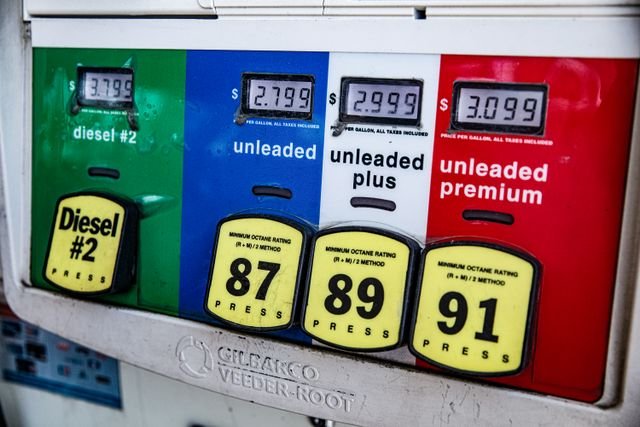
At 64.1 cents per kWh and 3.5 miles per kWh, EVgo works out to 18.3 cents a mile. A 30 mpg petrol car matches that when petrol costs $5.49 a gallon. In August 2026 exactly one state was above that line — California, at $5.64. Hawaii came within three cents of it at $5.46, and the national average sat at $4.08.
So on public rates, without a membership, EVgo costs more per mile than running a petrol car in 49 of 50 states. That is a genuinely uncomfortable sentence to write about the largest urban charging network in the country, but the arithmetic is not ambiguous.
The perspective that matters, though, is the home comparison. Charging at home at the US average of 18.44 cents per kWh costs 5.3 cents a mile. EVgo costs 3.5 times that. The entire economic case for an EV lives in that first number, which is why our state-by-state charging cost guide and home charging breakdown are the two pieces worth reading before any network comparison.
EVgo’s real value is not price. It is location. The network sits in supermarket, pharmacy and shopping-centre car parks in dense metros, which is exactly where drivers without a driveway need it. If you are charging at a Meijer while you shop, you are buying convenience, not cheap electricity — and there is nothing wrong with that as long as you know which one you are paying for. We work through the wider version of this decision in owning an EV without home charging.
Memberships: worth checking, hard to pin down
EVgo runs several tiers — pay-as-you-go with a per-session fee, a free account tier that removes it, and paid plans including PlusMax at around $12.99 a month that cut the per-kWh or per-minute rate and drop session and reservation fees.
We are not going to quote you a member rate, because EVgo does not publish one and the figures circulating on other sites are years old. What we can tell you is the shape of the decision, which is the same as it is on every network: a monthly fee divided by a per-kWh discount gives you a break-even in kWh per month. On Tesla’s network that break-even is about 77 kWh a month, and on Electrify America around 45. Open the EVgo app, note your local rate with and without the plan, and do the same division. If you fast charge more than a couple of times a month it will almost certainly pay.
Worth knowing separately: EVgo runs partner discounts that can beat any subscription. Uber Pro drivers get up to 45% off standard retail rates with no monthly fee, and several carmakers bundle EVgo credit with new vehicles. Those are enrolled through the app, not applied automatically.
Frequently asked questions
How much does EVgo cost per kWh?
An average of 64.1 cents per kWh across 893 tracked sites in June 2026, ranging from about 52 cents in Wisconsin to 69.4 cents in New York. Individual sites are priced separately and some markets bill by the minute instead.
Is EVgo more expensive than Electrify America?
Yes, slightly. EVgo averaged 64.1 cents against Electrify America’s 61.7, and Tesla’s standard rate of 60.1. The difference is about 70 cents on a 30 kWh top-up — small per session, but consistently at the wrong end.
Why does EVgo charge by the minute in some states?
State weights-and-measures regulations in several states prevent charging networks from billing by the kilowatt-hour. Every network faces the same rule in those markets. It penalises slower-charging cars heavily.
Is EVgo cheaper than petrol?
At public rates, no. It works out to about 18.3 cents a mile, which a 30 mpg petrol car beats at any pump price below $5.49 a gallon — and only California’s average was above that in August 2026. A membership or partner discount changes the answer.
Is the EVgo membership worth it?
Usually, if you charge more than twice a month, because the paid tiers remove session fees as well as cutting the rate. Check the current fee and your local rate in the app; EVgo does not publish either publicly.
Where does EVgo have the most chargers?
California, overwhelmingly — 412 of 893 tracked sites, or 46% of the network. Texas, Virginia and Florida follow at some distance. It is a metro-focused network rather than a highway one.
The short version
EVgo averages 64.1 cents per kWh, making it the priciest of the three big fast-charging networks, and in June its prices rose at 267 sites while falling at 5. Its rates barely vary by state, so there is no cheap region to seek out. At public pricing it costs about 18.3 cents a mile, which is more than petrol in 49 of 50 states and 3.5 times what the same energy costs at home. If your state bills by the minute, none of those numbers apply to you directly — what you pay depends on how fast your car charges, and a slow one can pay five times what a fast one does. Buy EVgo for where its chargers are, not for what they cost, and check the app for member and partner rates before you plug in.