Is the Long-Range EV Upgrade Worth the Extra Money?
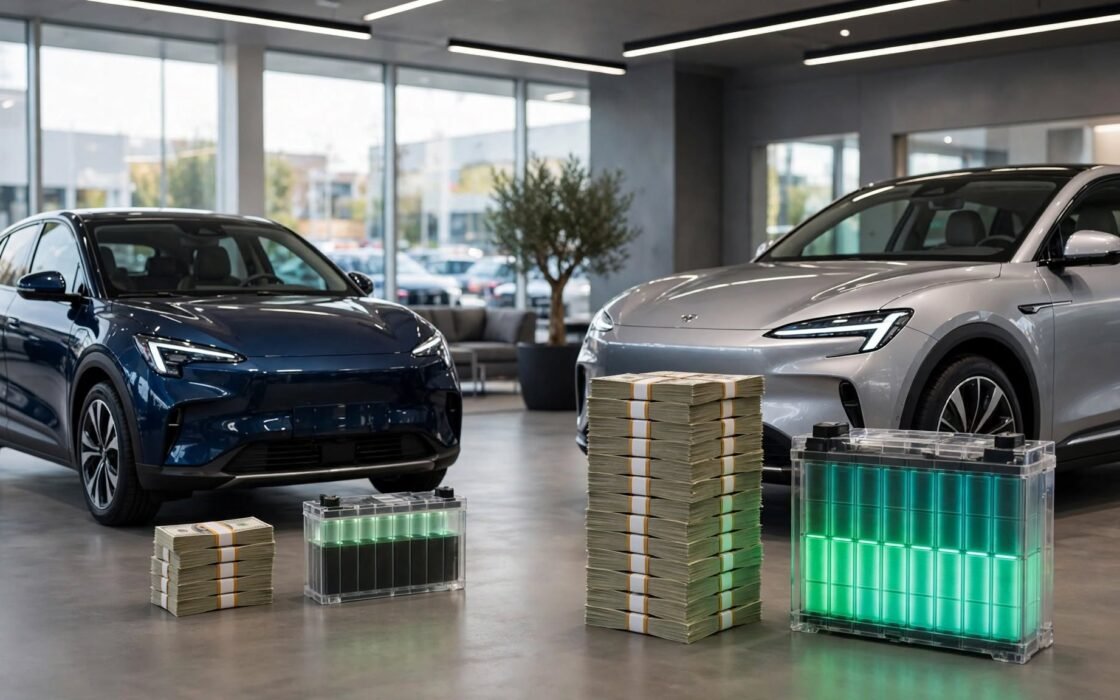
Ask any EV forum whether to buy the standard-range or the long-range version of the same car and you will get one answer, delivered with total confidence: always buy the bigger battery. It is appealing advice, and it is also how buyers end up paying $4,000 or more for miles they will never drive. The upgrade is not a scam, but it is not automatically smart either. The honest answer lives in three numbers: what the extra miles cost, how many days a year you would actually use them, and what the bigger battery quietly costs you over time.
What extra miles actually cost
- Hyundai Ioniq 5 SE RWD: $4,050 more buys 73 extra EPA miles (63 to 84 kWh) — $55.48 per added mile (our calculation).
- Kia EV6 Light RWD: $3,300 more buys 82 extra EPA miles (63 to 84 kWh) — $40.24 per added mile (our calculation).
- Kia EV9 Light RWD: $5,000 more buys 74 extra EPA miles (76.1 to 99.8 kWh) — $67.57 per added mile (our calculation).
- At retail, you are paying roughly $157–$211 per added kilowatt-hour of battery (our calculation) — and part of that delta is a stronger motor, not just cells.
- The federal $7,500 credit expired 30 Sep 2025, so the sticker-price gap is now the real gap — nothing shrinks it anymore.
Short answer
Paying for the bigger battery costs roughly $40–$68 per extra EPA mile on 2025 models. It is worth it if you regularly drive 200+ miles in a day, take frequent road trips, park outdoors in winter, or cannot charge at home. It is mostly wasted money if you charge at home nightly and rarely exceed 150 miles a day — the standard battery already covers that with room to spare.
The cleanest numbers in the 2025 market
Most brands make this comparison deliberately hard. They bundle the bigger battery with a trim jump, so the price gap includes leather seats, a better stereo, and a sunroof — you cannot tell what the miles themselves cost. Three models sell the same trim with two battery sizes, which makes the math honest. All prices below include destination charges, and all range figures are the manufacturer’s announced EPA estimates as reported at launch.
| Model (2025, RWD) | Standard battery | Big battery | Price gap | Extra EPA miles | Cost per added mile* |
|---|---|---|---|---|---|
| Hyundai Ioniq 5 SE | 63 kWh, 245 mi, $43,975 | 84 kWh, 318 mi, $48,025 | $4,050 | 73 | $55.48 |
| Kia EV6 Light | 63 kWh, 237 mi, $44,375 | 84 kWh, 319 mi, $47,675 | $3,300 | 82 | $40.24 |
| Kia EV9 Light | 76.1 kWh, 230 mi, $56,225 | 84 kWh, 304 mi, $61,225 | $5,000 | 74 | $67.57 |
*Our calculation: price gap ÷ extra EPA miles. Ioniq 5 figures per InsideEVs’ report of Hyundai’s 2025 pricing announcement (secondary source); EV6 figures per InsideEVs’ report of Kia’s 2025 EV6 pricing (secondary source), with the 237-mile base figure cross-checked against a second pricing database; EV9 figures per Green Car Reports’ 2025 EV9 pricing coverage (secondary source).
Two things stand out. First, the spread is wide: Kia charges you $40 per added mile on the EV6 and $68 on the EV9 for similar battery chemistry on the same platform. There is no universal “going rate” for range — each model’s pricing is its own negotiation. Second, the EV6’s upgrade is the clear value of the three, and it is not close. If you are cross-shopping the Ioniq 5 and EV6, the cheaper range upgrade is a genuine tiebreaker most comparisons never mention.
Why a kilowatt-hour costs you $157–$211 here
Divide the price gap by the added battery capacity and you get $192.86/kWh on the Ioniq 5, $157.14/kWh on the EV6, and $210.97/kWh on the EV9 (our calculations). That looks steep because it is not the price of cells. Three things are bundled into that number.
First, you are often buying a motor upgrade too. The Ioniq 5 SE jumps from 168 hp to 225 hp along with the bigger battery; the EV6 Light makes the same 167-to-225 hp step. Some of your $3,300–$4,050 is paying for acceleration, not range. Only the EV9 keeps the comparison nearly pure, with a single rear motor in both versions — and fittingly, it shows the highest per-kWh cost.
Second, retail battery pricing carries the automaker’s margin, warranty reserve, and integration cost: the cooling system, housing, battery management electronics, and the warranty liability on all of it for 8 years or 100,000 miles.
Third, manufacturers price the upgrade at what the market will bear, not what it costs to build. Range is the most persuasive number on an EV window sticker, and buyers demonstrably pay a premium to see a bigger one. The practical takeaway: never assume the upgrade is “about $50 a mile” on the car you are actually buying. Run the two sticker prices for your exact trim pair.
Do the math on your own driving
The sticker math tells you what the miles cost. This calculator tells you whether you will ever use them, by valuing the charging stops the extra range lets you skip on long trips — for most drivers, the only tangible return the upgrade ever pays.
Long-range upgrade calculator
Defaults shown are the Ioniq 5 SE example only — replace every figure with your own trim pair.
How the formula works: cost per added mile is simply the sticker-price gap divided by the extra EPA miles. The time value assumes each long trip lets the bigger battery skip roughly one DC fast-charging stop (about 25 minutes door to door, an example you can change), multiplies the skipped stops over your ownership years, and values the hours at the hourly figure you enter. It deliberately ignores fuel savings, because both batteries cost nearly the same per mile to charge — the upgrade buys convenience and buffer, not cheaper energy.
When the bigger battery earns its money
Four driver profiles genuinely benefit, and they are worth naming because everyone else is subsidizing them.
The road-tripper. If you drive 250-plus miles in a day more than a handful of times a year, the extra 70–80 miles often converts into one fewer charging stop per leg — 25–40 minutes saved and one less gamble on a busy charger. At six long trips a year over six years, 36 skipped stops at $30-an-hour values the upgrade near $450–$900: a real chunk of the EV6’s $3,300 gap, but barely a dent in the EV9’s $5,000.
The winter driver. Cold weather can erase a fifth or more of rated range, from whichever battery you bought. A 245-mile car becomes a ~195-mile car in deep winter; a 318-mile car becomes ~255. The upgrade’s value is not the summer number — it is the February number.
The driver who cannot charge at home. Apartment dwellers live on public charging, where every session costs time and the per-kWh price is triple the home rate. A bigger battery means fewer sessions per week — the profile where the upgrade’s convenience value is highest.
The long keeper. Batteries degrade — Geotab’s 2026 analysis of 22,700 EVs (primary source) puts the average at 2.3% per year, projecting 81.6% of original capacity after eight years. Apply that to the Ioniq 5: the 84 kWh pack still delivers about 259 miles of original-equivalent range at year eight, while the 63 kWh pack is down to about 200 (our calculations). The long-range car at eight years old still out-ranges the standard car when it was new. If you keep cars a decade, you are buying your future self out of range anxiety. Our battery degradation explainer walks through what speeds the decline up.
When it is money sitting in the driveway
Now the other side, which is most buyers. The average American drives under 40 miles a day. If you charge at home overnight, a 237-mile standard-range EV6 wakes up every morning with roughly six days of typical driving in it. The extra 82 miles you paid $3,300 for will sit unused 350 days a year, slowly degrading whether you use them or not. A quick test: knock 20% off the standard battery’s EPA figure for highway-speed driving — 245 becomes 196 miles (our calculation) — and check whether that still covers your longest regular day. If it does, the upgrade is a $4,050 insurance policy against a trip you do not take.
There is also an honesty check worth running: the bigger battery does not make charging cheaper. Both packs refill at the same per-kWh price, and the larger one takes longer to fill on the same charger. Hyundai’s own figures show the 84 kWh Ioniq 5 needing 30 minutes for a 10–80% Supercharger session versus 24 for the 63 kWh pack (reported by InsideEVs from Hyundai’s announcement). You pay more upfront and then wait longer at every stop — the only thing you buy is fewer stops.
The costs nobody puts in the configurator
The sticker gap is not the whole price of the upgrade. Four quiet costs follow the bigger battery around.
Weight and efficiency. Twenty extra kilowatt-hours means roughly 130–180 kg of extra cells and structure riding along every mile. The bigger pack is slightly less efficient per mile, so a small slice of your “extra” range is consumed just hauling itself. It also means marginally faster tire wear — and tires are already the biggest recurring cost difference between EVs and petrol cars.
Replacement cost. If the pack ever needs replacing out of warranty, a bigger pack costs more — more cells, more labor. Our battery replacement cost guide shows how pack size drives the quote. This is a tail risk, not a certainty, but it belongs in the ledger.
Insurers price partly on the car’s value and repair cost; a higher-MSRP trim with a larger, costlier pack can nudge premiums up slightly, compounding every year you own the car.
Resale. This one cuts in the upgrade’s favor, partially. Longer-range versions list higher on the used market — but they also started higher, so the question is whether they retain a bigger share of their price, and the answer varies by model and market. Our EV depreciation analysis tracks how range affects resale curves if you want the full picture before betting $5,000 on it.
Frequently asked questions
Does the bigger battery charge slower?
Per session, slightly — there is more energy to add. Per mile of range, it is about the same on an equally fast charger: both Ioniq 5 packs do 10–80% in roughly 20 minutes on a 350 kW charger. The gap shows on slower chargers — Hyundai quotes 30 versus 24 minutes on a Tesla Supercharger for the big versus small pack.
Does a bigger battery degrade slower?
The chemistry degrades at roughly the same percentage rate — Geotab’s 2.3%-per-year average applies to the pack, not the trim. But a degraded big battery still holds more absolute range than a degraded small one, which is exactly why long keepers benefit most from the upgrade.
Can I add range later instead of buying it now?
No. The battery is structural to the car; there is no factory upgrade path from the small pack to the large one after purchase. Software “range unlocks” exist on a few models but they only free up capacity the hardware already had. Decide at purchase time.
Is the standard-range battery enough for road trips?
Yes, with more stops. A 245-mile EV road-trips fine — it just stops every ~170 highway miles instead of every ~220. Two long trips a year means roughly an extra hour of charging per trip. Whether that hour is worth $3,300–$5,000 is the entire question this article answers.
Should I buy the bigger battery for resale value alone?
Not as a primary reason. Range helps resale, but you will not recover the full upgrade premium — no option ever returns 100% at resale. Buy the range for your own driving; treat any resale benefit as a discount on the cost, not the justification.
The short version
The long-range upgrade is fairly priced on some models and a luxury tax on others — $40 per added mile on the EV6, $68 on the EV9 — so run the sticker math on your exact trim pair instead of trusting a rule of thumb. Then be honest about your driving: home charging plus short daily miles means the standard battery already does the job. Frequent long days, harsh winters, no home plug, or a decade of ownership flip the answer. Range you use is worth paying for; range you only admire on the window sticker is the most expensive option on the car.
Written by Shurah, who researches and writes independently on the real cost of EV ownership — charging, maintenance, and total cost of ownership — backed by primary data and original calculations rather than recycled lists.