Your phone freezing after an update is annoying. Your car freezing after one is a different category of problem — and it’s happened, publicly, to more than one major EV brand. The reassuring part: “bricked” usually means something narrower and more recoverable than the word implies, and understanding which kind of bricking you’re dealing with changes what you should actually do about it.
Key Numbers
- In November 2023, Rivian publicly confirmed an over-the-air update sent “the wrong build with the wrong security certificates,” bricking infotainment systems on some R1T and R1S vehicles — the company stated fixing it could require physical repair in some cases.
- Chevrolet Equinox EV owners reported a failed OTA update cycling dashboard error messages and requiring an OnStar-assisted recovery in late 2025 — a documented case on the exact model our own maintenance research covers.
- Community-reported estimates from Volkswagen ID owners put failed OTA update risk around 1 in 20 attempts — anecdotal, not an official manufacturer figure, but a useful sense of scale.
- Kia issued an official OTA update in January 2026 (NHTSA-documented service bulletin) specifically to correct Vehicle Control Unit warning-light logic on 2026 EV9 models — proof manufacturers do push safety-relevant fixes via the same OTA channel that occasionally causes problems.
- Multiple owner reports describe a car deliberately locking itself out of driving after detecting an update irregularity — an intentional protective response, not an uncontrolled crash — the same underlying logic covered in our limp mode research.
Short Answer
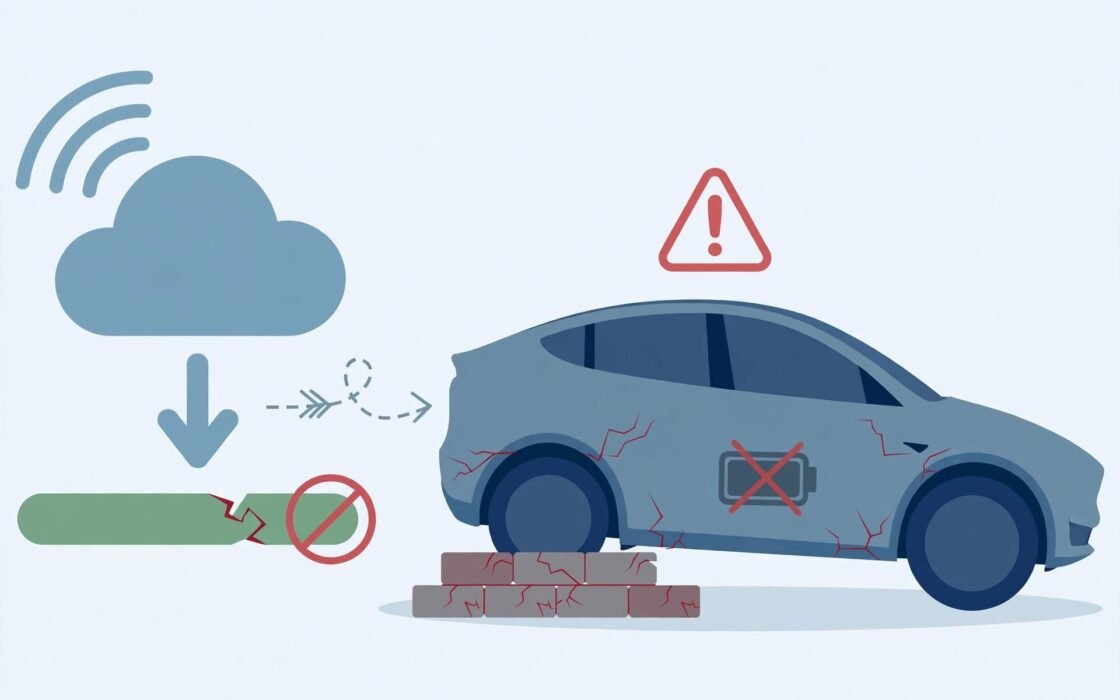
Yes, but “bricked” covers a range of outcomes that matter a lot in practice. The most common failures freeze infotainment or climate control — annoying, sometimes safety-relevant if it disables demisters, but not something that strands you on the road. Rarer failures can leave the car unable to shift out of park or power on at all, and in at least one documented case (Rivian, 2023) required a physical dealer visit to resolve. A car deliberately refusing to drive after a detected update problem is usually the vehicle’s own safety logic working as intended, not a random crash — the same protective mindset behind limp mode.
Not All “Bricking” Is the Same Severity
- Infotainment/app freeze. The most commonly reported failure mode — touchscreen unresponsive, app sync broken — genuinely inconvenient but typically doesn’t affect the vehicle’s ability to drive or charge.
- Climate/HVAC lockout. Less common but more serious — one widely discussed UK case left a driver’s demister completely non-functional after a failed HVAC software update, which the owner correctly flagged as making the car unsafe to drive in that condition, not just uncomfortable.
- Intentional protective lockout. Some vehicles are designed to refuse to drive if the update process detects anything abnormal in safety-critical systems — as one owner community explained it, this is “the intended outcome,” not the uncontrolled result of a fault. This mirrors exactly the logic behind limp mode: the software choosing caution over letting you drive on an uncertain system state.
- Full immobilization requiring service. The rarest and most serious category — Rivian’s 2023 incident, where the company itself said some units would need physical repair, not just a retry. This is uncommon but real, and it’s the scenario that actually justifies concern rather than annoyance.
Why Cars Are Riskier to Update Than Phones
A failed phone update usually just corrupts an app or the OS shell — annoying but low-stakes, since a phone has no moving parts and no safety function. A vehicle’s software update can touch the Vehicle Control Unit, battery management system, or HVAC controller — components with direct safety implications if they end up in a partially-flashed, inconsistent state mid-update. Manufacturers with more mature OTA infrastructure (Tesla is the most cited example) use dual-bank flashing, where the new firmware installs to a separate memory partition while the old, known-working version stays intact until the new one verifies successfully — if the update fails, the car simply reverts rather than getting stuck half-updated. Not every manufacturer’s OTA system has matured to that same level of redundancy, which is part of why failure patterns differ so much brand to brand.
What to Actually Do If It Happens to You
How to Reduce Your Risk Going In
- Never interrupt an update in progress — powering off or disconnecting mid-flash is the single highest-risk action you can take, since it can leave a control unit in a genuinely corrupted, half-written state.
- Keep the vehicle plugged in and stationary during updates when the manufacturer recommends it — this avoids a low-voltage or connectivity interruption mid-process.
- Don’t decline critical safety updates out of caution — as the Kia EV9 case shows, some OTA pushes exist specifically to fix a safety-relevant issue; skipping them trades one risk for another.
- If you have the option to update at a dealer rather than via OTA and you’re nervous about it, ask whether that path carries different risk — feedback here is genuinely mixed, since some owners report dealer-side updates as no more reliable than OTA ones.
FAQ
Is my EV’s traction battery at risk during a software update?
The traction battery’s core chemistry isn’t directly affected by a software update failure — the risk is to control electronics (VCU, HVAC controller, infotainment) rather than the battery cells themselves.
Can I refuse or delay a software update?
Often yes, for non-critical updates, though safety-relevant updates like Kia’s EV9 warning-light fix are generally worth accepting promptly rather than deferring indefinitely.
Does a bricked infotainment system affect my ability to charge?
Not typically — charging is usually managed by separate systems from the infotainment screen, though a fully immobilized vehicle (the rarest case) could affect both.
Will the manufacturer cover repair costs from a failed update?
Rivian explicitly took responsibility for its 2023 incident and covered resolution; policies vary by manufacturer and incident, so check your specific situation with the manufacturer directly rather than assuming either outcome.
Is this the same thing as limp mode?
Related but distinct — limp mode is a protective power restriction while driving, usually triggered by a battery or electrical fault; an update-related lockout is specifically about the vehicle refusing to operate after an update process itself went wrong or was interrupted. Our limp mode research covers the driving-fault version in detail.
The Short Version
Software updates can genuinely brick an EV, and it has happened publicly to more than one major brand — but “bricked” usually means an infotainment freeze or a deliberate protective lockout, not a random, unrecoverable failure. The rare full-immobilization cases, like Rivian’s 2023 incident, are real but uncommon, and manufacturers with more mature OTA infrastructure design around this risk with fail-safe reversion. The practical protection is simple: never interrupt an update in progress, don’t skip safety-relevant updates out of caution, and know that a car refusing to drive after an update is very likely its own safety logic doing exactly what it was designed to do.
About the author: Written by Shurah, who researches and writes independently on the real cost of EV ownership — charging, maintenance, and total cost of ownership — backed by primary data and original calculations rather than recycled lists.