A dash cam left running in parking mode has flattened plenty of gas-car batteries over a long weekend. On an EV, the same camera can do it faster, and the failure it causes is a different, more locking-you-out kind of problem than a gas car’s.
The physics is identical either way — a small continuous current, drawn for hours while nothing recharges it. What changes is the size of the battery paying for it, and that difference is bigger than most dash cam buying guides mention, because none of them are written with an EV’s smaller 12-volt battery in mind.
The key numbers
- 200–500 mA — typical dash cam draw in parking mode, depending on channels and resolution
- ~30 Ah — a typical EV’s small 12-volt auxiliary battery (a Tesla Model S runs about 33 Ah)
- 45–75 Ah — a typical gas car’s 12-volt battery, often 50% or more larger
- 30–75 hours — how long a dash cam takes to reach a safe discharge limit on an EV’s smaller battery, depending on the mode
- 12.0–12.4V — the low-voltage cutoff range that actually prevents this, and the one setting most owners never touch
- Locked out entirely — what a flat 12V does to an EV, versus a jump-start fix on most gas cars
Short answer: Yes, a parking-mode dash cam can drain an EV’s 12-volt battery, and it happens faster than in a gas car because EV auxiliary batteries are often 30–50% smaller. At a typical 200–500 mA draw, that’s roughly 30 to 75 hours before a safe discharge limit is reached with no protection. A hardwire kit with a low-voltage cutoff set around 12.2–12.4V, not the default 12.0V made for larger gas-car batteries, prevents it entirely.
Run your own setup through the numbers
Rather than a generic warning, work out where your specific dash cam and parking duration actually land.
Dash Cam Parking-Mode Drain Calculator
This runs the actual amp-hour math, not a generic claim. Enter your setup and see how long you actually have.
Assumes a safe discharge limit of 50% of rated capacity, with no low-voltage cutoff protecting the battery. A hardwire kit’s cutoff changes this entirely — see below.
Why the same dash cam is riskier on an EV
A dash cam in parking mode draws from the 12-volt system whether the car is electric or not — that part of the physics doesn’t care what powers the wheels. What changes is the reservoir it’s drawing from.
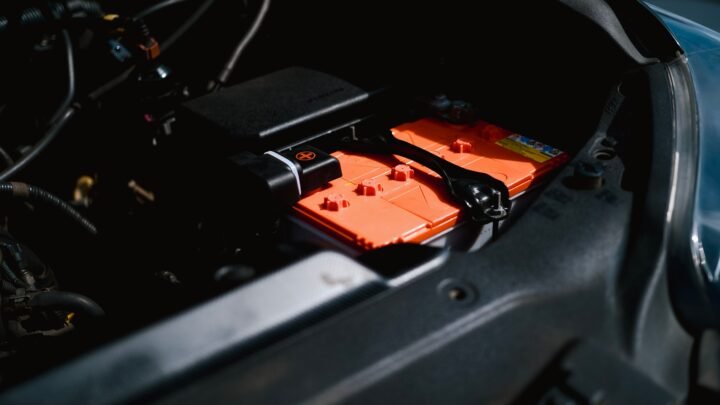
EVs don’t need a 12-volt battery capable of a 200–600 amp starting burst, because there’s no starter motor cranking a combustion engine. The 12-volt system in an EV exists mainly to wake the car, run accessories, and — critically — hold closed the contactors that connect the high-voltage traction battery to the rest of the car. That job needs steady, modest current, not a starting burst, so manufacturers fit a smaller battery: commonly in the 28–35 Ah range, against 45 to 75 Ah on a typical gas car’s battery. A Tesla Model S owner community has measured the car’s 12V battery at roughly 33 Ah — well under half of what a larger truck battery holds.
Run the same 300 mA dash cam against both, and the smaller tank simply empties sooner. It’s the identical draw, hitting a smaller battery.
Why this matters more on an EV when it actually happens
This is the part that changes the stakes, not just the timing. On a gas car, a dead 12-volt battery is an inconvenience with a well-known fix: jump-start it and drive off. On an EV, a dead 12-volt battery does something more total, covered in depth in our EV 12-volt battery guide: it leaves the high-voltage contactors open by design, as a safety measure, electrically isolating the traction pack from the rest of the car. A dash cam quietly flattening the 12V while the car sits at the airport doesn’t just mean a slow morning — it can mean a car that won’t respond to its key fob or door handle at all, sitting on 200-plus miles of range it can’t access to help itself.
You still jump-start an EV’s 12-volt system the same way as a gas car’s — through dedicated external terminals on most models, since the bonnet may not open without power — but knowing where those terminals are before you need them is worth five minutes now rather than a stressful search later.
The one setting that actually fixes this
A hardwire kit alone doesn’t solve the problem — it just moves the power source from a cigarette-lighter socket (which switches off with the ignition, defeating parking mode entirely) to a constant fuse-box circuit that stays live. The part that actually prevents a dead battery is the low-voltage cutoff (LVC): a circuit inside the hardwire kit that measures battery voltage continuously and cuts power to the camera before it drops to a level that risks a no-start.
Quality kits from brands like Viofo and BlackVue let you set this threshold, typically between about 11.8V and 12.4V. The default setting on most kits assumes a larger gas-car battery with more margin to spare — which is exactly why it’s worth raising, not leaving at default, on an EV with a meaningfully smaller reservoir. A cutoff of 12.2 to 12.4V is the range worth targeting for EV use specifically, checked against your owner’s manual since exact safe thresholds vary by vehicle. Set the cutoff too aggressively low and you get the drain risk covered above; set it appropriately for your smaller battery and the same dash cam becomes a non-issue.
What to actually do, in order
- Confirm whether your dash cam is on a hardwire kit or a cigarette-lighter plug. If it’s the plug, parking mode likely isn’t running at all when the car is off, since that socket usually switches off with the ignition — the drain risk in this article doesn’t apply, but neither does your parking-mode footage.
- Check your hardwire kit’s low-voltage cutoff setting and raise it toward 12.2–12.4V if your EV’s 12-volt battery is on the smaller side. Most kits ship at a default meant for larger batteries.
- Use motion-detection or time-lapse parking mode rather than continuous recording where your camera supports it — this alone can roughly halve the draw for the same coverage.
- Consider an external battery pack (a supercapacitor or dedicated lithium pack, such as a Cellink-style unit) if you park for extended periods regularly. This removes the vehicle’s 12-volt battery from the equation entirely, which matters most for airport trips and long-term storage.
- Don’t rely on a capacitor-based dash cam to solve this on its own. Capacitor units handle heat better than lithium-battery cameras — genuinely useful in a hot climate, since a car parked in direct sun can exceed the safe operating range of a standard lithium cell — but a supercapacitor still needs continuous external power to run parking mode. It’s a heat-tolerance upgrade, not a battery-drain fix.
- If you already have unexplained 12V problems, disconnect the dash cam for one night after a full charge and compare resting voltage with and without it connected, using the multimeter method the Universal Technical Institute describes for testing parasitic draw. If the drop disappears, the camera (or its wiring) is the cause; if it doesn’t, look at the broader parasitic-drain picture in our phantom drain guide, which covers Sentry Mode, app polling, and other always-on features competing for the same 12-volt system.
Where this fits with everything else draining your EV’s battery
A dash cam is one line item in a longer list. Camera-based security modes, remote app polling, cabin overheat protection, and now an aftermarket dash cam are all pulling from the same 12-volt system while the car sits still, and they compound rather than replace each other. If you’re already running Sentry Mode or an equivalent feature and add a dash cam hardwired without a properly set cutoff, you’re stacking two real draws on a battery that was already smaller than a gas car’s to begin with. Our full phantom drain breakdown covers the rest of that picture and the free settings that address the biggest sources.
Frequently asked questions
Can a dash cam drain an EV’s 12V battery?
Yes, and typically faster than on a gas car, because EV auxiliary batteries commonly run 28–35 Ah against 45–75 Ah for a gas car’s. At a typical 200–500 mA parking-mode draw, that’s roughly 30 to 75 hours to a safe discharge limit with no cutoff protection.
What happens if an EV’s 12V battery goes flat from a dash cam?
The high-voltage contactors connecting the traction battery to the rest of the car stay open as a safety measure, so the car becomes fully inaccessible — it won’t respond to the key fob or door handle, regardless of how much range is in the main battery. It’s jump-started the same way as a gas car’s 12V system, usually via dedicated external terminals.
What low-voltage cutoff setting should I use on an EV?
Around 12.2 to 12.4V is a reasonable starting point for a smaller EV auxiliary battery, higher than the roughly 12.0V default many hardwire kits ship with for larger gas-car batteries. Confirm against your specific vehicle’s owner’s manual where available.
Does the cigarette lighter socket work for parking mode?
Usually not. Most vehicles switch that socket off with the ignition, which defeats parking mode entirely. A hardwire kit connected to a constant, always-on fuse-box circuit is the standard way to actually power parking mode.
Is a capacitor-based dash cam safer for battery drain?
It’s safer for heat tolerance, not for battery drain. Supercapacitor units handle high temperatures (a hot, sun-parked car) better than lithium-battery cameras, but they still draw continuous external power to run parking mode, so a low-voltage cutoff is still necessary.
How do I know if my dash cam is causing 12V problems?
Fully charge the battery, disconnect the dash cam for one night, and check the resting voltage in the morning against a night with it connected. If the drop disappears without the camera, it’s the source; if the drop persists, the cause is elsewhere in the car’s parasitic drain.
Should I just avoid parking mode on an EV?
Not necessarily — a correctly configured hardwire kit with an appropriate low-voltage cutoff makes it safe on any car, EV included. The risk is specifically an unprotected setup, or a cutoff threshold left at a default meant for a larger battery than your EV actually has.
The short version
A parking-mode dash cam draws the same 200–500 mA whether it’s bolted to a gas car or an EV, but EV auxiliary batteries commonly run 30–50% smaller, so the same draw reaches a safe discharge limit in roughly 30 to 75 hours instead of 50 to 125. The fix isn’t avoiding the camera, it’s a hardwire kit with a low-voltage cutoff set for your actual battery size — 12.2 to 12.4V rather than the 12.0V default built for a bigger gas-car battery. Get this wrong on an EV specifically and the stakes are higher than a jump-start: a flat 12V leaves the high-voltage system locked out entirely, inaccessible from the key fob or door handle, regardless of how much charge is sitting in the main battery. Set the cutoff correctly once, and the same camera that would flatten a gas car’s battery in a long weekend causes no problem at all.
About the author: Written by Shurah, who researches and writes independently on the real cost of EV ownership — charging, maintenance, and total cost of ownership — backed by primary data and original calculations rather than recycled lists.