The most commonly repeated statistic about EVs and fire is also one of the most consistently backwards. Electric cars do not catch fire more often than petrol cars. By every major dataset available, they catch fire dramatically less.
The most-cited US analysis, from AutoinsuranceEZ using National Transportation Safety Board, Bureau of Transportation Statistics and manufacturer recall data, found 25.1 fires per 100,000 electric vehicles sold, against 1,529.9 for petrol and diesel cars and 3,474.5 for hybrids. On those numbers a petrol car is about 61 times more likely to catch fire than an EV, and a hybrid is roughly 138 times more likely — the category most people assume is the safe middle ground is actually the worst of the three.
That is the headline. It is not the whole story, and the parts that get left out matter for how you actually park, charge and drive.
The key numbers
- 25.1 vs 1,529.9 vs 3,474.5 — fires per 100,000 vehicles sold: EV, petrol/diesel, hybrid
- 61x — how much more likely a petrol car is to catch fire than an EV
- 138x — the same figure for a hybrid, the worst of the three categories
- 511 — verified EV traction-battery fires recorded globally since 2010
- 5% vs 34% — share of fires caused by the battery/engine itself, EV versus ICE
- 51% — share of verified EV battery fires linked to a collision, not spontaneous failure
The number holds up across countries, not just one study
A single US study is easy to dismiss as an outlier. This one is not an outlier — independently gathered data from several countries with mature EV markets lands in the same place.
| Region & period | BEV fire rate | Comparison vehicle | Comparison rate |
|---|---|---|---|
| US (AutoinsuranceEZ / NTSB) | 25.1 per 100,000 sold | Petrol/diesel | 1,529.9 per 100,000 |
| Sweden, MSB, 2018–2021 | 3.8 per 100,000 | Petrol/diesel | ~68 per 100,000 |
| Norway, 2022 | 4.1 per 100,000 registered | Hybrid | 25.4 per 100,000 |
| UK, 2021–2023 | 1.67 per 100,000 registered | — | — |
Different countries, different methodologies, different denominators — some measure vehicles sold, others vehicles currently registered — and the direction never changes. In Sweden the petrol/diesel rate runs about 18 times the BEV rate. In Norway, one of the most EV-saturated markets in the world, hybrids still catch fire at roughly 6 times the BEV rate. There is no dataset in circulation that shows EVs catching fire more often than combustion vehicles.
The honest caveat the researchers themselves flag
Worth stating plainly, because the study that produced the headline number says it about itself: the comparison is genuinely imperfect. The petrol and diesel fleet is far larger, far older on average, and includes millions of vehicles well past the age where wiring, fuel lines and worn components start failing. A brand-new EV fleet is being compared partly against decades of accumulated combustion-car wear.
The researchers’ own conclusion, though, is that this does not flip the result — the gap is wide enough that better data would narrow the multiple, not reverse it. A 61-times difference has a lot of room to shrink and still leave EVs meaningfully safer.
What actually starts an EV fire
This is the part almost no coverage includes, and it changes what the statistic means for you personally.
EV FireSafe, an Australian-government-funded project that has tracked verified traction-battery fires globally since 2010, has documented 511 confirmed incidents as of its latest count. Two things from that dataset matter more than the total:
- The battery itself is rarely the spontaneous cause. Analysis of verified EV fires attributes only about 5% to a battery failure with no external trigger, against roughly 34% of ICE vehicle fires traced to the engine itself. An EV fire is far more likely to have an external cause than a combustion-car fire is.
- Collision is the dominant trigger. Around 51% of verified EV battery fires in the Australian dataset followed a crash severe enough to puncture or crush the pack. A parked, undamaged EV catching fire on its own is the rare case, not the typical one.
The remainder splits across manufacturing defects, charging-related faults, and water damage after flooding, which has become its own recognised category following major storm events in the US.
The genuine downside: severity, not frequency
Fair coverage of this topic includes the part that does not flatter EVs, and there is one. When a lithium-ion battery fire does start, it behaves differently to a petrol fire — and worse, in ways that matter to how fire services respond.
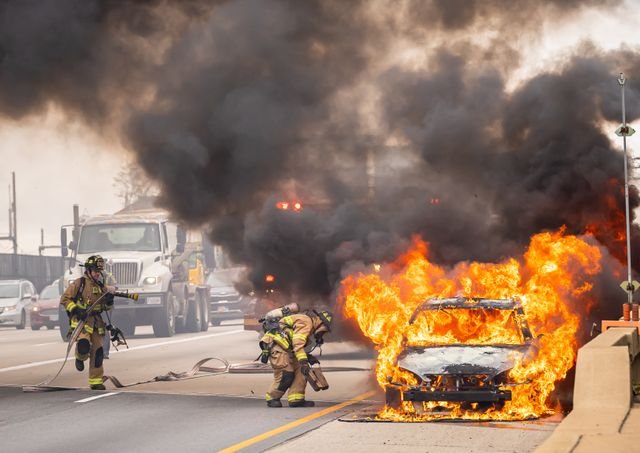
Thermal runaway is self-sustaining: a damaged or overheated cell releases heat and gas that trigger the next cell, and the reaction can propagate through the pack even after visible flames are extinguished. Fire departments have reported EV fires reigniting hours or even days after they appeared out, a pattern the NFPA has documented in its EV-fire response guidance for firefighters. They also burn hotter and can require vastly more water than a comparable petrol fire — sometimes reported in the tens of thousands of gallons for a single incident, against a few hundred for a car fire in a conventional engine bay.
This is a real difference and a real operational challenge for first responders. It is not, however, evidence that EVs catch fire more often — it is evidence that the two kinds of fire need different tactics once one has started. The two facts sit alongside each other without contradicting: rare and severe is a genuinely different profile from common and moderate, and EVs are the first of that pair on both counts.
The chemistry matters here too. As our guide to EV charging habits and battery chemistry covers, LFP batteries begin thermal runaway around 270°C against roughly 210°C for NMC, and current research puts LFP as around 80% less likely to enter runaway at all — which is part of why LFP has become the default chemistry in entry-level trims where cost and safety both favour it.
Where charging fits in
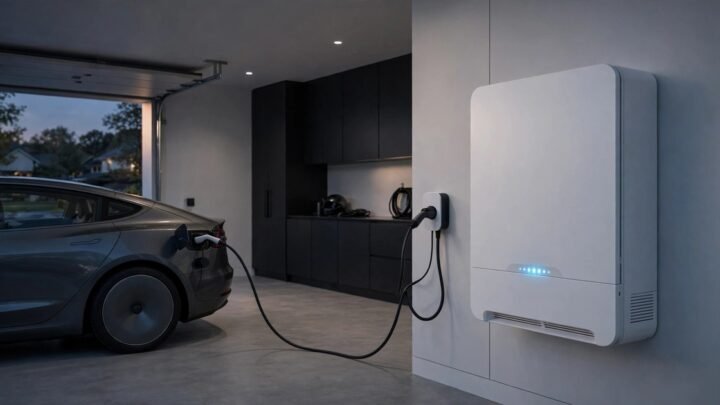
Charging-related causes show up in EV fire data too, and the more useful finding is where the fault usually sits. Industry analysis attributes a meaningful share of US charging-related EV fires to ageing or inadequate electrical infrastructure rather than the vehicle itself — old wiring, undersized circuits, and receptacles never designed for a continuous multi-hour load.
That lines up exactly with what we found reporting on portable home chargers: the standard household NEMA 14-50 socket is built for a cooker’s intermittent draw, not an EV’s continuous one, and residential-grade receptacles run three to five times the electrical resistance of industrial-grade ones under identical load. If home-charging fire risk concerns you, that receptacle — not the car — is where to spend the attention and the extra $30 to $60.
Parking garages, insurance, and the fear that outran the data
Some cities and building operators have restricted EV parking in underground garages, and several insurers have adjusted how they price EV cover, both partly in response to fire concerns. Reading the actual data, this reaction runs ahead of the risk it responds to. The frequency numbers above do not support treating a parked EV as a special hazard, and several major fire-safety bodies have said as much publicly while still taking the severity question seriously in their own guidance for firefighters and building design.
What has genuinely changed on the response side: many newer parking structures now include water suppression systems sized for EV-specific scenarios, and some manufacturers have added remote thermal monitoring that can flag a developing battery fault before it becomes visible. None of that implies elevated risk from a working, undamaged EV sitting in a car park — it reflects that when something does go wrong, the response needs to look different, which is a planning question rather than a frequency one.
What actually lowers your risk, as an owner
- Get collision damage to the battery inspected properly. Given that collisions cause about half of verified EV fires, any impact that could have reached the pack — even a moderate one — is worth a manufacturer inspection rather than a visual check alone.
- Use manufacturer-approved chargers and cables, and have your home receptacle professionally installed to code rather than assumed adequate because it already existed.
- Follow any battery recall promptly. Several of the highest-profile EV fire clusters trace back to specific manufacturing defects that were later recalled — the recall exists precisely because the risk was identified and is fixable.
- Avoid deep, prolonged submersion after flooding without a manufacturer inspection first. Saltwater intrusion in particular has been linked to delayed battery fires well after a flood event, sometimes days later.
- Don’t let severity anxiety change frequency-based decisions. The data does not support avoiding EV parking, EV purchase, or home charging out of fire concern — it supports the ordinary diligence above, which is a much shorter list than the fear implies.
- Rain is never the risk here — the real exception is a vehicle that’s been through actual flooding, which is a separate and well-documented cause of delayed battery faults.
Frequently asked questions
Are electric cars more likely to catch fire than gas cars?
No. US data puts EVs at 25.1 fires per 100,000 sold against 1,529.9 for petrol and diesel cars, roughly a 61-times difference. Data from Sweden, Norway and the UK shows the same direction, though the exact multiple varies by country and methodology.
Do hybrids catch fire more than either EVs or gas cars?
In the most-cited US data, yes — hybrids had the highest rate of the three categories at 3,474.5 per 100,000 sold, more than double the petrol/diesel rate and roughly 138 times the EV rate.
What actually causes EV fires?
Most verified cases follow a collision severe enough to damage the battery pack, around 51% in the largest tracked dataset. Spontaneous battery failure with no external cause accounts for only about 5% of cases, against 34% of ICE fires traced to the engine itself.
Are EV fires harder to put out?
Yes, once one starts. Thermal runaway can propagate through a battery pack and cause fires to reignite hours or days later, and extinguishing one typically requires far more water than a comparable petrol car fire. This is a genuine severity difference, separate from the much lower frequency.
Can charging my EV at home start a fire?
The risk is low but real, and it usually traces to the home’s electrical infrastructure rather than the car — specifically a residential-grade NEMA 14-50 receptacle overheating under a continuous EV load. Specifying an industrial-grade receptacle largely addresses it.
Is LFP battery chemistry safer than NMC?
Meaningfully, yes. LFP’s thermal runaway onset sits around 270°C against roughly 210°C for NMC, and research puts it as roughly 80% less likely to enter thermal runaway in the first place. It is part of why LFP has become common in lower-cost trims.
How many EV fires have there been worldwide?
EV FireSafe, an Australian government-funded tracker, has verified 511 traction-battery fires globally since 2010. The absolute count rises as the global EV fleet grows; the rate per vehicle is not increasing.
The short version
Electric cars catch fire far less often than petrol or hybrid cars, by a wide and consistent margin across every country with data worth trusting — roughly 61 times less often than a petrol car and 138 times less often than a hybrid in the most-cited US analysis. Most EV fires follow a collision rather than starting spontaneously, and the battery itself is rarely the uncaused trigger. The genuine downside is severity rather than frequency: once a lithium-ion pack does catch fire, it burns hotter, needs more water, and can reignite after apparently being extinguished. Both of those things are true at once, and neither cancels the other out. If you want to lower your own risk further, the highest-leverage single step is not about the car at all — it is making sure the socket it charges from at home was built for the job.