Portable solar panels marketed for EV charging are everywhere — foldable kits, roof-mounted arrays, “off-grid power for your car” ads. Some of it is genuinely useful engineering. Most of it isn’t going to power your daily commute, and the math explains exactly why, with no need to guess.
Key Numbers
- A typical 200W portable solar panel produces roughly 0.8 kWh in about 5 peak sun hours — enough for around 2.5–3 miles of EV range per day.
- Even a large 1,000–1,200W portable array in strong sun tops out around 10–30 miles of added range per day.
- For comparison, a standard home Level 1 outlet adds roughly 3–5 miles per hour, and a Level 2 home charger adds 12–60 miles per hour — both far faster than portable solar, even in one hour versus a full sunny day.
- Solar panels can’t be wired directly into an EV’s battery — the connection requires an inverter/charge controller and compatible charging equipment, since raw panel DC output isn’t compatible with a car’s charging system as-is.
- Covering a genuine daily commute (~37 miles/day) with rooftop solar realistically takes 6–8 residential-grade panels (360–410W each) dedicated to that load — a fixed installation, not a portable kit.
Short Answer
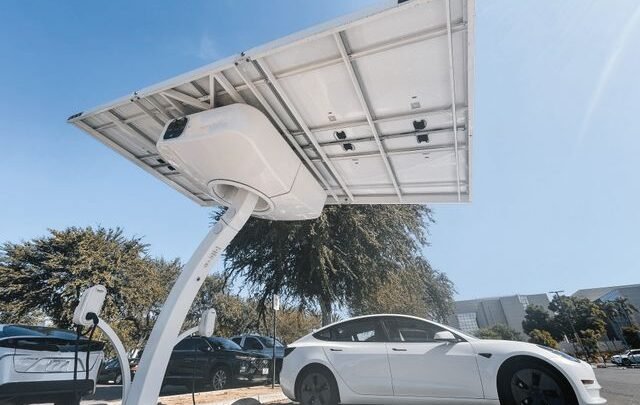
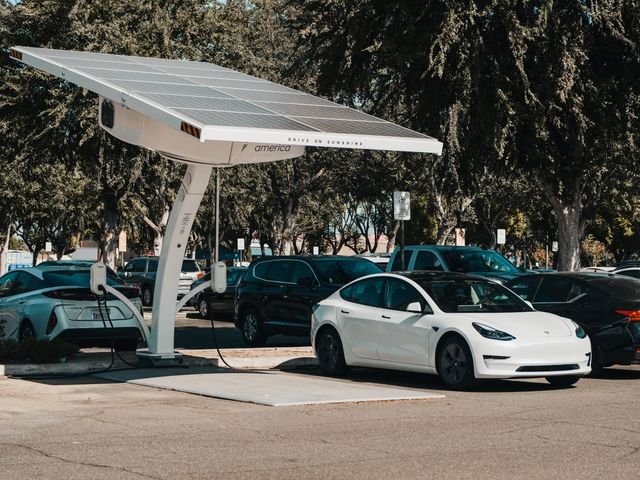
Portable solar panels can genuinely charge an EV, but the numbers are modest: a few miles a day from a small panel, up to maybe 10–30 miles a day from a large portable array in strong sun — useful for emergency backup, camping, or a very low-mileage second car, not for replacing your daily charging routine. A properly sized rooftop solar system is a completely different story and can realistically cover most or all of a typical commute, but that’s a fixed home installation, not the portable “clip it to your car” products most solar-EV ads show.
How Solar-to-EV Charging Actually Works
You can’t just point a solar panel at your car and plug it in. A panel produces raw DC current whose voltage and current characteristics don’t match what an EV’s charging system expects, so every real setup needs an inverter and/or charge controller in between — either charging a portable battery pack first (which then feeds the car through a standard charging cable) or, for a home rooftop system, tying into your home’s electrical panel the same way any other solar-powered appliance does. This middle step is also where some of the energy is lost to conversion inefficiency, which is part of why the real-world numbers below come in lower than a simple “watts × hours” calculation would suggest.
What Portable Solar Actually Delivers
| Portable panel size | Approx. daily energy (5 peak sun hours) | Approx. added range |
|---|---|---|
| 100–200W | ~0.5–0.8 kWh | ~1.5–3 miles |
| 400W | ~1.5–2.5 kWh | ~4–8 miles |
| 1,000–1,200W | ~4–6 kWh | ~10–30 miles |
These figures assume good direct sun, correct panel angle, and reasonably efficient equipment — cloud cover, poor angle, or a less efficient inverter setup pulls the real number down further. As one industry analysis put it plainly: portable solar isn’t practical for daily EV charging at commuter-relevant mileage — it’s realistically a top-up tool, not a primary charging method.
Do the Math for Your Own Panel
Where Rooftop Solar Is a Genuinely Different Story
Everything above is about portable, plug-it-yourself panels. A properly designed rooftop solar system sized for your actual daily driving is a completely different proposition. For a typical ~37-mile daily commute at common EV efficiency, industry sizing guides put the requirement at roughly 6 to 8 residential-grade panels (360–410W each) dedicated to that load — adding that capacity to an existing home solar system typically costs somewhere in the $1,000–$4,500 range depending on whether the racking and inverter infrastructure already exists. Unlike a portable panel trickling a few miles a day, a correctly sized rooftop system genuinely can offset most or all of a typical commute’s electricity use over a billing cycle, because it’s generating and exporting to the grid throughout the entire day, not just whenever you happen to have the portable panel deployed and aimed correctly.
The economics can be compelling too: one industry cost comparison put solar-charged electricity at roughly 3.5¢ per mile, versus around 5¢ per mile on standard grid electricity and considerably more for gasoline — though your actual savings depend heavily on your specific electricity rate, panel cost, and how much of your usage the system actually covers, so treat any specific dollar figure as an estimate to verify against your own utility rate and installer quote, not a guaranteed number.
What About Solar Roof Racks and Built-In Solar Roofs?
A newer category of product — solar-panel roof racks that fold out and connect to a battery pack — claims more ambitious numbers. One prototype from a startup, for instance, claims its larger 2,000W folding array could add up to 40 miles of range per day. Treat marketing numbers like this from an early-stage or prototype product with real caution until independently tested at scale — a startup’s own claimed output figure isn’t the same as a verified, repeatable, real-world result, and pricing/availability for developing products like this can change or simply not materialize as marketed. If you’re specifically curious about roof-mounted accessories in general, our piece on roof racks and range loss covers the more established side of that equation — namely, that anything mounted on the roof adds aerodynamic drag, which cuts into whatever energy benefit a roof-mounted solar accessory might otherwise provide.
Who Portable Solar Actually Makes Sense For
- Emergency/backup charging — genuinely useful if you’re stranded somewhere without grid access.
- Off-grid camping or overlanding where you’re not driving far daily and have hours of sun exposure while parked.
- A very low-mileage second vehicle that mostly sits, where a few free miles a day meaningfully covers actual usage.
- Not a commuter’s daily charging solution — for that, a home Level 2 charger remains dramatically faster and more predictable; see our charger sizing guide if you’re setting one up.
FAQ
Can I just leave a portable solar panel on my dashboard while parked?
Most portable EV solar kits require the correct inverter/charge controller and compatible charging cable setup — a bare panel with no conversion equipment generally can’t safely or effectively charge the vehicle’s high-voltage system on its own.
Is it worth buying a portable solar EV charger just for daily use?
For most commuters, no — the daily mileage gain is small relative to the cost, and a standard home charger delivers far more energy per hour. It makes more sense as a backup/emergency tool than a primary charging method.
Does cloudy weather really make that much difference?
Yes — solar output drops substantially under cloud cover, and the “peak sun hours” figures used in these calculations already assume reasonably clear conditions for your region.
Is a home solar system a better investment than a portable panel for EV owners?
If you’re already considering solar for your home generally, sizing it to cover your EV’s charging load is a well-established approach; a portable panel bought specifically and only for EV charging is a much smaller-scale purchase with correspondingly smaller results.
Do factory solar roof options on some cars (like certain Hyundai models) actually add meaningful range?
Factory solar roof panels are physically smaller than a dedicated portable or rooftop-home panel and are generally marketed and understood as a modest trickle-charge feature for 12V systems or minor range top-up, not a primary charging source — check the specific manufacturer’s own published figures for that feature rather than assuming it performs like a full-size solar installation.
The Short Version
Solar panels can charge an EV — the physics is real — but portable panels marketed for this purpose deliver a few miles to a few dozen miles a day, not a replacement for plugging into a wall. The math comes down to watts, sun hours, and conversion losses, and even a large portable array can’t match one hour on a home Level 2 charger. A properly sized rooftop solar system is genuinely capable of covering most of a typical commute’s electricity use, but that’s a different product entirely from the folding panel kits sold as EV accessories. Know which one you’re actually buying before expecting either one to replace your regular charging routine.
About the author: Written by Shurah, who researches and writes independently on the real cost of EV ownership — charging, maintenance, and total cost of ownership — backed by primary data and original calculations rather than recycled lists.