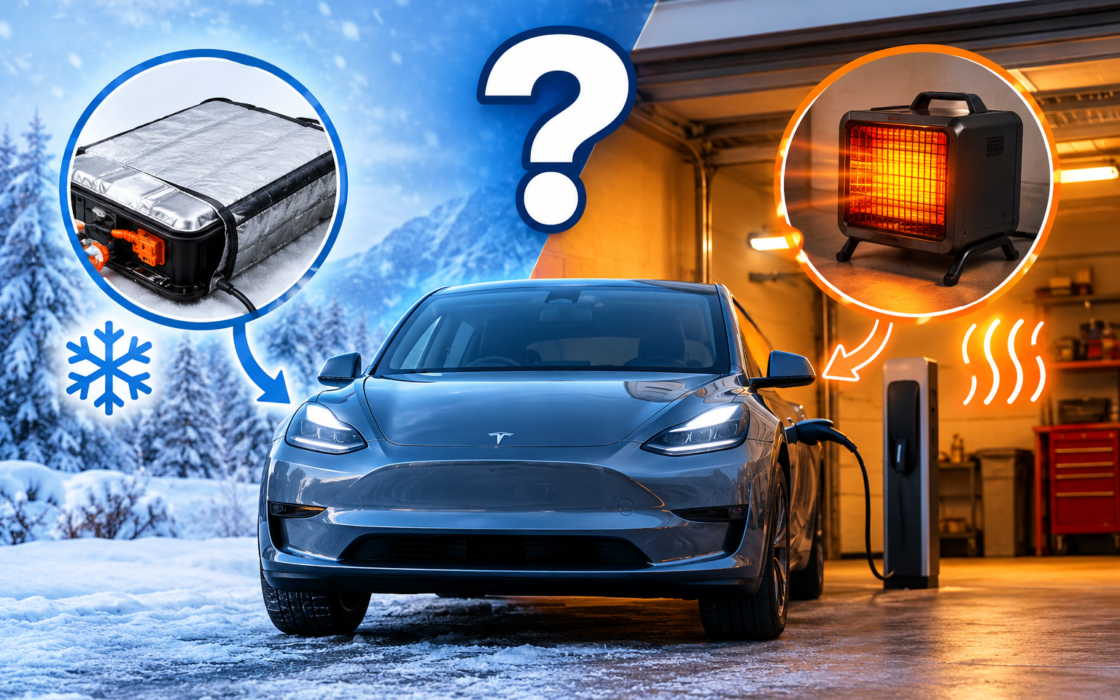
Search “EV winter accessories” and you’ll find battery blankets, garage heater kits, and warming pads marketed specifically at electric car owners worried about cold-weather range. Some of these products are genuinely useful engineering — for a completely different kind of battery than the one in your car. This looks at what’s actually inside a modern EV’s pack, what preconditioning already does for free, and the one narrow case where an aftermarket heater actually makes sense.
Key Numbers
- Nearly every EV built in roughly the last decade uses active liquid cooling with a built-in resistive or PTC heater for the battery pack — the exception is the first-generation, air-cooled Nissan Leaf.
- Per SAE J1634 test data cited by automotive engineers, a short trip at 20°F without preconditioning can see range fall 30–50% below the EPA window-sticker figure; preconditioning while plugged in cuts that impact to roughly 10–30%.
- Ford’s own owner guidance confirms that when preconditioning is scheduled and the car is plugged in, energy is drawn from the grid, not the battery — the cabin/battery warm-up costs you nothing in range.
- Aftermarket “EV battery heater” products marketed by companies like Powerblanket are built for exposed battery banks — marine, off-grid solar, DIY EV conversions — not the sealed, structural underbody pack of a production EV.
- A typical space heater draws 1,200–1,500 watts; running one in an unheated garage overnight uses far more electricity than a single 15–45 minute vehicle preconditioning cycle.
Short Answer
No — the overwhelming majority of production EVs from roughly the last decade already have an active thermal management system that heats the battery pack automatically, and the free preconditioning feature in your car’s app does the job an aftermarket “battery blanket” claims to do, using grid power instead of draining the pack. Aftermarket battery heater products are real and useful, but they’re designed for exposed battery banks like marine or off-grid solar setups, not the sealed pack under a production EV’s floor. A heated garage can still make winter more pleasant, but it’s a comfort upgrade, not a battery necessity.
What’s Actually Inside a Modern EV’s Pack
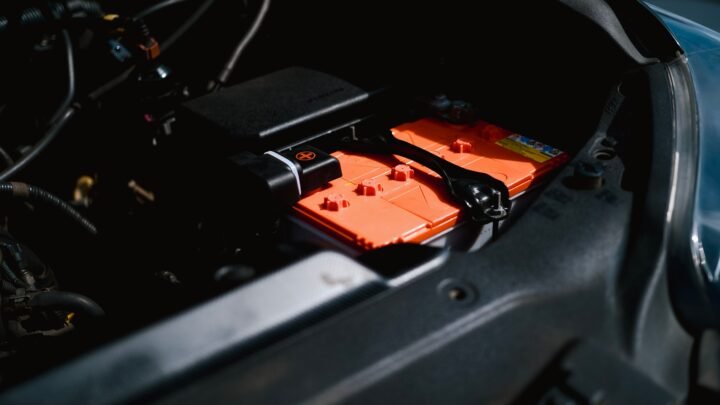
The battery pack in a modern EV isn’t just a stack of cells — it’s built with its own climate control loop. Most packs use liquid coolant circulating through channels around the cells, paired with a resistive or PTC (positive temperature coefficient) heating element that the car’s software activates automatically whenever the pack drops below its ideal operating range. The target zone for lithium-ion cells to age well is narrow — roughly 20–25°C — and the whole point of this system is to keep the pack near that zone without you doing anything.
The one real exception is the first-generation, air-cooled Nissan Leaf, which shipped without active liquid cooling and relied on passive air exposure instead — a design choice Nissan moved away from starting with the third-generation Leaf. If you own one of those early Leafs, or a similarly older EV with a passive thermal design, the calculus here is genuinely different from what it is for a 2018-or-newer mainstream EV.
Where Aftermarket Battery Blankets Actually Belong
Products like insulated blanket heaters and heat-trace kits are real, well-engineered accessories — for a market that isn’t production EVs. Marine battery banks, off-grid solar installations, RV house batteries, and hobbyist DIY electric-vehicle conversions all use exposed, accessible battery packs that a blanket or heat-trace cable can physically wrap around. A production EV’s pack is a sealed, structural component bolted into the underbody as part of the chassis — there’s no exposed surface to strap a blanket to, and no owner-accessible way to retrofit one even if you wanted to. When you see these products marketed toward EV owners, read the actual installation instructions before assuming it applies to your car; in most cases, it doesn’t, because there’s nowhere on a Tesla, Ioniq 5, or Bolt to physically attach one.
What Already Solves This, for Free
The feature that actually delivers what a battery blanket promises is preconditioning, and it’s already built into your car’s app or touchscreen. When you schedule a departure time or manually trigger preconditioning while the car is plugged in, Ford’s own owner support documentation confirms the energy for that warm-up comes from the wall, not the traction battery — so you start your drive with a full charge and a pack that’s already near its ideal temperature, at no range cost at all.
The scale of the effect is significant. Citing SAE J1634 cold-weather test data, automotive engineers have found that a short trip in 20°F weather without any preconditioning can lose 30–50% of the EPA-rated range, mostly from a combination of cabin heating draw and reduced battery efficiency while cold. Preconditioning while still plugged in cuts that loss roughly in half, down to a 10–30% range hit — the same mechanism a battery blanket would be trying to achieve, except it’s already in your car and costs nothing extra to use.
Is a Heated Garage Actually Worth It, Then?
A heated garage does something real that preconditioning doesn’t fully replace: it keeps the vehicle’s overall starting temperature warmer for hours, not just for the 15–45 minutes before departure, which can mean less frost to scrape, more stable tire pressure, and slightly less work for the battery heater on the very coldest mornings. But it’s solving a comfort and convenience problem, not a battery-necessity one — and the energy cost of heating an entire garage space overnight is a different order of magnitude from a short preconditioning cycle.
Compare the Real Cost
When an Aftermarket Heater Genuinely Makes Sense
- First-generation, air-cooled Nissan Leaf owners in genuinely extreme cold climates — this is the one mainstream production EV case where the built-in thermal management argument above doesn’t fully apply.
- DIY EV conversions using aftermarket battery packs without integrated climate control, where the pack is physically accessible.
- Off-grid, marine, or solar battery banks — the actual intended market for most of these products, where “battery blanket” isn’t a myth at all.
Outside those cases, if your EV was built with an integrated liquid-cooled pack — which describes nearly every mainstream EV sold since the mid-2010s — an aftermarket blanket has nowhere to physically go and nothing to add that preconditioning doesn’t already cover for free.
FAQ
Will a garage heater improve my EV’s winter range?
Indirectly and modestly, mostly by reducing frost/defrost time and keeping the cabin closer to comfortable at the start of the trip. It’s not solving a battery problem the car’s own thermal management and preconditioning feature don’t already handle.
Can I attach a battery blanket to my Tesla or Ioniq 5?
No — the pack is a sealed structural component under the floor with no owner-accessible surface to wrap anything around. These products are built and sold for a different kind of battery installation entirely.
Does preconditioning use up my charge if I’m not plugged in?
Yes, unplugged preconditioning draws from the traction battery instead of the grid, so it still helps performance but costs you some range — the free-range benefit specifically depends on the car being plugged in while it precondition.
Is my older EV missing this feature?
Check your specific model and year — active liquid-cooled thermal management became close to universal industry-wide by the mid-to-late 2010s, but it’s worth confirming for your exact vehicle rather than assuming, especially for early first-generation EVs.
What actually helps most in cold weather, if not an aftermarket heater?
Scheduling preconditioning while plugged in, parking somewhere sheltered from wind even if unheated, and keeping the charge level higher in winter — see our full breakdown of what’s actually driving winter range loss for the complete picture.
The Short Version
The battery blanket and garage-heater products marketed at EV owners are solving a real engineering problem — for a different kind of battery. Nearly every mainstream EV already ships with an active, liquid-cooled thermal management system that heats the pack automatically, and the preconditioning feature already in your car’s app delivers the range-preserving benefit these aftermarket products promise, using free grid power instead of your battery’s own charge. A heated garage can make winter mornings more pleasant, but it’s a comfort purchase, not a battery necessity — the one real exception is an older, air-cooled EV like a first-generation Nissan Leaf, where the built-in thermal management this article describes may not fully apply.
About the author: Written by Shurah, who researches and writes independently on the real cost of EV ownership — charging, maintenance, and total cost of ownership — backed by primary data and original calculations rather than recycled lists.